All species › Passerines › African Warblers › Grey Longbill
Grey Longbill | Macrosphenus concolor
Grijze langsnavelzanger | Picolargo Gris
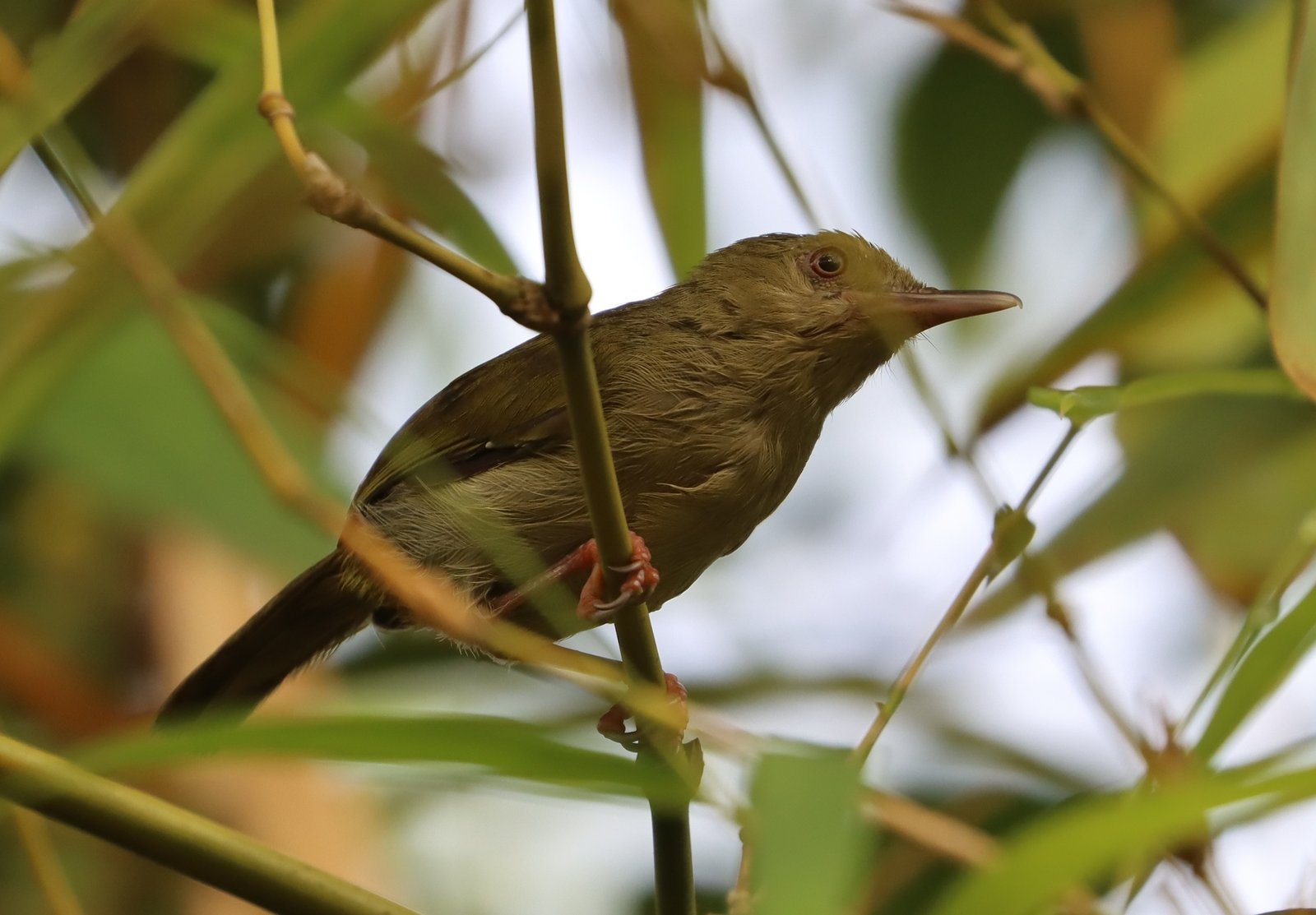
The Grey Longbill is a small, almost unmarked warbler of the West and Central African rainforest, with a long, thin bill. It keeps to dense lianas and foliage and is heard far more often than seen. It touches the region only in the far north-east of Angola, on the edge of the Congo Basin.
Voice
A loud, clear series of whistles, often repeated and powerful for a bird of this size, as well as dry, chattering or rattling contact calls. The song is usually the first sign that the species is present.
Recording: Étienne Leroy — CC BY-NC-SA 4.0 · xeno-canto
Identification
11–12 cm. A plain longbill with no supercilium, eye-ring or wing bars. The upperparts are olive-green to greyish olive, the head slightly greyer; in sunlight the back can look surprisingly green. The underparts are pale grey with an olive wash on the breast and flanks and a somewhat paler belly. The bill is long, straight and pointed, dark with a paler lower mandible. The tail is of medium length, clearly longer than in the crombecs. The sexes are alike. The best feature is the very lack of markings, combined with the long bill.
Confusion species
Yellow Longbill Macrosphenus flavicans, which can share the same forest in northern Angola, has bright yellow underparts and a shorter tail. Green Crombec Sylvietta virens is smaller and almost tailless, with a brownish head and a shorter bill. Green Hylia Hylia prasina is larger and darker green, with a long pale supercilium. Little Grey Greenbul Eurillas gracilis and Little Greenbul Eurillas virens are similarly olive-grey, but have a shorter, thicker bill and a longer tail. Tit Hylia Pholidornis rushiae is much smaller, with a short bill and a finely streaked head and breast, and Little Green Sunbird Anthreptes seimundi has a shorter, slightly curved bill and yellowish-green underparts.
Habitat
Dense moist lowland forest, especially liana tangles, forest edges and clearings with tangled growth, and also mature secondary forest. It forages in the lower and middle strata, often in pairs or mixed flocks, gleaning insects and other invertebrates from leaves, twigs and lianas.
Where the bird is most at home, classified by the vegetation units of southern Africa.

Range and movements
A rainforest species of West and Central Africa, from southern Guinea and Sierra Leone through the West African forest belt and via Cameroon and the Congo Basin to south-western Uganda. In the region only in the far north-east of Angola, in the Lunda provinces, where the forest connects with that of the Congo Basin. For this guide it is therefore a marginal species, at the southern limit of its range.
How and when to look
Year-round. Within the region a species of the rarely visited north-east of Angola, where few birders go. Listen for the loud whistled series at forest edges and in gallery forest and follow mixed flocks through the lianas; expect brief, partial views of a bird without obvious features.
Conservation status
Not threatened; widespread and locally common in the rainforest of West and Central Africa. Within the region it is confined to a small area of forest at the edge of its range, where it is barely studied and depends on the forest being retained.
Scientific name
Macrosphenus concolor | (Hartlaub, 1857)
Hartlaub described the species in 1857 as Camaroptera concolor; because it was later moved to another genus, the author and year stand in brackets. The genus Macrosphenus was introduced in 1859 by Cassin. Macrosphenus comes from the Greek makros, 'long', and sphēn, 'wedge' — for the long, tapering bill. concolor is Latin for 'of one colour', from con- 'alike' and color 'colour', after the uniform, almost unmarked plumage. The specimen the first description was based on came from Guinea.