All species › Gamebirds › Pheasants and partridges › Grey-Striped Spurfowl
Grey-Striped Spurfowl | Pternistis griseostriatus
Grants frankolijn | Francolín Angoleño
The Grey-Striped Spurfowl is an endemic of the western escarpment of Angola, where it lives in the dense undergrowth of dry forest and thicket. It is heard far more often than seen and is one of the specialities of the forests around Kumbira and Gabela.
Voice
A loud, grating cackle, kerak-kerak-kerak, often by several birds at once, mainly at dawn and at dusk. For most observers the call is the only sign of its presence.
Recording: Ken Behrens — CC BY-NC-SA 4.0 · converted to mono · xeno-canto
Identification
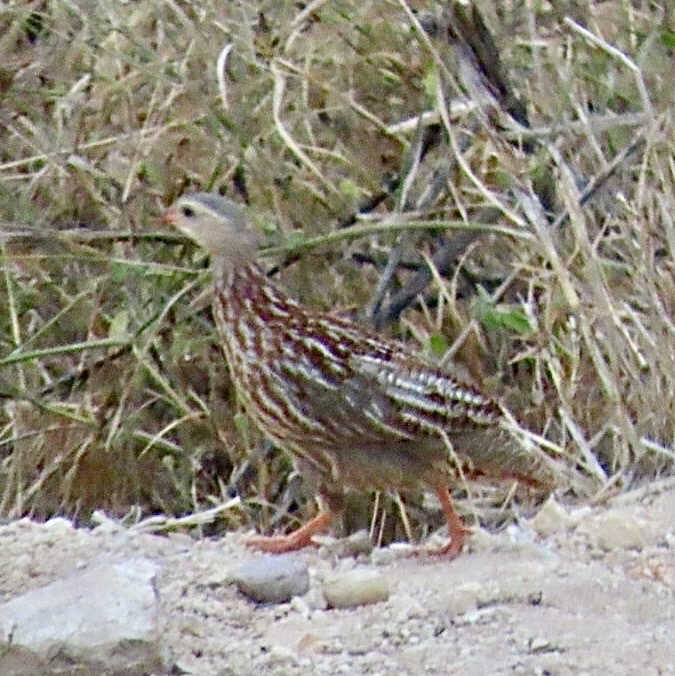
About 30 cm, a medium-sized, dark spurfowl. The plumage is warm chestnut-brown; the feathers of the neck, mantle and breast have grey edges that form a striking grey-streaked pattern. The crown is dark brown and the throat paler. The bill and legs are red; there is no bare facial skin. The sexes are nearly alike. It walks through the leaf litter with the tail raised and escapes by running.
Confusion species
The Red-Necked Spurfowl, found in the same part of Angola, has a bare red throat and bare red skin around the eye and lives more in open scrub and field edges. Swierstra's Spurfowl of the highest peaks is patterned black and white. The Crested Francolin has a white supercilium, an erectile crest and a finely spotted breast.
Habitat
Dense undergrowth of dry and semi-humid lowland forest on the escarpment slopes, gallery forest, thicket at forest edges and secondary growth, also in abandoned coffee plantations with shade trees. It forages on the ground in the leaf litter for seeds, berries, tubers and insects.
Where the bird is most at home, classified by the vegetation units of southern Africa.

Range and movements
Endemic to western Angola: the escarpment and adjacent hills of Cuanza Sul and Cuanza Norte into northern Benguela, for example at Gabela, Kumbira, Conda and Seles. Not found outside Angola.
- Resident
- dark = core range, pale = thinly spread
How and when to look
Kumbira Forest near Conda is the best site. Stand on a forest trail at dawn and listen for the cackling; if you then keep still where the birds call, they sometimes cross a track. Driving slowly along a forest road in the early morning also produces sightings.
Conservation status
Not threatened under the current assessment, but with a small range. Its escarpment habitat is under pressure from clearance for charcoal, the spread of small-scale farming and the felling of shade trees in old coffee plantations; snaring also occurs.
Scientific name
Pternistis griseostriatus | (Ogilvie-Grant, 1890)
Ogilvie-Grant described the species in 1890 as Francolinus griseo-striatus; because it was later moved to another genus, the author and year stand in brackets. The genus Pternistis was introduced in 1832 by Wagler. Pternistis comes from Greek pternistēs 'one who strikes with the heel', from pterna 'heel', after the spurs on the legs. griseostriatus comes from the Latin griseus, 'grey', and striatus, 'striped', for the grey streaking of the plumage. The specimen the first description was based on came from Cuanza River, Angola.