All species › Passerines › Weavers › Holub's Golden Weaver
Holub's Golden Weaver | Ploceus xanthops
Saffraanwever | Tejedor Azafranado
Holub's Golden Weaver is a large, uniformly golden-yellow weaver with a heavy black bill and a pale yellow eye. It lives solitarily or in pairs in woodland edges, thickets and gardens, and is notable mainly for its sturdy build and quiet, unobtrusive behaviour.

Click a thumbnail to switch the photo above.
Voice
A fairly quiet species: a soft, hoarse chatter and sizzling during display, and a sharp tsik or chuk contact call.
Recording: Bram Piot — CC BY-NC-SA 4.0 · converted to mono · xeno-canto
Identification
16–18 cm; one of the largest yellow weavers in the region, with a heavy, conical bill. The male is almost uniformly golden yellow, with an olive-green wash on back and wings and an orange wash on throat and breast; the eye is pale yellow. The bill is black. The female closely resembles the male but is slightly duller and lacks the orange wash; its eye is also pale yellow. There is no separate eclipse plumage. Juveniles are greener and duller, with a darker eye and a horn-coloured bill.
Confusion species
Eastern Golden Weaver (Ploceus subaureus) is smaller and more slender-billed, the male with a reddish eye, and breeds colonially in reeds. Cape Weaver (Ploceus capensis) has a long pointed bill and a brown face in the male. Spectacled Weaver (Ploceus ocularis) is smaller and has a black eye-stripe. Female-type weavers with a heavy yellow body and a pale eye are almost always Holub's Golden Weavers; the massive bill and uniform golden yellow without mask or streaking are decisive.
Habitat
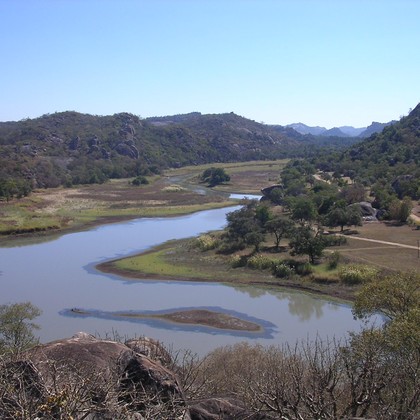
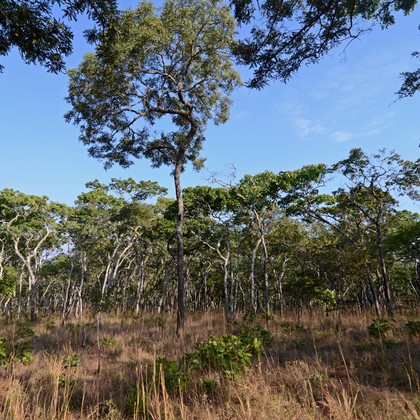
Woodland edges, riverine scrub, rank vegetation by vleis and rivers, miombo and mixed woodland with dense undergrowth, abandoned fields and gardens. It breeds solitarily, not in colonies. The nest is a large, rather coarse and untidy oval of grass with an entrance underneath and no tube, usually in bushes, reeds or low trees, often near water. It eats seeds, insects and fruit, and visits flowering trees for nectar.
Where the bird is most at home, classified by the vegetation units of southern Africa.

Range and movements
In the north and east of the region: Angola, Zambia, Malawi, Mozambique, Zimbabwe, northern Botswana (Okavango and Chobe), the Caprivi Strip and Kavango in Namibia, and in South Africa in Limpopo, Mpumalanga and northern KwaZulu-Natal, as well as Eswatini. Beyond the region north to Uganda and Kenya and west to Gabon.
- Resident
- Summer visitor (c. Oct–Mar)
- Winter visitor (c. Apr–Sep)
- Passage (Mar–Apr, Oct–Nov)
- dark = core range, pale = thinly spread
How and when to look
All year; search woodland edges and overgrown gardens for a large, uniformly yellow weaver moving quietly through the thicket. The heavy black bill and pale eye are easy to see at close range. The untidy nest in a bush near water is often found before the bird itself.
Conservation status
Not threatened; widespread and locally fairly common, but nowhere numerous. It adapts well to gardens and overgrown fields.
Scientific name
Ploceus xanthops | (Hartlaub, 1862)
Hartlaub described the species in 1862 as Hyphantornis xanthops; because it was later moved to another genus, the author and year stand in brackets. The genus Ploceus was introduced in 1816 by Cuvier, GLCFD. Ploceus comes from the Greek plokeus, 'plaiter, weaver', for the tightly woven, ball-shaped nest that gives weavers their name. xanthops comes from the Greek xanthos, 'yellow', and ōps, 'face' — for the all-yellow head. The specimen the first description was based on came from lower Cuanza River, Angola.