All species › Passerines › Weavers › Marsh Widowbird
Marsh Widowbird | Euplectes hartlaubi
Hartlaubs widavink | Obispo Marismeño
The Marsh Widowbird is the large, long-tailed widowbird of marshy grassland on the plateaus of Angola and Zambia. The breeding male is black with a yellow-and-orange shoulder patch and a long, broad tail, and is conspicuous when it performs its display flight over wet grassland.

Voice
Low scratchy notes, a dry chirping and a sizzling chizz-chizz from the male, from a grass stem or in flight. Flocks give a sharp chik.
Recording: Dries Van de Loock — CC BY-NC-SA 4.0 · converted to mono · xeno-canto
Identification
Female about 15–16 cm; breeding male about 17–18 cm without the tail and about 25–28 cm with it. The breeding male is wholly black with a long, broad, slightly arched tail and a shoulder patch that in southern birds is yellow and orange, orange on the lesser coverts and buff-yellow to pale on the median coverts; the bill is blue-grey. The female is buff-brown with heavy dark streaking above, a pale supercilium, a lightly streaked pale buff breast and a short tail. The non-breeding male resembles the female but is larger and keeps the coloured shoulder. Juveniles resemble the female.
Confusion species
The Fan-Tailed Widowbird (Euplectes axillaris) is smaller, with a short, fanned tail and an orange-red shoulder. The White-Winged Widowbird (Euplectes albonotatus) has a yellow shoulder and a white wing patch that shows in flight. The Long-Tailed Widowbird (Euplectes progne) of the same Angolan and Zambian grasslands has a far longer tail and a red-and-white shoulder. The Yellow-Mantled Widowbird (Euplectes macroura) has a yellow mantle as well as a yellow shoulder, and a shorter tail. In northern Malawi the species may overlap with the Montane Widowbird (Euplectes psammacromius), which lives higher in montane grassland and has a yellow shoulder with a broad buff lower border. Females can only be identified with certainty in the company of males.
Habitat
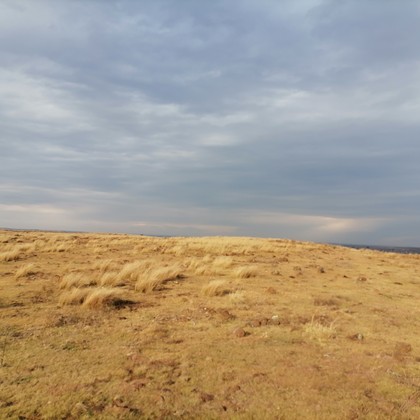
Marshes, boggy and seasonally flooded grassland, vleis and dambos on the plateaus, with tall dense grass and sedge. The male defends a territory in the wet grass; outside the breeding season it also uses drier open grassland and field margins. It eats grass seeds and insects.
Where the bird is most at home, classified by the vegetation units of southern Africa.

Range and movements
In the region in Angola, mainly on the central plateau and in the north, and in Zambia, mainly in the north and north-west (Luapula, Bangweulu, Mwinilunga) and the west; very local in northern Malawi. Old or isolated reports from further south are unconfirmed. Beyond the region from Nigeria and Cameroon through Gabon, Congo and DR Congo to Uganda, Kenya and Tanzania; northern birds have a shorter tail and a more orange shoulder.
- Resident
- dark = core range, pale = thinly spread
How and when to look
In the rains, scan dambos and marsh edges in northern Zambia or on the Angolan plateau for long-tailed black males flying low over the grass and landing on tall stems. A telescope helps to see the yellow and orange shoulder; the Fan-Tailed Widowbird lacks the long tail.
Conservation status
Not threatened. Locally fairly common in suitable marshes, but vulnerable to drainage and the conversion of dambos to cropland.
Scientific name
Euplectes hartlaubi | (Bocage, 1878)
Bocage described the species in 1878 as Penthetria hartlaubi; because it was later moved to another genus, the author and year stand in brackets. The genus Euplectes was introduced in 1829 by Swainson. Euplectes joins Greek eu 'fine, good' to New Latin plectes 'weaver'. hartlaubi honours the German physician and ornithologist Gustav Hartlaub (1814–1900), an authority on African birds. The specimen the first description was based on came from Angola.