All species › Nightjars › Nightjars › Montane Nightjar
Montane Nightjar | Caprimulgus poliocephalus
Ethiopische nachtzwaluw | Chotacabras Abisinio
The Montane Nightjar is an East African mountain species that reaches the region only in the far north-east, on the plateaus of Malawi and Zambia. There, in montane grassland with forest patches, it replaces the lowland Fiery-Necked Nightjar.
Voice
A high, piercing and rather plaintive whistle, peeeoo-wirr, often repeated at short intervals; shorter and higher than the song of the Fiery-Necked Nightjar. It calls mainly at dusk and by moonlight from a branch, rock or post.
Recording: David Moyer — CC BY-NC-SA 4.0 · converted to mono · xeno-canto
Identification
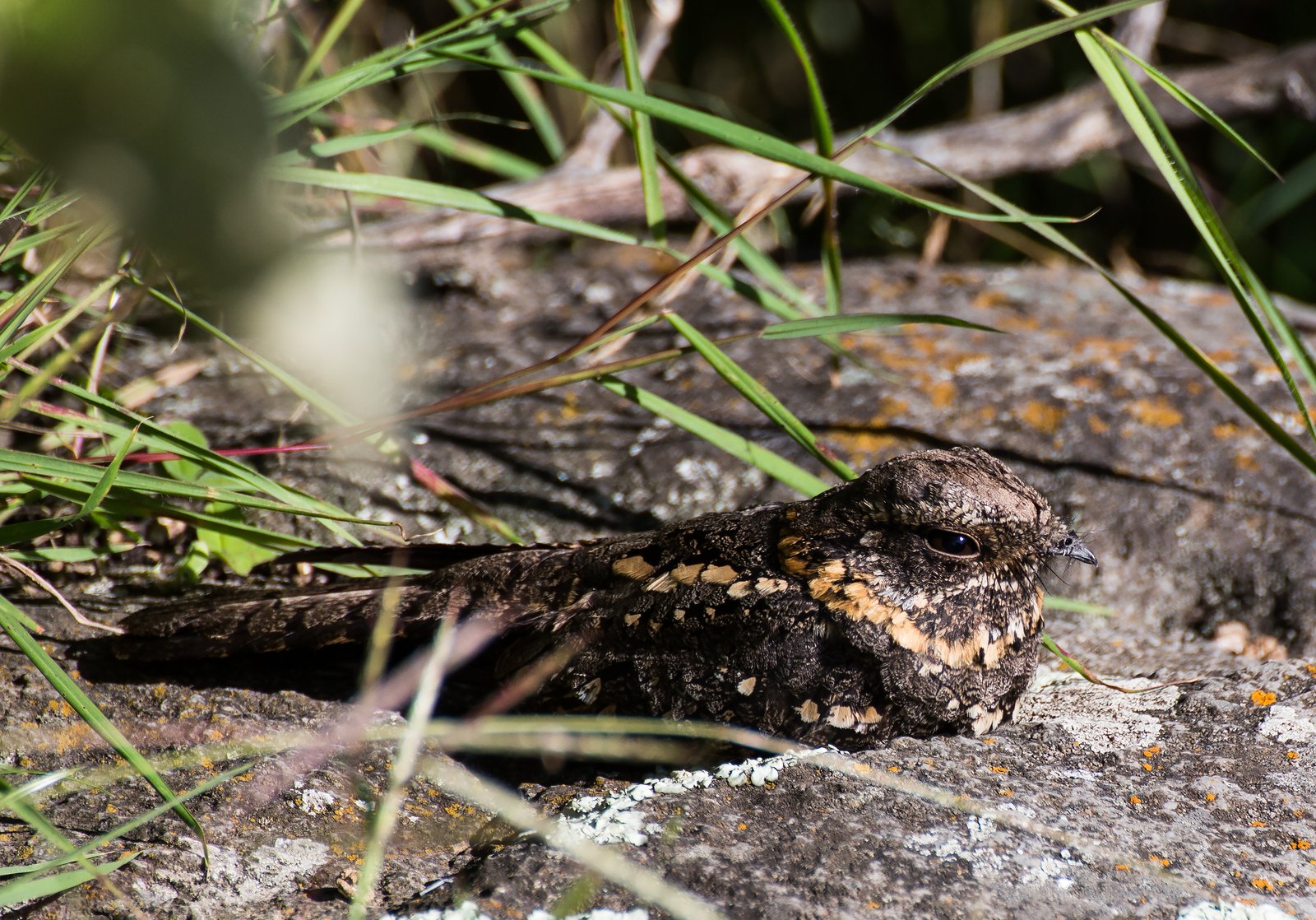
22–24 cm. A rather small, dark nightjar with grey-brown, heavily speckled and spotted upperparts, an indistinct rufous hind collar and a dark breast with fine pale spots. The throat has a white patch on each side. The male has white spots on the four outer primaries and a striking amount of white in the tail: the outer tail feathers are largely white. In the female the wing spots are paler and the tail white more restricted and duller.
Confusion species
The Fiery-Necked Nightjar (Caprimulgus pectoralis) is warmer and paler, with an obvious rufous collar and breast and less white in the tail; the two meet at middle altitudes. The Freckled Nightjar (Caprimulgus tristigma) is larger, darker and sits on bare rock. On the plateaus themselves no other nightjar is to be expected.
Habitat
Montane grassland with scattered forest patches, forest edges and clearings in montane forest, also pine plantations and scrub, mostly above 1500 m. It roosts by day on the ground under cover of grass or shrubs, and hunts moths and beetles along forest edges and over grassland.
Where the bird is most at home, classified by the vegetation units of southern Africa.


Range and movements
Within the region only in the north-east: in Malawi on the Nyika, the Viphya Plateau and south to the Zomba and Mulanje massifs, and in Zambia on the Zambian part of the Nyika and the Mafinga Hills. Beyond the region from Ethiopia through Kenya, Uganda and eastern DR Congo to Tanzania.
- Resident
- dark = core range, pale = thinly spread
How and when to look
Best on the Nyika Plateau in Malawi, where birds call at dusk near the lodge area and along the edges of forest patches. Listen for the high whistle and find the bird with a torch on a post or boulder; in flight the extensive white in the tail stands out.
Conservation status
Not threatened. In the region it is confined to a few plateaus, where it is locally common. Fire, grazing and the conversion of montane forest and grassland to farmland or plantations can degrade its habitat locally.
Scientific name
Caprimulgus poliocephalus | Rüppell, 1840
Rüppell described the species in 1840 and placed it straight away in the genus where it still stands. The genus Caprimulgus was introduced in 1758 by Linnaeus. Caprimulgus is Latin, from capra 'nanny goat' and mulgere 'to milk', after the old belief that nightjars suckled goats at night. poliocephalus comes from Greek polios, 'grey', and kephalē, 'head': 'grey-headed'. The specimen the first description was based on came from Kulla, Ethiopia.