All species › Passerines › Sunbirds › Neergaard's Sunbird
Neergaard's Sunbird | Cinnyris neergaardi
Neergaards honingzuiger | Suimanga de Neergaard
Neergaard's Sunbird is a small, short-billed double-collared sunbird almost confined to the sand forest and dry woodland of Maputaland and southern Mozambique. It is one of the sought-after near-endemics of north-eastern KwaZulu-Natal.
Voice
A soft, high tsip and a dry tchik. The song is a short, fast, high series of twittering notes, tsi-tsi-tsiwi-tsi-tsu, often repeated from a treetop in the canopy.
Recording: Maarten Sluijter — CC BY-NC-SA 4.0 · converted to mono · xeno-canto
Identification
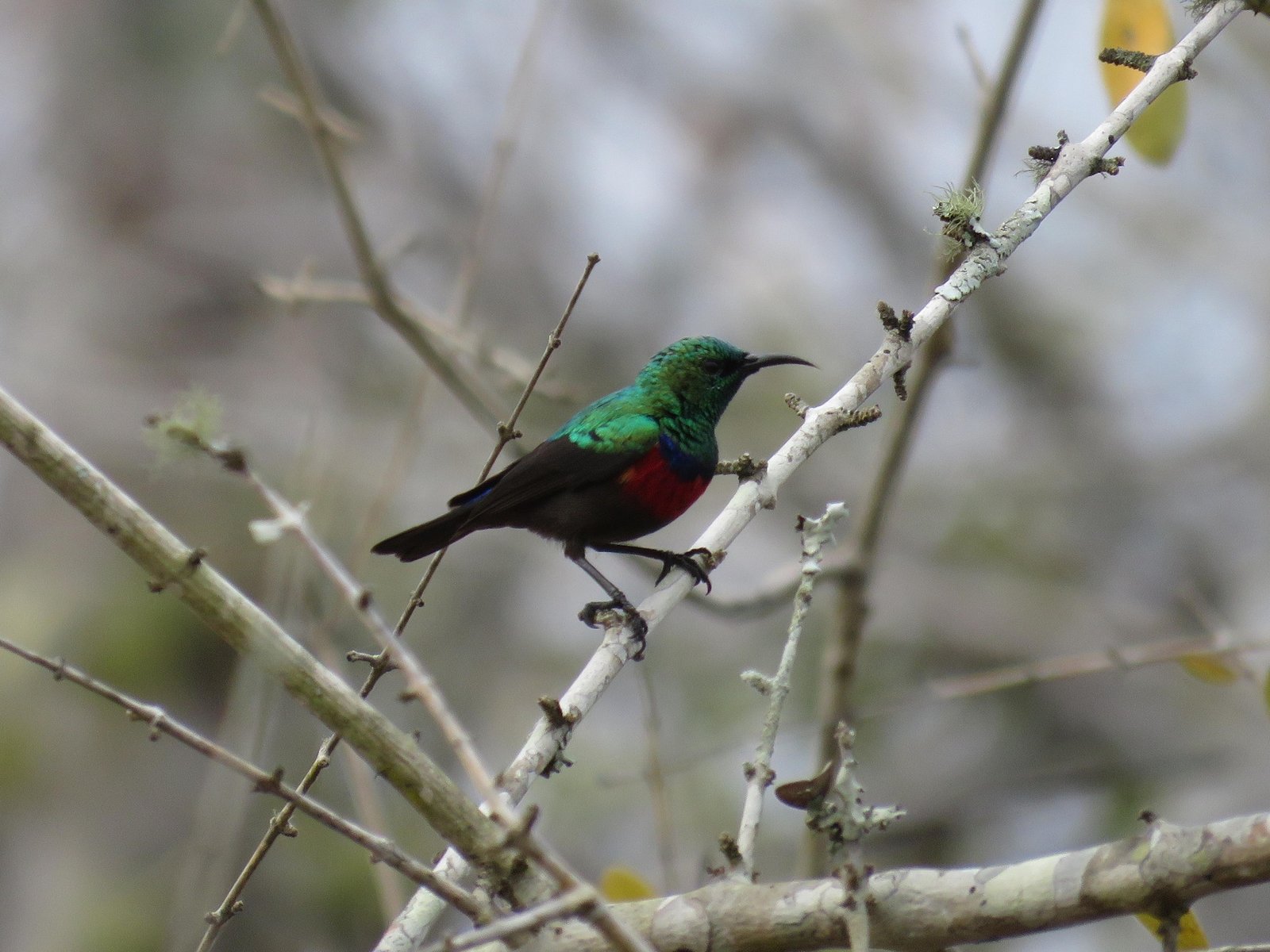
Small, 10 to 11 cm, with a short, fine, slightly decurved bill. The male has the head, throat and upperparts glossy metallic green, the uppertail coverts blue-violet; below the throat a narrow blue line and a bright scarlet breast band, and below that a sooty black belly. The female is grey-olive above and pale yellowish grey below, almost without streaking. Juveniles resemble the female. It often keeps high in the canopy, where the red shows well only in good light.
Confusion species
Purple-Banded Sunbird (Cinnyris bifasciatus) is the same size, also dark-bellied and lives in the same area, but the male wears a narrow blue and a broad purplish-maroon band, not a red one; against the light that band can look red. Southern Double-Collared Sunbird (Cinnyris chalybeus) and Greater Double-Collared Sunbird (Cinnyris afer) are larger, with a longer bill and a grey belly. Female Purple-Banded Sunbirds show a clearer supercilium and faint streaking below.
Habitat
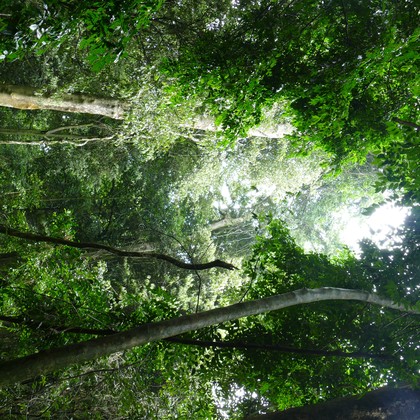
Sand forest, dry coastal forest and open woodland on sandy soils with Afzelia, Terminalia and Newtonia, and their edges. It forages mainly in the canopy at flowering trees and mistletoes, and also searches for insects among the leaves.
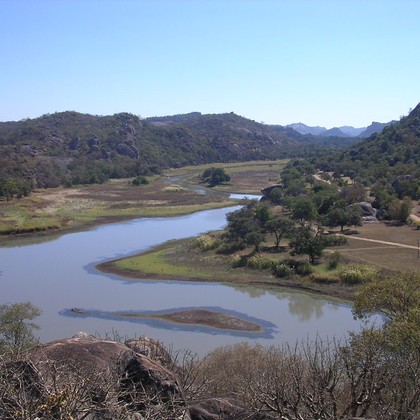
Where the bird is most at home, classified by the vegetation units of southern Africa.
Range and movements
North-eastern KwaZulu-Natal in Maputaland, from about Hluhluwe and the Mkhuze north to the Mozambique border, and on through southern Mozambique in Maputo, Gaza and Inhambane provinces to about the Save River. Nowhere beyond.
- Resident
- Winter visitor (c. Apr–Sep)
- Passage (Mar–Apr, Oct–Nov)
- dark = core range, pale = thinly spread
How and when to look
The sand forest of Tembe Elephant Park, Mkhuze and Ndumo is the classic site, especially at flowering mistletoes and canopy trees. Work sand-forest trails early in the morning, listen for the high song and take the time to see the red of the band in good light, since Purple-Banded Sunbird is far commoner there.
Conservation status
Near Threatened. The species has a small range and depends on sand forest and dry woodland on sand, which is disappearing fast in southern Mozambique through logging, charcoal burning and agriculture. Numbers are stable in the protected areas of Maputaland.
Scientific name
Cinnyris neergaardi | Grant, 1908
Grant described the species in 1908 and placed it straight away in the genus where it still stands. The genus Cinnyris was introduced in 1816 by Cuvier, GLCFD. Cinnyris derives from the Greek kinnuris, the name of a small bird mentioned by the lexicographer Hesychius that cannot be identified further. neergaardi honours Paul Neergaard, a Danish recruiting officer for the Wenela labour agency, stationed in southern Mozambique. The specimen the first description was based on came from Coguno, Inhambane district, Mozambique.