All species › Waders, gulls and terns › Avocets and stilts › Pied Avocet
Pied Avocet | Recurvirostra avosetta
Kluut | Avoceta Común
The Pied Avocet is a black-and-white wader with long blue-grey legs and a fine, strongly upcurved bill, which it sweeps from side to side through shallow water. In southern Africa it is a nomadic breeder of salt pans, lagoons and saltworks, often in flocks of tens to hundreds of birds.

Voice
A clear, fluting kloo-it or kloo-it kloo-it, louder and higher when agitated; disturbed colonies produce a chorus of sharp, yelping kweet calls.
Recording: Dan — CC BY-NC-SA 4.0 · converted to mono · xeno-canto
Identification
42–45 cm. The plumage is white with a black cap from forehead to hindneck, black scapular stripes, a black band across the inner wing coverts and black primaries. The bill is black, thin and sharply upturned; shorter and more strongly curved in the female than in the male. The legs are long and blue-grey, with webbed feet. In flight the black-and-white pattern stands out, with the legs projecting well beyond the tail. Juveniles have brownish-black instead of black areas and brownish fringes on the upperparts.
Confusion species
Black-Winged Stilt Himantopus himantopus has a straight, needle-like bill, wholly black wings and much longer, red legs. African Oystercatcher Haematopus moquini is all black with a red bill. At distance a swimming avocet can resemble a small gull, but the upturned bill is then decisive.
Habitat
Shallow, open waters with soft mud: salt pans, coastal lagoons, estuaries, saltworks, sewage works and shallow dams, both fresh and brackish. It sweeps small crustaceans, insect larvae and worms from water and mud with sideways strokes of the bill, and also swims and then picks food from the surface. It breeds in loose colonies on islets and bare shores; the nest is a scrape with a little material.
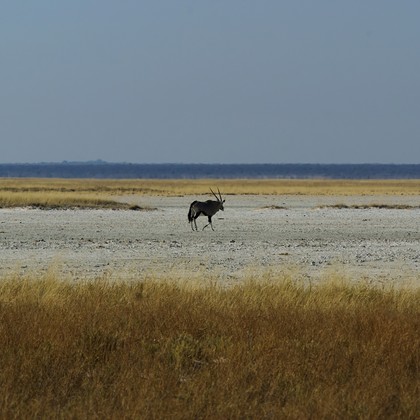
Where the bird is most at home, classified by the vegetation units of southern Africa.


Range and movements
Scattered through the region, with the largest numbers in the western half: along the coast of Namibia (Walvis Bay, Sandwich Harbour), in the Etosha and Makgadikgadi pans, and in the Cape provinces, the Free State and the highveld of South Africa; scarcer and more irregular in Botswana, Zimbabwe, Zambia, Mozambique, Malawi and Angola, where it appears mainly as a wanderer or after good rains. Beyond the region in East Africa, and as separate populations in Europe and Asia; European birds winter south to West and East Africa but hardly reach southern Africa.
- Resident
- Summer visitor (c. Oct–Mar)
- Winter visitor (c. Apr–Sep)
- Passage (Mar–Apr, Oct–Nov)
- dark = core range, pale = thinly spread
How and when to look
Visit Walvis Bay lagoon or the saltworks at Velddrif and Swartkops, or a full highveld pan after rain, and look for a group of white birds with black caps walking through the water with rhythmically swinging heads. After good rains colonies suddenly appear on pans that have been dry for years.
Conservation status
Not threatened. The southern African population is estimated at a few thousand birds and fluctuates strongly with rainfall. It is vulnerable to loss and pollution of coastal lagoons and pans, disturbance of colonies and changes in the management of saltworks.
Scientific name
Recurvirostra avosetta | Linnaeus, 1758
Linnaeus described the species in 1758 and placed it straight away in the genus where it still stands. He introduced the genus Recurvirostra in that same work. Recurvirostra is Latin, from recurvus 'curved backwards' and rostrum 'bill', after the upturned bill. avosetta comes from avosetta, the Venetian name for the avocet; the word's further origin is uncertain. The specimen the first description was based on came from Italy.