All species › Kingfishers, bee-eaters and rollers › Rollers › Purple Roller
Purple Roller | Coracias naevius
Roodkruinscharrelaar | Carraca Coroniparda
The Purple Roller is the largest and heaviest roller of the region, with purple-brown, white-streaked underparts and a broad white supercilium. It sits long and motionless on a lookout in dry savanna and is far less colourful than its relatives until it takes off and shows its purple-blue wings.

Voice
A hard, raucous, repeated call, kaa-kaa-kaa or karaa-karaa, loudest during the display flight, in which the bird flies around with jerky wingbeats, rocking from side to side. Often silent outside the breeding season.
Recording: Tony Archer — CC BY-NC-SA 4.0 · converted to mono · xeno-canto
Identification
About 38 cm, stocky, with a heavy black bill and a square tail. The crown is olive to rufous-brown, the broad supercilium white, and there is a white patch on the nape. Mantle and back are olive-brown. The underparts are lilac- to rufous-brown with conspicuous broad white streaks. In flight the wings are deep purple-blue with a paler blue band, and the tail dark blue-green. The sexes are alike. Juveniles are duller, with less crisp streaking.
Confusion species
Lilac-Breasted Roller (Coracias caudatus) is smaller and slimmer, with a lilac breast lacking broad white streaks, a turquoise belly and tail streamers. European Roller (Coracias garrulus) is wholly blue on the head and underparts, with a chestnut back. Racket-Tailed Roller (Coracias spatulatus) is pale blue below and has tail feathers ending in spatules. Broad-Billed Roller (Eurystomus glaucurus) is smaller and cinnamon, with a broad yellow bill.
Habitat
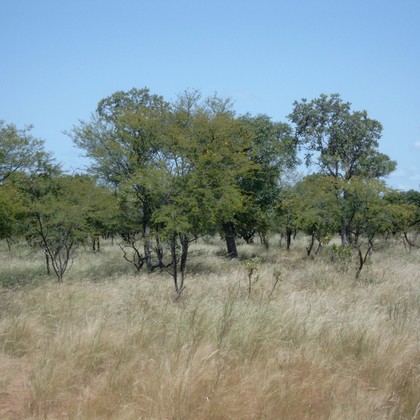
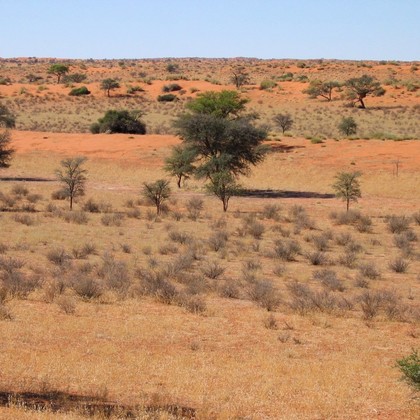
Dry, open savanna, acacia thornveld, Kalahari sandveld and mopane veld with scattered trees, also overgrazed land and the edges of semi-desert. It hunts from a dead branch, post or wire for large insects, scorpions, centipedes, lizards and small rodents, which it seizes on the ground. It nests in tree cavities, sometimes in old woodpecker holes or rock crevices.
Where the bird is most at home, classified by the vegetation units of southern Africa.

Range and movements
Widespread in the drier savannas of the region: Namibia, Botswana, Zimbabwe, northern and north-eastern South Africa, southern Mozambique, southern Angola, western and southern Zambia and locally in Malawi; in the dry season birds wander south and west, into the Northern Cape. Absent from the Cape, the Karoo and the humid east coast. Beyond the region it ranges through the Sahel from Senegal to Ethiopia and Somalia, and south through East Africa.
- Resident
- Summer visitor (c. Oct–Mar)
- Winter visitor (c. Apr–Sep)
- Passage (Mar–Apr, Oct–Nov)
- dark = core range, pale = thinly spread
How and when to look
Best in the dry season, May to October, in the Kalahari, Etosha and the mopane veld of northern Botswana and Kruger. Scan dead branches and roadside posts: the bird often sits still for a long time and stands out only by its size and broad white supercilium. The rocking display flight is typical of the species.
Conservation status
Not threatened and fairly common over the dry interior, though less numerous than Lilac-Breasted Roller. Local declines are attributed to the loss of dead trees with nest holes and to the use of insecticides. Along roads, traffic is a cause of death.
Scientific name
Coracias naevius | Daudin, 1800
Daudin described the species in 1800 and placed it straight away in the genus where it still stands. The genus Coracias was introduced in 1758 by Linnaeus. Coracias is the Greek word for a crow-like bird, used by Aristotle for a jackdaw or raven; later authors applied the name to the rollers, which are not related to crows in any way. naevius is Latin for 'spotted', from naevus, 'mole, blemish' — for the white-streaked, spotted underparts. The specimen the first description was based on came from Senegal.