All species › Woodpeckers and allies › African barbets › Red-Rumped Tinkerbird
Red-Rumped Tinkerbird | Pogoniulus atroflavus
Roodstuitketellapper | Barbudito Culirrojo
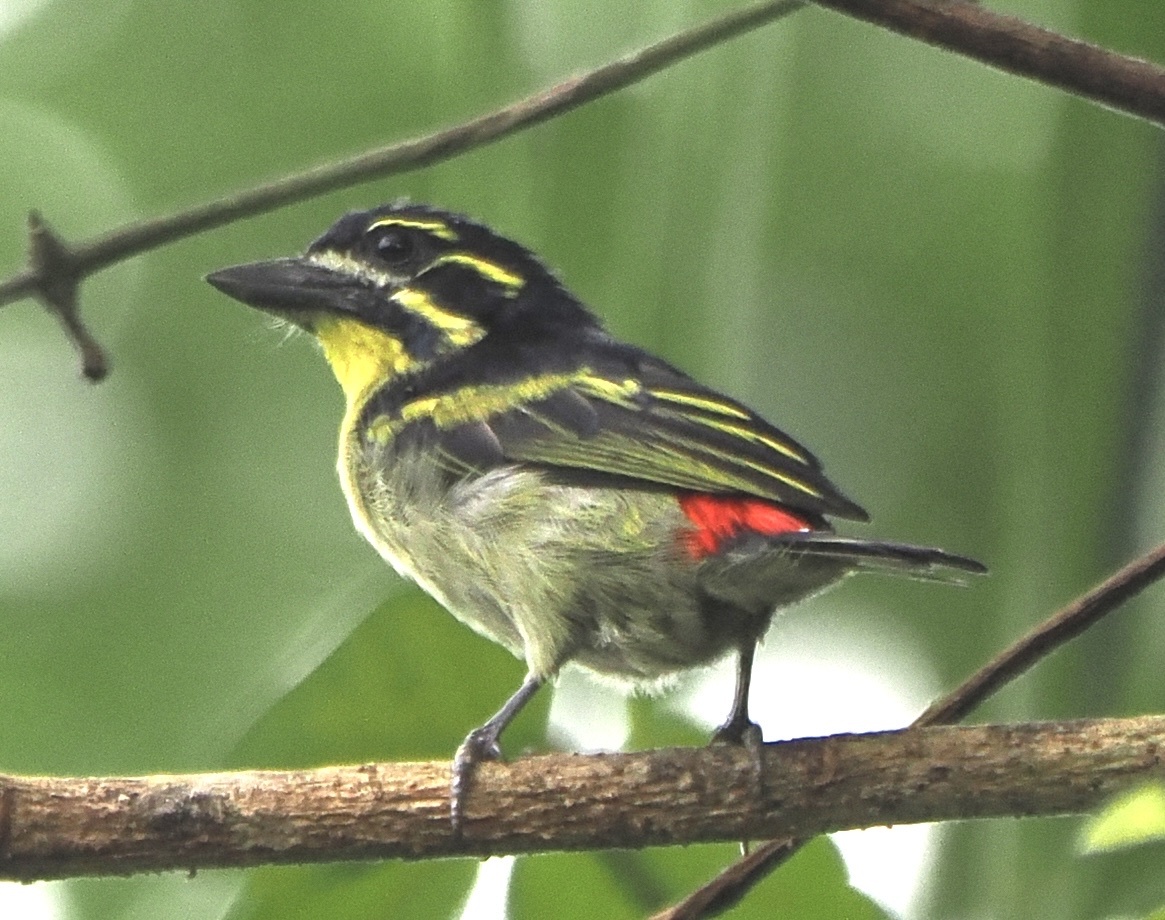
The Red-Rumped Tinkerbird is the largest tinkerbird, black with yellow face stripes and a red rump, a bird of the West and Central African rainforests that reaches the region only in northern Angola. Its monotonous series of popping notes sounds from the forest edge all day long.
Voice
An unbroken, monotonous series of popping notes, pop-pop-pop-pop, about one per second, sometimes kept up for minutes; also rapid trills lasting a few seconds that may vary in tempo.
Recording: GABRIEL LEITE — CC BY-NC-SA 4.0 · converted to mono · xeno-canto
Identification
About 11–12 cm, sturdily built. Head, back and wings are black; a narrow yellow eyebrow runs above the eye and a broad yellow moustachial stripe below it. The rump is scarlet, often partly hidden by the wings. The flight feathers and coverts have yellow edges. Throat and underparts are dull lemon to olive-yellow. The bill is black. The sexes are alike; juveniles are duller, with a more orange rump and a pale bill base.
Confusion species
Yellow-Throated Tinkerbird (Pogoniulus subsulphureus) is smaller, with a yellow rump and a bright yellow throat bordered by white and yellow face stripes. Yellow-Rumped Tinkerbird (Pogoniulus bilineatus) has a yellow rump and white face stripes. With a good view of the rump confusion is ruled out: no other tinkerbird in the region has a red rump.
Habitat
Humid lowland forest, both in the interior and at the edges, clearings, gallery forest and old secondary forest, mostly in the mid-storey and canopy. It eats mistletoe berries and other fruit, supplemented with insects. It excavates a nest cavity in a dead branch.
Where the bird is most at home, classified by the vegetation units of southern Africa.


Range and movements
Within the region in northern Angola: Cabinda and the forests of Zaire, Uíge and Cuanza Norte provinces, east in gallery forest into the Lunda provinces. Beyond the region from Senegal and Gambia through the West and Central African forest belt to Uganda and southern DR Congo.
How and when to look
Learn the slow, regular pop series; in the forests of northern Angola it is often the first sign of the species. The red rump shows only when the bird lifts its wings or flies off, so wait patiently near the perch.
Conservation status
Not threatened and common over most of its range. In Angola it is local and depends on the remaining northern forests, which are shrinking through logging and farming.
Scientific name
Pogoniulus atroflavus | (Sparrman, 1798)
Sparrman described the species in 1798 as Bucco atro-flavus; because it was later moved to another genus, the author and year stand in brackets. The genus Pogoniulus was introduced in 1842 by De Lafresnaye. Pogoniulus is a diminutive of Pogonias, from the Greek pōgōnias, 'bearded' — thus 'little barbet', fitting for these smallest barbets. atroflavus comes from the Latin ater, 'black', and flavus, 'yellow' — for the black-and-yellow plumage. The specimen the first description was based on came from Sierra Leone.