All species › Tubenoses › Petrels and shearwaters › Salvin's Prion
Salvin's Prion | Pachyptila salvini
Salvins prion | Prión de Salvin
Salvin's Prion is intermediate in bill width and size between Broad-Billed Prion and Antarctic Prion. It breeds in large numbers on the Prince Edward Islands and in winter is one of the prions most often washed up on South African beaches.

Voice
Silent at sea. At the colonies a rhythmic, cooing kuk-kuk-koo-er from the burrows at night.
No recording with a suitable Creative Commons licence is available for this species yet.
Identification
About 28 cm, a medium-sized prion. The upperparts are blue-grey with a black M across the wings, the underparts white with a grey half-collar on the side of the breast. The head shows a dark eye-stripe and a white supercilium. The bill is clearly broad, with bowed sides, but blue-grey in colour and less massive than in Broad-Billed Prion. The tail has a fairly narrow black terminal band. It flies low and twisting over the waves, often in flocks with other prions.
Confusion species
Broad-Billed Prion (Pachyptila vittata) is larger, with an even broader, dark bill and a more angular head. Antarctic Prion (Pachyptila desolata) has a narrower bill and is slightly smaller; the two can be separated at sea only with good photographs. Fairy Prion (Pachyptila turtur) and Slender-Billed Prion (Pachyptila belcheri) have a narrow bill and a paler face.
Habitat
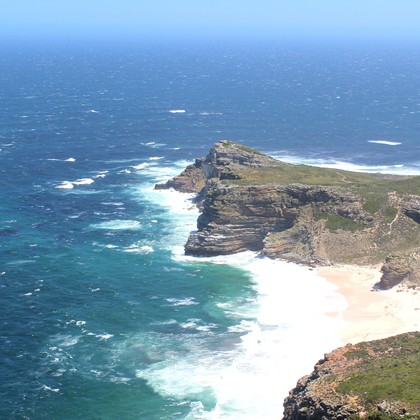
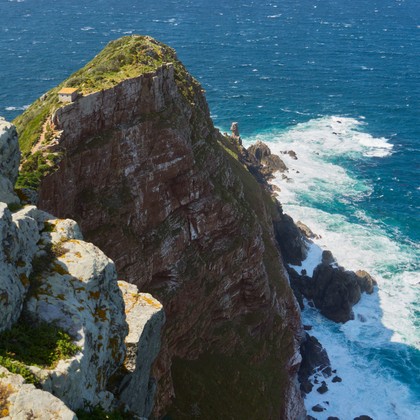
Cold subantarctic ocean, in winter north over the Benguela Current and the waters off the Cape. It filters zooplankton from surface water and picks up krill. It breeds in burrows in peaty soil on subantarctic islands.
Where the bird is most at home, classified by the vegetation units of southern Africa.
Range and movements
In the region a numerous breeder on Marion and Prince Edward, where birds attend the colonies from October to April. In winter it disperses north and is then regular off the Western and Southern Cape, sometimes as far as KwaZulu-Natal and Namibia; after storms hundreds of dead birds are sometimes found on the beaches. Beyond the region it breeds on the Crozet Islands, Amsterdam and Saint-Paul.
How and when to look
Beached prions on Cape beaches after a winter storm are mostly Salvin's or Antarctic Prions; measure the bill width to separate them. At sea a pelagic trip out of Cape Town in July or August gives the best chance, but many prions remain unidentified.
Conservation status
Not threatened; the world population is estimated at several million pairs, most of them on the Crozet and Prince Edward Islands. On Marion cats long put the colonies under pressure; mice are now the main threat.
Scientific name
Pachyptila salvini | (Mathews, 1912)
Mathews described the species in 1912 as Prion vittatus salvini; because it was later moved to another genus, the author and year stand in brackets. The genus Pachyptila was introduced in 1811 by Illiger. Pachyptila comes from the Greek pakhus, 'dense, thick', and ptilon, 'feather' — for the dense, soft plumage of the prions. salvini honours the English ornithologist Osbert Salvin (1835–1898), who published extensively on petrels. The specimen the first description was based on came from Marion Island.