All species › Passerines › Swallows and martins › White-Throated Swallow
White-Throated Swallow | Hirundo albigularis
Witkeelzwaluw | Golondrina Gorjiblanca
The White-Throated Swallow is a sturdy, glossy blue-black swallow with a pure white throat separated from the white belly by a complete dark breast band. It is a breeding bird of southern Africa, closely tied to water, which now nests mainly under bridges, dam walls and pump houses.

Voice
The song is a soft twittering chatter with short trills and whistles, quieter and less musical than that of the Barn Swallow. The call is a short chik or vit; when alarmed at the nest, a sharper repeated chit-chit.
Recording: Lynette Rudman — CC BY-NC-SA 4.0 · converted to mono · xeno-canto
Identification
14–17 cm, fairly robust, with a broad wing base and a deeply forked tail with moderately elongated outer feathers, slightly longer in males than in females. The upperparts are deep glossy steel-blue and the forehead is chestnut. The throat and the cheeks below the eye are bright white, closed off by a broad, complete blue-black breast band; the rest of the underparts is white, sometimes washed grey on the flanks. The underwing coverts are greyish-white. When spread, the tail shows a row of white spots. Juveniles are duller brown above, with a rusty forehead and a narrower, browner band. The flight is strong and often low over water, and it likes to perch on posts, wires or stones above the water.
Confusion species
The Barn Swallow Hirundo rustica has a rufous rather than white throat; young Barn Swallows with a pale buff throat are a pitfall but lack the pure white reaching below the eye and have a narrower breast band. The Pearl-Breasted Swallow Hirundo dimidiata is smaller and slimmer, without a chestnut forehead and without a breast band. The Angola Swallow Hirundo angolensis has a rufous throat and grey underparts. The Wire-Tailed Swallow Hirundo smithii has a rufous crown, no breast band and wire-like tail streamers. Among the region's swallows, a white throat above a complete dark band is diagnostic.
Habitat
Almost always near water: rivers, dams, vleis and lakes in open grassland, savanna and semi-desert, up to 2000 m and higher. Originally it nested on rock ledges and under overhanging banks, but it now nests largely under bridges, culverts, dam walls, pump houses and overhanging roofs. The nest is an open half-cup of mud against a vertical wall or beam, usually above or close to water. It hunts flying insects low over the water and the surrounding grassland.
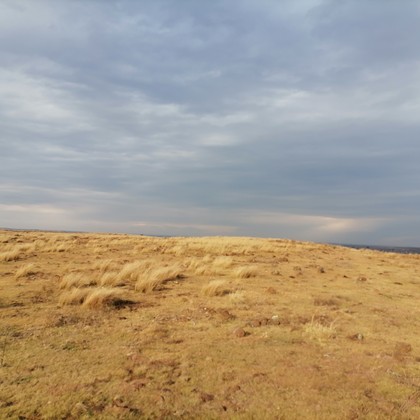
Where the bird is most at home, classified by the vegetation units of southern Africa.


Range and movements
Breeds in South Africa (almost throughout, commonest on the Highveld and in the eastern provinces, scarcer in the arid north-western Cape), Lesotho, Eswatini, southern and eastern Botswana, central and southern Namibia along rivers and dams, Zimbabwe and southern Mozambique; locally also in southern Zambia and Malawi. In the southern winter it moves north to Angola, Zambia and southern DR Congo. The species breeds only in southern Africa.
- Resident
- Summer visitor (c. Oct–Mar)
- Winter visitor (c. Apr–Sep)
- Passage (Mar–Apr, Oct–Nov)
- dark = core range, pale = thinly spread
How and when to look
From August to April: check bridges over rivers and dams, especially on the Highveld and in the Free State; birds often sit on the bridge railing or on posts in the water and fly low circles round the nest when approached. Look for the combination of white throat, complete black band and chestnut forehead; in mixed flocks with Barn Swallows the species stands out by its sturdier build and more contrasting head.
Conservation status
Not threatened. The species has expanded and increased considerably through the building of dams, bridges and other structures that provide water and nest sites. Nests are lost locally during bridge maintenance.
Scientific name
Hirundo albigularis | Strickland, 1849
Strickland described the species in 1849 and placed it straight away in the genus where it still stands. The genus Hirundo was introduced in 1758 by Linnaeus. Hirundo is the ordinary Latin word for 'swallow'. albigularis comes from the Latin albus, 'white', and gula, 'throat' — for the white throat. The specimen the first description was based on came from Cape Peninsula, South Africa.