All species › Passerines › Oxpeckers › Yellow-Billed Oxpecker
Yellow-Billed Oxpecker | Buphagus africanus
Geelsnavelossenpikker | Picabueyes Piquigualdo
The Yellow-Billed Oxpecker is the larger and scarcer of the region's two oxpeckers. It prefers the largest, thick-skinned hosts such as buffalo, rhino, hippo and giraffe, and is more closely tied to big-game country than Red-Billed Oxpecker.

Voice
A sharp hissing krisss and a rasping cherrr-cherrr, harsher and higher than in Red-Billed Oxpecker; groups keep up a continuous hissing, especially when a host startles.
Recording: Zsombor Károlyi — CC BY-NC-SA 4.0 · converted to mono · xeno-canto
Identification
21–23 cm. Head, back, wings and tail are olive-brown; the rump and uppertail-coverts are pale buff and contrast sharply with the dark back, especially in flight. The underparts are pale buff. The bill is thick and heavy, bright yellow at the base and red at the tip. There is no coloured eye-ring; the eye is orange-red. The tail is graduated and stiffened, the legs are short with sharp claws. The sexes are alike. Juveniles have a dark brown bill and a less contrasting rump.
Confusion species
Red-Billed Oxpecker Buphagus erythroryncha has a slimmer, all-red bill, a bright yellow bare ring around the eye and a uniform brown rump without contrast. Dark-billed juveniles of both species are best told by the pale rump and thicker bill of Yellow-billed. At a distance the host is a clue: on buffalo and rhino both species often occur together.
Habitat
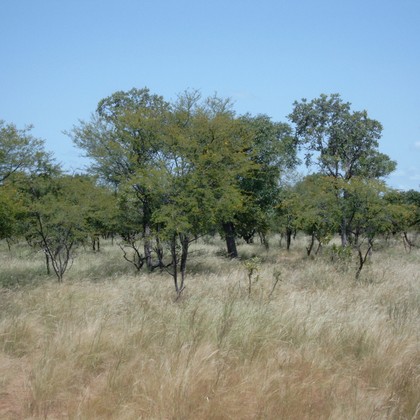
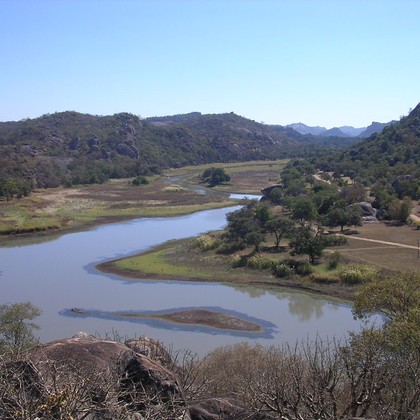
Savanna and open woodland with large mammals, especially buffalo, rhino, hippo, giraffe and eland; in the region far less on cattle than Red-Billed Oxpecker. It eats ticks and other parasites, blood and wound tissue. It breeds in tree holes and in crevices in rocks or buildings, lined with hair from its hosts.
Where the bird is most at home, classified by the vegetation units of southern Africa.

Range and movements
In the region mainly in the north: the Okavango and Chobe areas of northern Botswana, the Zambezi Region (Caprivi) of Namibia, Zambia, Zimbabwe (Zambezi Valley and Hwange), Malawi, Mozambique and Angola. It had disappeared from South Africa in the twentieth century; since the late 1970s it has re-established itself in Kruger NP, mainly in the north, and birds have been released elsewhere. Beyond the region from Senegal and Gambia east to Sudan and in East Africa.
- Resident
- Summer visitor (c. Oct–Mar)
- Winter visitor (c. Apr–Sep)
- Passage (Mar–Apr, Oct–Nov)
- dark = core range, pale = thinly spread
How and when to look
All year. The best chances are with buffalo herds in northern Botswana and northern Kruger NP, and with rhino and hippo along the Zambezi. Check the rump in every group of oxpeckers: the pale rump shows well in flight, even at a distance. In southern and eastern South Africa a Yellow-billed is still an unusual record.
Conservation status
Not threatened, but much scarcer than Red-Billed Oxpecker in the south of its range. It suffered even more from the dipping of cattle with toxic chemicals and from the decline of large wild mammals; in South Africa it remains locally rare.
Scientific name
Buphagus africanus | Linnaeus, 1766
Linnaeus described the species in 1766 and placed it straight away in the genus where it still stands. The genus Buphagus was introduced in 1760 by Brisson. Buphagus comes from the Greek bouphagos, 'ox-eating' — for the oxpeckers' habit of picking ticks and other parasites off cattle and large game. africanus is Latin for 'African', after the continent where the species lives. The specimen the first description was based on came from Senegal.