All species › Even-toed ungulates › Bovids › Alpine Ibex
Alpine Ibex | Capra ibex
Alpensteenbok | Íbice De Los Alpes
The Alpine ibex (Capra ibex) is a wild goat of the Alps that lives on steep rocky slopes above the treeline. In the nineteenth century the species was reduced to fewer than one hundred animals in the area of the present Gran Paradiso National Park in Italy. All present populations descend from those animals; after reintroductions from 1902 onwards, more than 55,000 Alpine ibex lived in six countries in 2015.
Tracks
The slot is cloven, with blunt, rounded halves: a hard rim around a softer sole that gives grip on rock. Tracks and trails are clearest in snow, where they run along and across rock bands. Under overhanging rock and on ledges there are resting places with heaps of droppings; the droppings are dark, round to oval and resemble those of chamois and domestic goat. At salt-rich places the animals lick minerals from the rock. In Piedmont, females and young climb the wall of the Cingino dam, which has a slope of 57 degrees, for this purpose; adult males do not.
Identification
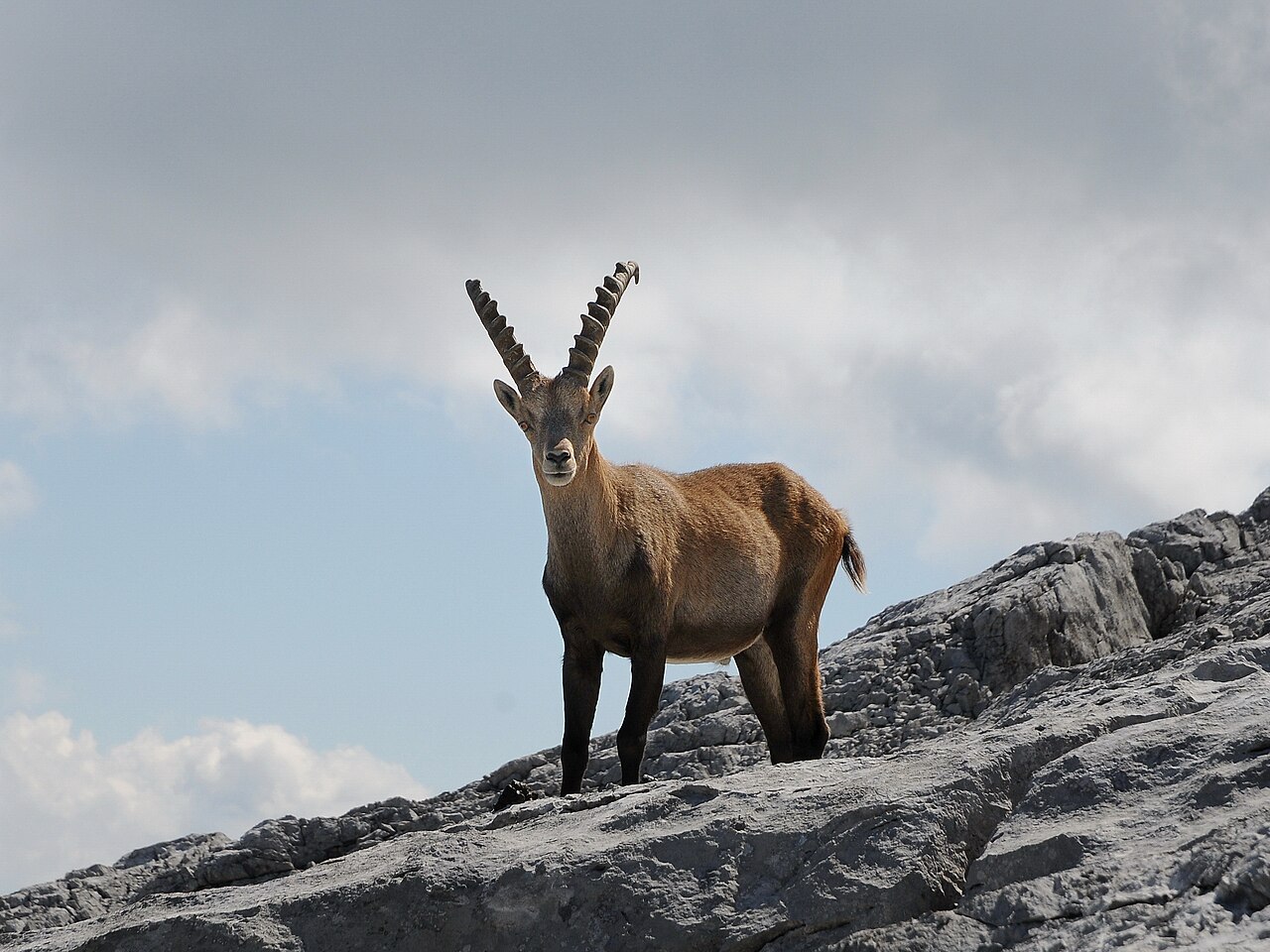
A stocky, heavy wild goat of 121 to 171 cm head-body length, 73 to 101 cm shoulder height and 40 to 120 kg, with a large difference between the sexes: an adult male weighs about twice as much as a female. The male carries long horns of 69 to 98 cm, curved backwards in one plane and set with coarse transverse knobs on the front surface; the horns of the female are short, thin and almost smooth, 18 to 35 cm. The male has a short chin beard of 6 to 7 cm. Females and young animals are pale ochre to light brown; males are yellowish brown with dark legs in summer and turn dark chestnut towards the end of winter. The tail is short, 15 to 30 cm by the widest figure given, and dark.
Similar species
The Spanish ibex (Capra pyrenaica) lives on the Iberian Peninsula; the two species do not overlap anywhere. The horns of the Spanish ibex turn outwards and twist upwards and inwards at the tip, whereas those of the Alpine ibex curve backwards in one plane and carry coarse knobs on the front. The chamois shares the habitat but is slimmer, has a pale face with a black stripe from muzzle to ear, and short horns hooked backwards at the tip. Free-ranging domestic goats usually have a more variegated coat and differently shaped horns; hybrids between domestic goat and Alpine ibex occur and cannot always be identified with certainty.
Habitat
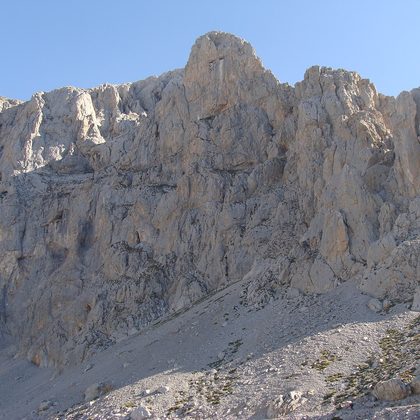
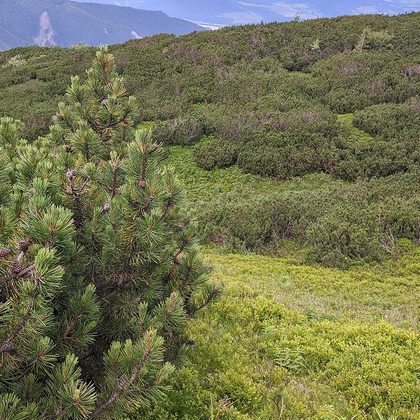
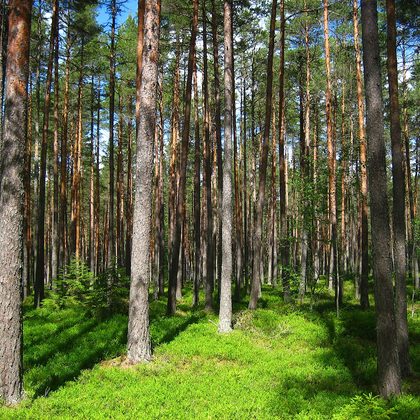
Alpine grassland, scree and cliffs between about 1600 and 3300 m, with a preference for slopes of 30 to 45 degrees. In summer the animals stay high, to above 3000 m; in winter they keep to steep south-facing slopes where the snow slides or is blown away, and sometimes to the upper zone of the mountain forest. Steep, rocky terrain close to the feeding site is a condition everywhere: the animals flee there when threatened.
Where the animal is most at home, classified with EUNIS — the European standard for habitats.


Distribution
The Alps only, from the French Maritime Alps to Austria and Slovenia. In the nineteenth century the species survived only in the Gran Paradiso area, with fewer than one hundred animals. From that population the Alpine ibex has been reintroduced throughout the Alps since 1902, and after 1948 also from the newly formed colonies. The distribution around 2015 was roughly: Switzerland more than 17,800 animals, Italy more than 16,400, France and Austria about 9000 each, Germany about 500 and Slovenia about 280. The populations consist of separate colonies in individual mountain groups. Outside the Alps the species does not occur in the guide area.
- Native
- dark = core range, pale = thinly spread
Way of life
The Alpine ibex is active by day, mainly in the morning and late afternoon. In winter it seeks the sun in the morning and lowers its heart rate and metabolism. It eats mainly grasses all year, supplemented with herbs in summer and with dwarf shrubs and conifer shoots in autumn and winter. Outside the rut the sexes live apart: females with young in groups of five to twenty, males in their own groups with a hierarchy based on age, body size and horn length. The rut takes place in December and January; gestation lasts 165 to 170 days, and a single kid, rarely two, is born in late May or June. In Gran Paradiso avalanches, winter food shortage and old age are the main causes of death; golden eagles take young animals. Males live to about 16 years, females to 20.
Where and when to look
In summer, search above the treeline early in the morning, on the grassland below cliffs; a telescope helps. In protected areas such as Gran Paradiso, the Vanoise and the Hohe Tauern the animals are not shy and can often be seen at close range. In April and May they come lower to eat the first grass on south-facing slopes and are easier to reach. Stay on the paths and keep your distance from females with young.
Conservation status
Least Concern (LC, 2020). The recovery of the species rests entirely on reintroduction. Because all animals descend from fewer than one hundred founders, genetic variation is low, and inbreeding locally increases susceptibility to disease. Relevant diseases are brucellosis, foot rot and the infectious eye inflammation keratoconjunctivitis, which also occurs in chamois, as well as gastrointestinal worms and lungworms. Hybridisation with domestic goats is a risk to the genetic integrity of the colonies.
Scientific name
Capra ibex | Linnaeus, 1758
Linnaeus described the species in 1758 and placed it straight away in the genus where it still stands. Capra is the Latin word for 'she-goat'. ibex is the Latin word for the wild goat of the Alps; the Romans probably took it over from a pre-Latin Alpine language. The specimen the first description was based on came from Switzerland.