All species › Lagomorphs › Hares and rabbits › Broom Hare
Broom Hare | Lepus castroviejoi
Cantabrische haas | Liebre De Piornal
The Broom Hare was described as a species only in 1977 and lives in a strip 230 by 30 kilometres, above a thousand metres, in the broom and heath of the Cantabrian Mountains; it occurs nowhere else. The range is sharply bounded, but in the field the species is difficult to identify: altitude and locality are the most important identification data.

Tracks
The species does not dig burrows; its signs are on the surface. The form is a worn hollow under a broom or heather bush, often in the lee of a tussock and with a view over the slope below; in this landscape forms are harder to find than on farmland, because the scrub is dense and tall. The droppings are flattened spheres of about 15 to 20 mm, hard, coarsely fibrous and ochre, scattered singly and not in heaps; in heath they often lie on open patches and along runs between the bushes. The print is that of a hare: long, narrow and with an indistinct edge due to the furred sole, in the bound with the two long hind feet ahead of the small fore feet. Prints are most visible in wet peaty ground and on the narrow stock paths of the summer pastures, and in winter in fresh snow on the high ridges. There are also feeding signs: clean oblique cuts of about 45 degrees on young broom twigs and heather shoots, and in winter stripped bark on young birch and willow along streams. The species feeds preferentially on recently burnt or cut patches of heath, where new shoots come up.
In its habitat

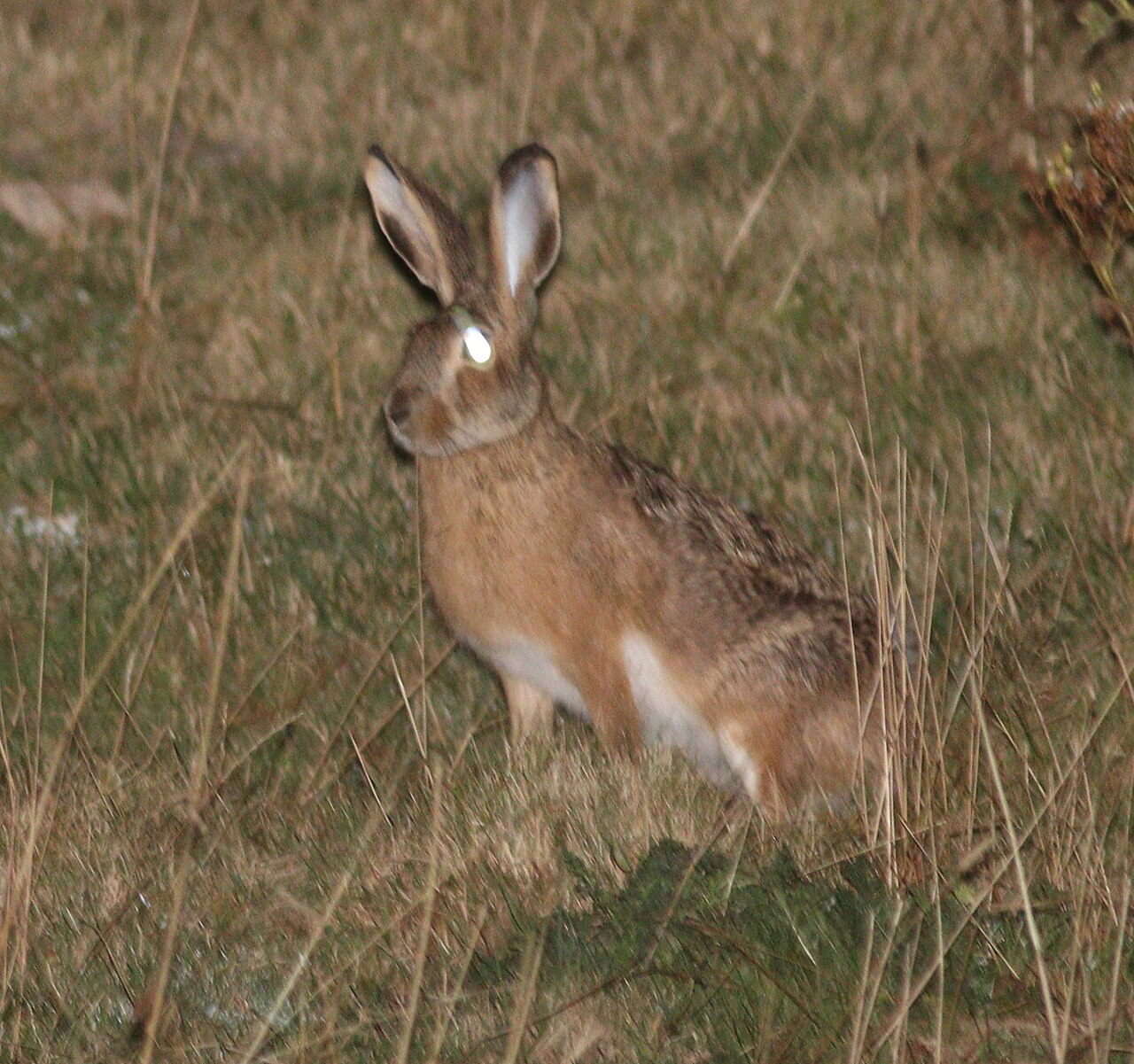
Head close-up
Identification
A medium-sized hare of 49 to 52 cm head-body and 2.6 to 3.2 kg; in size between the Brown Hare and the Iberian Hare. It is darker and greyer than either: the back is darkly grizzled brown-black, with a white hair base visible through the coat, the flanks are ochre-brown and the belly white. The ears are short for a hare and have a clear black tip; the tail is also short, black above and white below. The head is relatively small, with a white streak from the muzzle to the eye ring. In winter coat it is greyer and denser. It never turns white; no Spanish hare turns white, and the Mountain Hare does not occur in Spain.
Similar species
The Brown Hare (Lepus europaeus) occurs as far as central Asturias and along the southern edge of the range, the Iberian Hare up to the southern slope and in Galicia, and in the contact zones all three species occur together without external characters that give certainty. The Broom Hare is the darkest of the three and has the shortest ears and the shortest tail, but these differences are gradual and not reliable in the field, at dusk among the broom. Altitude and vegetation are decisive: above a thousand metres, in piornal and brezal (broom, gorse, ling, bell heather and bilberry), on the Cantabrian crest between the Sierra de los Ancares and the Sierra de Peña Labra, a hare is very probably this species. When animals descend to the valleys in hard winters, this criterion no longer applies. The Rabbit hardly plays a role here, because it lives in lower, warmer areas.
Habitat
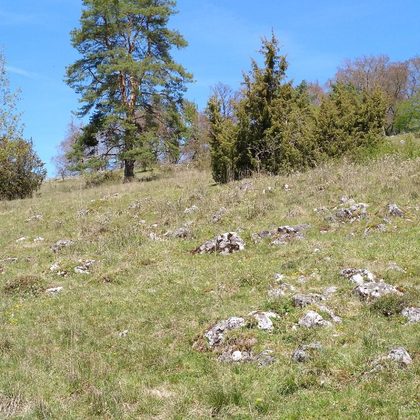
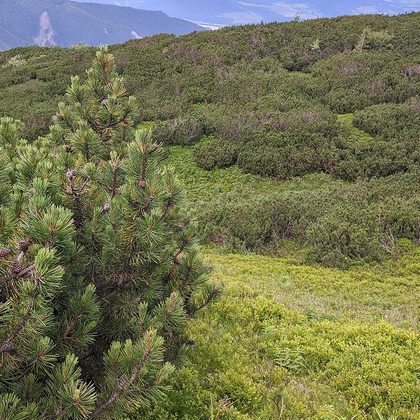
The high Cantabrian heath and broom between about one thousand and nineteen hundred metres: piornales of Genista and Cytisus, brezales of ling, bell heather and bilberry, with alpine and subalpine grassland, boggy hollows and clear-fells and clearings in oak and beech woodland between them. The species needs a combination of dense scrub for resting and open, short-grazed or freshly burnt grassland for feeding; a uniform, old, tall broom field and a bare pasture are both unsuitable. In hard winters it descends to about a thousand metres, below the snowline.
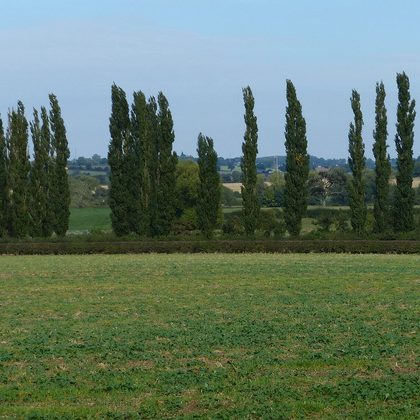
Where the animal is most at home, classified with EUNIS — the European standard for habitats.



Distribution
Only the Cantabrian Mountains of northern Spain, in a band about 230 kilometres long and 25 to 40 kilometres wide, from the Sierra de los Ancares on the Lugo–León border to the Sierra de Peña Labra and the Sierra de Híjar on the Cantabria–Palencia border. The range includes parts of Galicia, Asturias, León, Cantabria and Palencia. It is also fragmented: the population consists of cores separated by valleys and woodland, and at the eastern end the species has declined in recent decades. GBIF holds nearly three hundred records, almost all from this area.
- Native
- dark = core range, pale = thinly spread
Way of life
Strictly nocturnal: by day it lies hidden in dense scrub, at night it feeds on open patches, preferably on recently burnt or cut heath. It eats grass and herbs, young broom shoots, heather and bilberry, and in winter bark and twigs; like all hares it re-ingests its caecal pellets. Less is known about its breeding than for other European hares: litters are born between about March and September, with an estimated two to three litters a year of on average two young, fewer than in lowland Brown Hares. The young are born furred and with open eyes and each lies separately among the bushes. There is no winter dormancy; the species remains active under snow.
Where and when to look
The best times are the last minutes of daylight and the first hour of the night, on a recently burnt or short-grazed slope above a thousand metres, with binoculars or a lamp. Mountain passes are practical observation sites: Puerto de San Isidro, Puerto de Ventana (the type locality of the species), Puerto de Somiedo, Puerto de Pajares, Puerto de Piedrasluengas and the high ground of Alto Campoo. Drive slowly along the pass road after sunset and look for eyeshine along the verges; by day the chance is small. When walking the ridges in June or July an animal may be flushed from the broom. Record the exact location: for this species the locality is the most important identification datum.
Conservation status
Vulnerable (VU, 2025), almost entirely as a result of the small, fragmented range: the entire world range lies within an area of roughly 230 by 40 kilometres, and it is shrinking at the eastern edge. Numbers are estimated at a few thousand animals. Threats are changes to heath and broom (the loss of traditional grazing and burning, which lets the scrub close up and age, and in addition burns that are too large and too frequent), conifer afforestation, roads and wind farms on the ridges, and climate warming, which reduces the suitable altitudinal zone from below. Hunting is permitted in León and Cantabria and closed in Asturias, but the species has no legal protection in any province. In addition there is the risk that released hares from elsewhere introduce diseases and foreign genes into a population that has no other populations from which recovery is possible.
Scientific name
Lepus castroviejoi | Palacios, 1977
Palacios described the species in 1977 and placed it straight away in the genus where it still stands. Lepus is the Latin word for 'hare'. castroviejoi honours the Spanish biologist Javier Castroviejo, at the time director of the Doñana Biological Station. The specimen the first description was based on came from Spain, Puerto Ventanas.