All species › Carnivores › Mustelids › Caucasian Badger
Caucasian Badger | Meles canescens
Meles canescens | Meles canescens
Meles canescens, the Caucasian or Southwest Asian badger, is the badger of south-west Asia: from the Caucasus and Anatolia through the Levant and Iran to Central Asia, with populations on Crete and Rhodes as well. William Blanford described it in 1875 as a separate species from Iran; in 1899 it was reduced to a subspecies of the Eurasian badger. In 2013 Abramov and Puzachenko restored it to species rank on cranial and dental characters, and the Mammal Diversity Database follows them. Within the guide area it concerns Crete, Rhodes, Anatolia west of 37°E and the Levant.

Tracks
The signs of this species have not been described separately from those of the Eurasian badger. Until 2013 south-west Asian badgers were included in Meles meles, so what general works say about badgers also covers these populations: badgers live in setts with several entrances, tunnels and chambers used year after year, with dung pits around them and well-worn paths to the foraging areas. Whether that pattern is the same in M. canescens in the dry, warm parts of its range has not been studied.
Identification
A badger with the familiar black-and-white head mask: on each side of the head a broad black to blackish-brown stripe runs from the tip of the snout over eye and ear, with a pure white central stripe between them extending over the back of the head onto the neck. Snout, cheeks and ear tips are white. The coat is paler overall than that of the Eurasian badger, a grizzled silvery grey. It is clearly smaller than the Eurasian badger. In the skull the shorter rostrum and mandible, the low cranium and the unflattened auditory bullae are characteristic; the first upper premolar is often absent and the second lower premolar is large and usually single-rooted.
Similar species
The Eurasian badger (Meles meles) is larger and darker with a similar head mask; in the field the difference shows only in size and colour, and certain identification rests on skull and teeth or DNA. Within the guide area geography separates them: the Bosporus and Dardanelles divide the Eurasian badger in Europe from M. canescens in Anatolia. In the northern Caucasus, outside the guide area, the boundary between the two has not been established and possible hybrids have been found. The Asian badger (Meles leucurus) lives further east and has a different facial mask.
Habitat
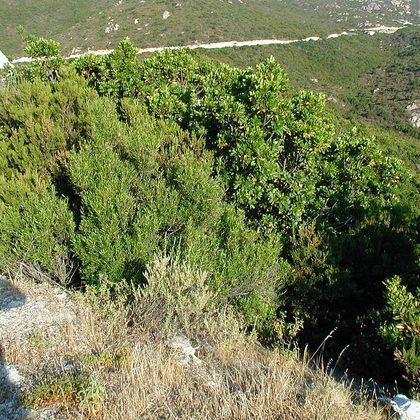
In Syria it occurs in almost all habitats except arid and semi-arid areas. In Uzbekistan, where it meets the Asian badger, M. canescens lives in the mountains and the Asian badger on the plains and in semi-desert. The only known animal from Afghanistan was found at 3192 m, in dry mountain steppe with dwarf shrubs and alpine meadows.
Where the animal is most at home, classified with EUNIS — the European standard for habitats.




Distribution
The Caucasus (Armenia, Georgia, Azerbaijan and the northern slope of the Greater Caucasus), Turkey, Iran, Iraq, Syria, Lebanon, Israel, northern Afghanistan, Turkmenistan and the foothills of the western Tien Shan and Pamir-Alai in Kyrgyzstan, Uzbekistan and Tajikistan. Also Crete and Rhodes. East of the Caspian the ranges of M. canescens and the Asian badger are separated by the Kara Kum and Kyzyl Kum deserts. Within the guide area there are recent records from Israel, Greece (the islands), Turkey, Syria, Lebanon and the Palestinian territories.
- Native
- dark = core range, pale = thinly spread
Way of life
Diet, breeding and use of space have hardly been studied separately for this species; data on south-west Asian badgers from before 2013 are filed under the Eurasian badger. According to mitochondrial DNA the lineages of M. canescens and the Eurasian badger separated between 2.37 and 0.45 million years ago. The authors who recognised the species again in 2013 identify the Greater Caucasus and the Bosporus and Dardanelles as barriers that prevented genetic exchange between them.
Where and when to look
On Crete and Rhodes this is the only badger, and the same holds for Anatolia and the Levant; a badger photographed at night there belongs to this species. For the species map, records from Crete, Rhodes and western Anatolia are the most useful, with a photograph of head and flank.
Conservation status
Not Evaluated (NE) on the global Red List; the IUCN treats these populations as part of the Eurasian badger (Meles meles, LC, 2016). In Syria it is regarded as abundant. There are no data on numbers, trend or threats for M. canescens as a separate species.
Scientific name
Meles canescens | Blanford, 1875
Blanford described the species in 1875 and placed it straight away in the genus where it still stands. Meles is the Latin word for 'badger'; the Romans could use it of the marten as well. canescens is Latin for 'turning grey', the present participle of canescere, 'to grow hoary', from canus, 'grey', after the grizzled coat. The specimen the first description was based on came from Iran, Abadah.