All species › Carnivores › Mustelids › Eurasian badger
Eurasian badger | Meles meles
Das | Tejón
The badger digs its own sett and comes above ground only after dark. The species leaves many signs: a sett that stays in use for generations, paths running straight through hedges, latrine pits on the territory boundary, and a print with five toes and claws about three centimetres long in front of them. Fieldwork on this species therefore consists mainly of finding and interpreting signs rather than of seeing the animal itself.

Tracks
The badger's signs are numerous and remain visible for a long time. Central is the sett: a system of three to ten entrances, in old setts several dozen, with tunnels that can total hundreds of metres. The entrance is wider than high, about 25 to 30 cm, with a flattened floor; a fox earth is higher than wide. In front of each used entrance lies a fan of excavated soil, often with old bedding pushed out: bleached leaves, grass, bracken and straw, sometimes in trails that the animal has dragged out backwards. On warm days fresh bedding lies outside to dry. Trees near the sett have claw marks at badger height, and the ground is trampled bare into a play area. The paths are also characteristic: straight runs ten to fifteen centimetres wide that cross property boundaries, through hedges, under gates and under the bottom strand of barbed wire. Hairs catch on that wire; badger hair can be recognised by three characters: seven to eight centimetres long, coarse, oval in section so that it does not roll between finger and thumb but flips over, and three-coloured: white at the base, a black band and a white tip. Along the edge of the territory lie the latrines: open, shallow pits ten to fifteen centimetres across, dug and not covered, usually several together. The dropping itself is not very distinctive (from black and meaty to a doughy brown mass with earthworm remains, beetle wing cases or cherry stones), but the pit beneath it is diagnostic: a fox places its dropping high and in the open on a stone or molehill, never in a dug pit. In short grassland snuffle holes can be found: hundreds of funnels two to five centimetres across, made with the nose while searching for leatherjackets and chafer grubs. The print is distinctive: five toes in a shallow arc in front of one broad, continuous pad, the forefoot about 5 to 6.5 cm wide and wider than long, with the marks of the long claws ahead of the toes and separate from them. The hind foot is narrower and longer and often partly overlaps the fore print. Four toes indicate dog, cat or mustelid; five toes in an arc with claws well ahead indicate badger. In addition: dug-out wasp nests in banks, maize plants pulled down along the field edge in August and September, and on still autumn evenings the heavy, musky smell of an occupied sett.


In its habitat

Head close-up

The young

Identification
A low, broad, wedge-shaped animal: heavy behind, narrow in front, with short legs and a short, pale tail. Back and flanks are grey because the hairs are banded black-white-black; belly and legs are black. The head is white with two black stripes running from the muzzle over the eye to the small, white-rimmed ears; this pattern is recognisable at any distance, including in torchlight or on a camera-trap image. The eyes are small, the snout mobile, the neck heavy. The forefeet have long, slightly curved digging claws up to about three centimetres. The badger walks with a shuffling gait, head low and back slightly arched, trots jerkily, and is broad and fat in autumn and narrow and angular in spring. Young badgers at first have a vaguer, greyish face pattern.
Similar species
In good view confusion is impossible: no other European mammal has a black-and-white striped head. In the dark, in a torch beam or on a camera-trap image there are three confusion species. The Raccoon has a black eye mask instead of head stripes, stands higher on the legs, carries its black-ringed tail raised and climbs; the badger does not climb. The Raccoon Dog is equally low and stocky, but has a dark mask around the eye, a brown, shaggy coat and black legs. A young Wild Boar has a similarly heavy silhouette, but no white head and a different gait. At a distance in a field a badger is sometimes taken for a feral cat; the shuffling gait and broad hindquarters are then decisive. The Asian Badger (Meles leucurus) occurs only east of the European range of the badger.
Habitat
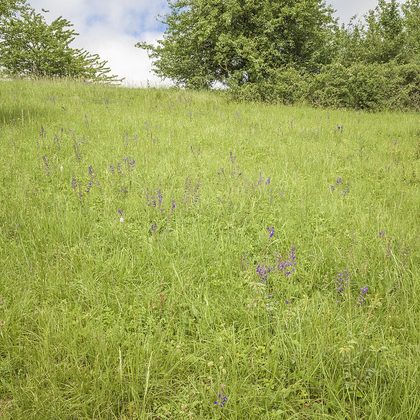
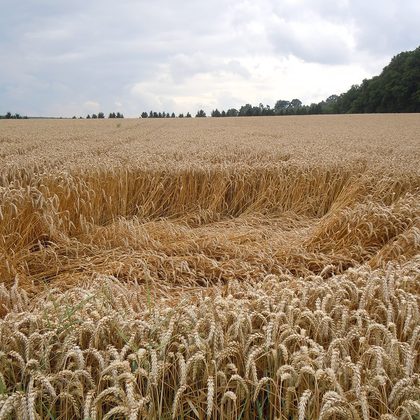
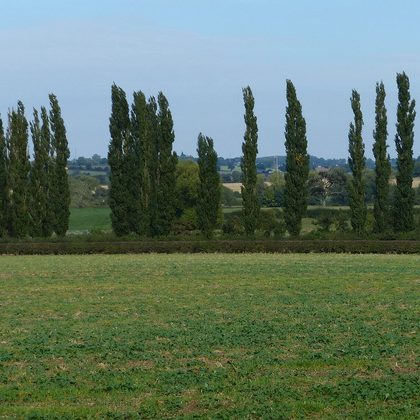
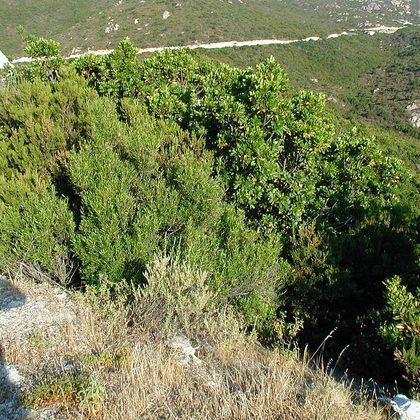
Typical habitat is a mosaic of small broadleaved woods and copses, hedgerows, shelterbelts and sunken lanes, alternating with grassland and arable land on which the animal feeds. It needs easily dug, free-draining soil (sand, loess, chalk or loam) on a slope or bank, with the water table at least one and a half metres below the sett, and as little disturbance as possible. As a result the badger occurs mainly on higher, lighter soils and in hilly country, and is almost absent from wet clay. Also woodland edges, railway embankments, old hedge banks, riverine woodland, orchards and olive groves, and in southern Europe holm and cork oak dehesa and maquis. The species reaches village edges and gardens, but the sett then lies under a shed, in a bank or in a copse.
Where the animal is most at home, classified with EUNIS — the European standard for habitats.


Distribution
From Ireland to the Volga and from southern Scandinavia to the Mediterranean; more thinly distributed in the south, and in the north with a limit linked to the duration of frost. In Britain and Ireland densities are high: the badger is common in England and Wales, most numerous in the south-west, widespread in lowland Scotland and present throughout Ireland; it is absent from the Isle of Man and most smaller islands. On the Iberian Peninsula it is common and widespread, except in the driest parts of the south-east, and absent from the Balearic and Canary Islands; it is numerous in the Cantabrian Mountains, the Iberian System, the Pyrenees and their foothills, also occurs in dehesa, riverine woodland, olive groves and Mediterranean scrub far into the south, and in the mountains up to almost 2000 metres. In many districts it is little noticed; setts in stream banks and field margins are there the best evidence of presence. In Portugal the situation is similar. In France, Germany and Poland it is a common species of farmland and woodland edges. In the Netherlands persecution, land consolidation and above all road traffic had reduced the badger by the 1970s and 1980s to a few thousand animals in a limited number of core areas. Legal protection, badger tunnels with guiding fences, hedgerow restoration and some translocations have since led to recovery; it now again occurs on the Veluwe, in the Achterhoek, Twente, eastern North Brabant and South Limburg and is spreading westward. It is almost entirely absent from the low, wet west. In Wallonia it is common and widespread; in Flanders it is scarce and largely confined to Voeren, Haspengouw and Limburg, with a slow expansion.
- Native
- dark = core range, pale = thinly spread
Way of life
Nocturnal; in summer usually above ground only after dark, in undisturbed areas in May and June before sunset. The badger lives in a clan of two to about ten animals sharing one sett and one territory, with a joint system of latrines on the boundary. The earthworm is the main food: on mild, damp nights the badger searches short grassland and can eat hundreds per night. In addition leatherjackets and chafer grubs, beetles, slugs, frogs, young rabbits, eggs, carrion, wasp brood, and in late summer cereals, maize, elderberries, blackberries and fallen apples, in southern Europe also figs and grapes; with these the fat reserve for winter is built up. Breeding involves delayed implantation: mating takes place during much of the year, but the fertilised egg remains dormant for months and implants only in December. In January or February two or three blind cubs are born, which first come above ground in April or May and spend the summer at the sett. The badger does not hibernate: in frost and snow it stays in the sett for days to weeks, living on its fat reserve and losing weight, but its body temperature does not fall, and in mild weather it is active outside even in midwinter. Badgers can live ten to fifteen years in the wild; most die much earlier, mainly in traffic.
Where and when to look
Start by day at the sett: fresh soil, bedding pushed out, worn paths and fresh latrine pits indicate occupation. A mild, still evening in May or June is then the best time, from an hour and a half before sunset, fifteen to twenty metres away and downwind of the sett, without moving; the badger sees poorly but has a very good sense of smell and hearing. White light drives the animal away. Disturbing a badger sett is prohibited in many countries, including Britain, Ireland and the Low Countries. A camera trap on a path causes no disturbance and often produces images within a week. After a wet night, closely mown or grazed grassland is the best place to look for snuffle holes, prints in the mud of a ditch bank and hairs on the lowest strand of barbed wire.
Conservation status
Least Concern (LC, 2016) and stable or increasing across most of Europe. In Britain and Ireland the badger is numerous and in Britain has been legally protected since 1992 (Protection of Badgers Act); at the same time it has for decades been at the centre of a politically charged debate on culling because of its role in the transmission of bovine tuberculosis; Ireland runs its own culling programme for the same reason. In the Netherlands and Flanders the badger had become scarce in the twentieth century through persecution, gassing of setts and loss of hedgerows; it is strictly protected there, including the sett, and is slowly recovering, with traffic as the main cause of death, which has led to the construction of hundreds of badger tunnels and fences. In Spain the badger is a game species in some regions and protected in others; the main problems are road casualties, destruction of setts during agricultural and forestry work, snares and poison aimed at other species, and direct persecution where it is blamed for damage to vineyards and maize fields. Elsewhere in Europe it is a quarry species or a tolerated species of farmland. The survival of the species is nowhere at issue; the concerns are traffic, habitat fragmentation and the loss of small-scale farmland.
Scientific name
Meles meles | (Linnaeus, 1758)
Linnaeus described the species in 1758 as Ursus Meles; because it was later moved to another genus, the author and year stand in brackets. Meles is the Latin word for 'badger'; the Romans could use it of the marten as well. The specific name repeats the genus name. The specimen the first description was based on came from Sweden.