All species › Hedgehogs, shrews and moles › Shrews › Caucasian Pygmy Shrew
Caucasian Pygmy Shrew | Sorex volnuchini
Sorex volnuchini | Sorex volnuchini
The Caucasian Pygmy Shrew is the pygmy shrew of the Caucasus and the surrounding mountains. It was described in 1922 as a subspecies of the Eurasian Pygmy Shrew (Sorex minutus) and is treated as a separate species on the basis of its chromosomes and genetic studies. Its range extends from southern European Russia through the Caucasus to northern Turkey and north-western Iran. Only the western edge of that range lies within the guide area, and whether the pygmy shrews of Crimea belong to this species is unresolved.
No photograph of a living wild animal of this species with a suitable Creative Commons licence exists. Do you have one that meets the rules? Send it in.
Tracks
No signs are known that are specific to this species. Droppings, runs and footprints cannot be separated from those of other small Sorex. The species is recorded by trapping and in owl pellets, in which the small skulls and jaws with red-brown tooth tips are recognisable; assigning them to this species rather than the Pygmy Shrew rests in practice on locality.
Identification
A small Sorex closely resembling the Eurasian Pygmy Shrew. The fur is two-toned: in young animals a pale, brownish-olive back, in adults a dark brown back, slightly paler, yellowish-tinged flanks and a pale grey belly. The tail reaches 70 to 75 per cent of head-body length and is sharply bicoloured. The tooth tips are red-brown. The species increases in size from north to south, which explains the wide spread in measurements. The karyotype is 2n = 40. Head-body 4.3 to 7.4 cm, tail 3.3 to 5.0 cm, hind foot 10 to 13 mm, weight 2 to 9 g.
Similar species
Externally the Caucasian Pygmy Shrew is hardly separable from the Eurasian Pygmy Shrew (Sorex minutus): both are small and two-toned with a relatively long tail. The literature is divided on whether the two can be told apart by external characters; the conclusive difference is the karyotype, 2n = 40 against 2n = 42 in the Pygmy Shrew. In practice locality decides, as their ranges largely exclude each other. The Caucasus and northern Turkey also hold larger Sorex species, such as Sorex satunini and Sorex raddei, which differ in size and in their relatively shorter tail. White-toothed shrews, including Crocidura gueldenstaedtii, common in the region, have white teeth, prominent ears and long scattered hairs on the tail; water shrews (Neomys) are larger and dark with a pale belly.
Habitat
In the northern Caucasus the species lives in varied habitats, from forest to mountain meadows. In the central and eastern Caucasus, where the climate is drier, the range of habitats narrows and mainly damp places near water are occupied. In the Caucasian foreland numbers are low even in wet habitats, possibly because of competition with the abundant Crocidura gueldenstaedtii. In Turkey it favours humid forests of beech, fir and spruce with rhododendron scrub and rocks.
Where the animal is most at home, classified with EUNIS — the European standard for habitats.



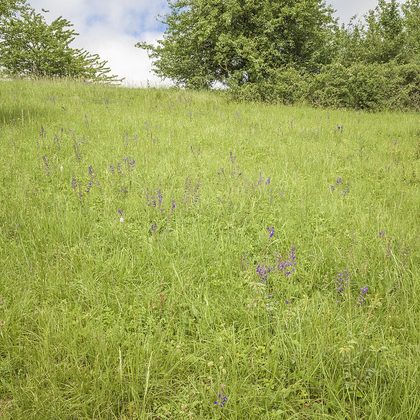


Distribution
Southern European Russia north of the Caucasus, the Greater and Lesser Caucasus in Russia, Georgia, Armenia and Azerbaijan, northern Turkey and the Talysh Mountains of north-western Iran. Two subspecies are recognised: S. v. volnuchini in the Caucasian foreland, eastern Transcaucasia and the Talysh Mountains, and S. v. colchicus in northern Turkey and the western Caucasus. The guide area covers only the western edge of this range. In Crimea there are pygmy shrews larger than those of mainland Ukraine; they have been described as dahli and assigned by some authors to Sorex volnuchini. A 2020 checklist of the rodents and insectivores of Crimea lists the records there as either Pygmy Shrew or Sorex volnuchini, without choosing between them.
Way of life
The species is active round the clock, with most activity in the hours of darkness. Its diet has not been studied specifically; beetles and caterpillars predominated in the stomach contents of a few animals examined. Breeding starts in late March or early April and ends in late July or early August; females presumably have two litters per season, of two to eight young, six on average. Young of both sexes can breed in their year of birth. No data exist on home range or social organisation. Like all Sorex, it does not hibernate.
Where and when to look
The Caucasian Pygmy Shrew cannot be identified in the field; a small, two-toned, long-tailed shrew in the Caucasus or northern Turkey can only be recorded as a pygmy shrew in the broad sense. Certainty comes from trapping with chromosome or DNA analysis, which requires a licence. Within the guide area, records from Crimea and from the western part of the Turkish Black Sea coast are the most relevant, because the limits of the range are uncertain there. With each record, note the exact place and altitude.
Conservation status
Least Concern (LC, 2016) on the IUCN Red List. The species is common in parts of its range and locally abundant, but numbers are low in other regions; in the Russian republic of Kabardino-Balkaria it is on the regional Red List. Uncertainty about species limits, especially in Crimea, makes statements about its status at the western edge of the range difficult.
Scientific name
Sorex volnuchini | Ognev, 1922
Ognev described the species in 1922 and placed it straight away in the genus where it still stands. Sorex is the Latin word for a shrew. volnuchini honours a Volnukhin; Ognev gives no explanation of the dedication and who he meant has not been established. The specimen the first description was based on came from Russia, Adygea.