All species › Rodents › Squirrels and marmots › Caucasian Squirrel
Caucasian Squirrel | Sciurus anomalus
Kaukasuseekhoorn | Sciurus anomalus
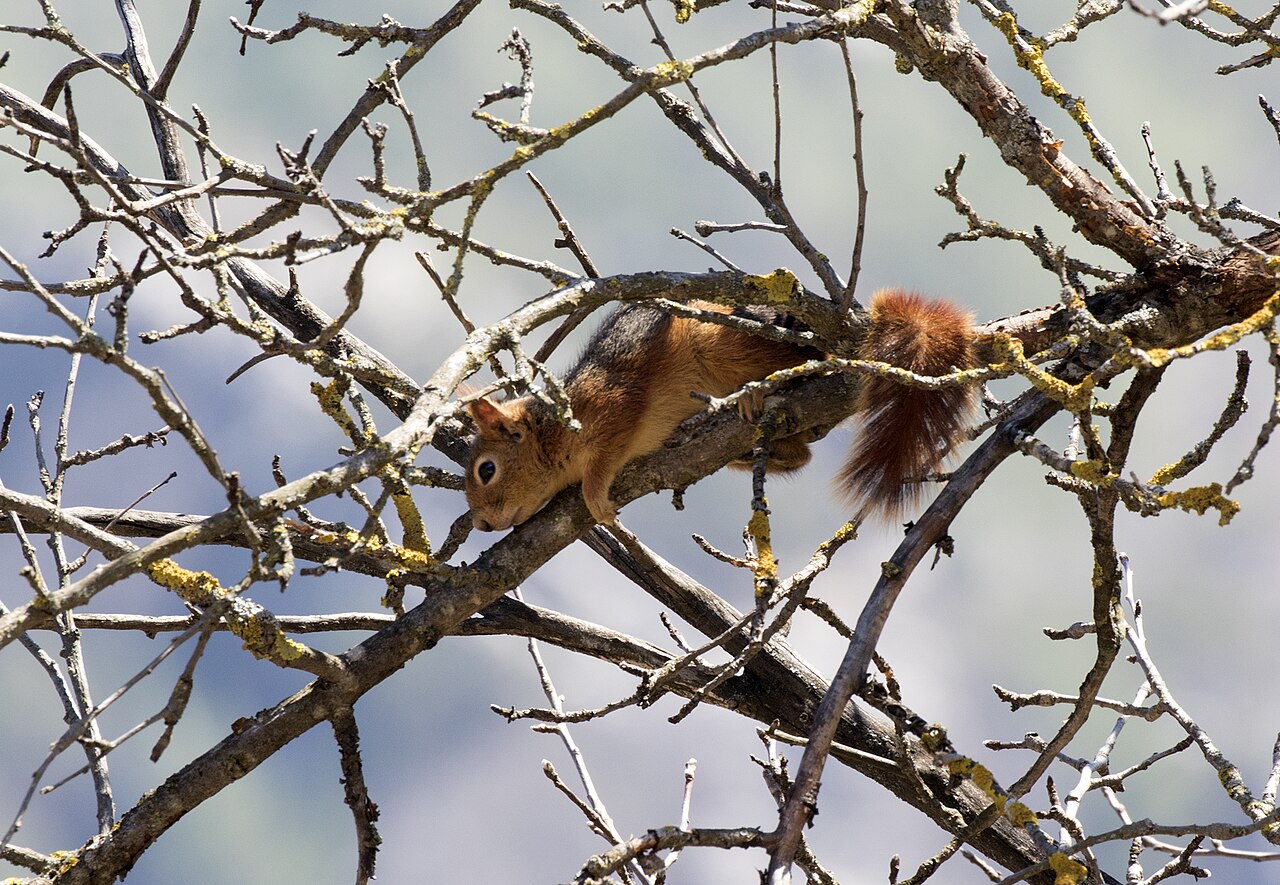
The Caucasian Squirrel lives in Anatolia, the Caucasus and the Near East; within the European Union it occurs only on the Greek island of Lesbos. It is grey above and rusty-buff below, has a short tail and no ear tufts. It is less tied to trees than the Eurasian Red Squirrel and is often seen on the ground and on dry-stone walls.
Tracks
The species is active by day and is seen more often than it is recognised from signs, but signs do occur. The clearest is the feeding place with cones: like the Eurasian Red Squirrel, the Caucasian Squirrel holds a cone of Calabrian pine, black pine or cedar in its forepaws, turns it and bites the scales off from the base to the core, leaving a bare core with an edge of stubs and a tuft of untouched scales at the tip. These cores lie by the dozen on a stone, a stump or a wall. In autumn there are also opened nuts: hazelnuts, walnuts, almonds and pistachios, split in two or with a large, ragged hole, never with the small round hole of a mouse. In oak woodland acorn caches can be found, hidden in tree cavities and shallowly in the soil; stores of up to six kilograms of seed have been described from a single animal. Look also for the nest cavity: unlike the Eurasian Red Squirrel, which often builds a drey of twigs, this species prefers to nest in cavities in old trunks, five to fourteen metres up, lined with moss and leaves; rock crevices and cavities under tree roots are also used. The species marks its range with urine and droppings at fixed places: a dry-stone wall or a thick horizontal branch with a small heap of dark, cylindrical droppings half a centimetre long is a regular crossing point.

In its habitat

Head close-up

Identification
A medium-sized squirrel: head-body about 20 cm, tail 13 to 18 cm, weight 250 to 410 g. The back is grey to grey-brown with a speckled, yellowish-grey wash from buff hair tips; the flanks pass into rusty-buff to cinnamon, and this colour continues over the whole underside. This is the decisive character: the Caucasian Squirrel never has a white belly. A pale ring surrounds the eye. The ears are small and rounded and never have tufts, not even in winter. The tail is shorter and less bushy than in the Eurasian Red Squirrel and usually warm red-brown or rusty, clearly different in colour from the back. The legs are short, the claws strong and on average 0.65 cm long; the species digs as much as it climbs. No difference between summer and winter coat is visible in the field.
Similar species
On Lesbos the Caucasian Squirrel is the only squirrel and therefore cannot be confused. Confusion is possible only at the edges of the range. The Eurasian Red Squirrel meets it in north-western Turkey and the Caucasus; the distinction is simple: that species has a white to cream belly with a sharp boundary along the flank, long ear tufts in winter, and a longer, fuller tail. In case of doubt the belly decides: buff or rusty is anomalus, white is vulgaris. The Persian Ground Squirrel and other ground squirrels in Anatolia have shorter tails, run low over the ground, dig burrows and do not climb trees. The Caucasian and Anatolian dormice are much smaller and nocturnal. In parks of some Turkish and Lebanese cities feral exotic squirrels live; there, look for bright colours and a striped or bicoloured back.
Habitat
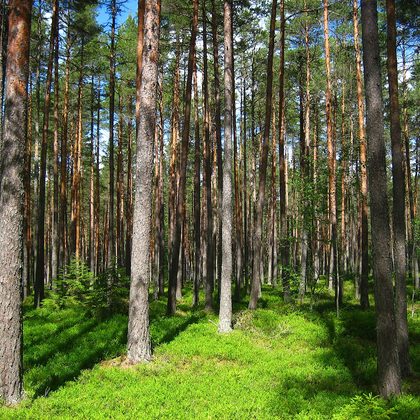
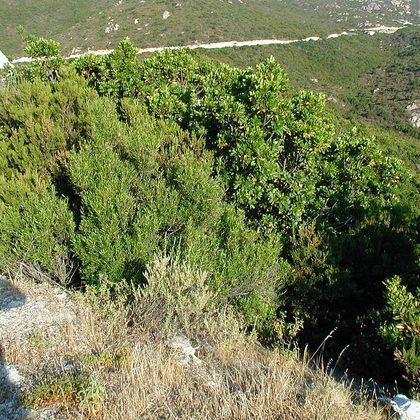
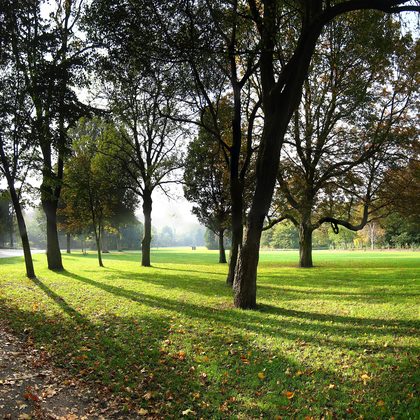
Broadleaved and mixed woodland of the eastern Mediterranean and the Caucasus, especially oak woodland, woodland of Calabrian and black pine, and dry woodland with Pistacia and juniper. The farmed landscape is equally important: the species lives in walnut, chestnut, almond and olive orchards, in old parks and village plantings, and reaches the edges of towns. On Lesbos it lives in the open pine woods and olive groves of the west and centre of the island, up to the rocky, half-open ground near the monastery of Ypsilou. From sea level to about 2000 m. The species is less tied to a closed canopy than the Eurasian Red Squirrel and forages much on the ground, so that it can also live in sparse, half-open woodland where the Red Squirrel is absent.
Where the animal is most at home, classified with EUNIS — the European standard for habitats.




Distribution
From western and southern Turkey east through the Caucasus (Georgia, Armenia, Azerbaijan) to Iran and Iraq, and south through Syria and Lebanon to Israel, the Palestinian territories and Jordan. Within the European Union the species occurs in one place: the island of Lesbos, where it is common. It also lives on the Turkish island of Gökçeada. This makes it one of only two squirrel species that inhabit an island in the Mediterranean. It is absent from the Greek mainland and from the other Aegean islands.
- Native
- dark = core range, pale = thinly spread
Way of life
Diurnal, with a peak in the early morning and again in the late afternoon, and on hot summer days a long pause around midday. The species is solitary, in territories that are scent-marked, but at places with abundant food, such as a walnut orchard in October, several animals gather temporarily. The diet consists of nuts, seeds, acorns, pine seed, buds and young shoots, supplemented with fruit, fungi and occasionally insects and eggs. In autumn large stores are laid up, partly in tree cavities and partly in the ground; seeds that are not recovered can germinate. There is no hibernation; the animals are active all year but stay in their cavity for days during storms and cold. One or two litters a year, of on average three to four young, in spring and late summer; the young are independent at about ten weeks.
Where and when to look
Within the European Union the species can be seen only on Lesbos. Go to the west of the island, to the pine woods and olive groves around Ypsilou, Sigri and Andissa, and watch along woodland edges and dry-stone walls in the first two hours after sunrise. The animals often run on the ground and cross roads. Note the low outline without ear tufts and the rusty tail. In Turkey, Georgia and Armenia the species is widespread in mountain forests and old walnut orchards; a walnut orchard in October is the most reliable place. Look under the trees as well: gnawed cone cores on a stone indicate the presence of the species, even if it is not seen that morning.
Conservation status
Least Concern (LC, 2017). The species has a large range, has few requirements and benefits from orchards and village plantings, so that it is common in parts of Anatolia and the Caucasus. Nevertheless it is locally under pressure: deforestation and the removal of old walnut orchards in Turkey and the Near East take away both food and nest cavities, and in parts of Iran and Iraq it has disappeared because of logging and overgrazing. On Lesbos it forms an isolated island population that is vulnerable to wildfires; this is the greatest risk for the only population of this species in the European Union.
Scientific name
Sciurus anomalus | von Güldenstädt in von Schreber, 1785
Von Güldenstädt in von Schreber described the species in 1785 and placed it straight away in the genus where it still stands. Sciurus is the Latin word for 'squirrel', from Greek skiouros, from skia, 'shadow', and oura, 'tail': the animal that shades itself with its tail. anomalus is Greek anōmalos, 'irregular, deviating', from a-, 'not', and homalos, 'even, uniform'; Güldenstädt took the animal for a squirrel out of the ordinary. The specimen the first description was based on came from Georgia.