All species › Carnivores › Civets and genets › Common genet
Common genet | Genetta genetta
Genetkat | Gineta
The common genet is a viverrid (Viverridae). Its range covers much of Africa, the Arabian Peninsula and south-western Europe. In Europe the species is regarded as recent: genetic studies indicate introduction from North Africa in historical times. Within the area of this guide it lives in Spain, Portugal, south-western France and on Mallorca, Ibiza and Cabrera.

Tracks
In Doñana fore tracks averaged 29.8 mm long and 30.2 mm wide, hind tracks 29.5 mm long and 25.8 mm wide. The scat averages 10 cm long and 1.3 cm thick and contains feathers, hair, bones and teeth of small mammals, beetle wing cases, fruit and seeds. The genet deposits its scats in latrines on raised, flat spots: boulders, stones, thick branches and tree stumps. In Doñana 80% of the signs found lay near streams and 20% on forest tracks. The species also scent-marks.
Identification
The size of a domestic cat, but with a longer, more slender body, shorter legs and a tail nearly as long as the body. Head-body 43 to 55 cm, tail 33 to 49 cm, weight 1.5 to 2.3 kg; animals on Ibiza weigh no more than 1.3 kg. The coat is grey-brown with rows of black spots along the flanks and a thin dark line along the middle of the back. The tail has eight to ten dark rings alternating with pale ones, and a pale tip. The head is pointed, with large rounded ears and dark mask markings above the muzzle. The claws are semi-retractile.
Similar species
A domestic cat has a shorter body relative to the legs, a shorter muzzle, smaller ears and a much shorter tail; a spotted domestic cat never shows the combination of a long, thin ringed tail and a pointed head. The wildcat is heavier (3.5 to 8 kg), has faint stripes rather than spots and a thick, blunt tail. The Egyptian mongoose, which lives in the same areas of Iberia, is grizzled grey without spots, has a tail broad at the base and ending in a black tuft, and is active by day.
Habitat
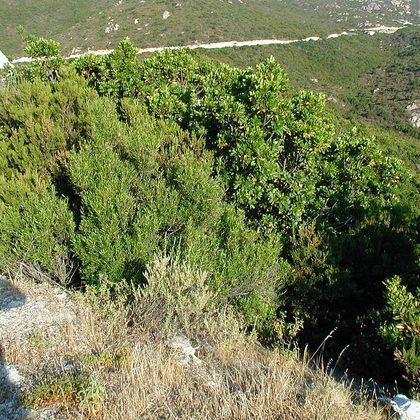
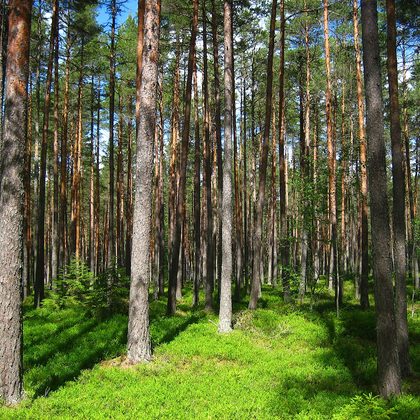
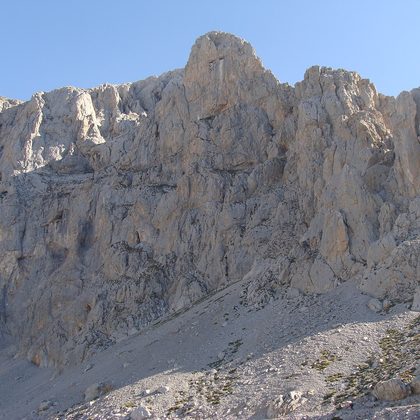
Woodland and scrub in warm and temperate regions at low altitude: holm oak, oak and cork oak woodland and the dehesa, where it is numerous, also olive groves, riverine woodland, maquis, rocky ground and pine woodland. Cover of shrubs or trees is required; very dry areas are avoided.
Where the animal is most at home, classified with EUNIS — the European standard for habitats.




Distribution
Africa north and south of the Sahara, the Arabian Peninsula and south-western Europe. In Europe the species lives on the Iberian Peninsula, in south-western France and on Mallorca, Ibiza and Cabrera; it is absent from the Canary Islands. Iberian animals belong to the nominate form; separate subspecies live on the Balearics. It probably reached Spain from North Africa in historical times and spread from there to France and Portugal. Isolated records exist from Belgium, Germany, the Netherlands, Italy and Switzerland. Within the area of this guide it also occurs in Morocco, Algeria, Tunisia and Libya.
- Native
- dark = core range, pale = thinly spread
Way of life
Mainly nocturnal, most active from sunset to midnight, sometimes with a second peak before sunrise. The day is spent in tree holes, hollow logs, dense vegetation, among rocks or in a hole in the ground. The genet climbs well but is mostly active on the ground. Solitary; home ranges vary from 0.25 to 50 km². The diet consists mainly of small mammals, rodents in particular, and also of birds, reptiles, amphibians, fish, insects, eggs and fruit. There may be two breeding periods a year; after a gestation of 70 to 77 days usually two or three young are born between March and November, weighing 60 to 85 g at birth. Sexual maturity is reached at 19 to 24 months.
Where and when to look
Look for latrines on boulders and thick branches along streams in dehesa and Mediterranean woodland. A camera trap at a latrine or on a stony stream bank often records the species. At night it can be seen with a lamp on branches and rocks, where the long ringed tail is the first feature.
Conservation status
Least Concern (LC, 2015). In Iberia it is a widespread species. The Ibiza subspecies, G. g. isabelae, is listed in Spain as Vulnerable (VU), with habitat fragmentation as the cause.
Scientific name
Genetta genetta | (Linnaeus, 1758)
Linnaeus described the species in 1758 as Viverra Genetta; because it was later moved to another genus, the author and year stand in brackets. Genetta is French genette, 'genet', which came through Spanish gineta from Arabic jarnayt. The specific name repeats the genus name. The specimen the first description was based on came from Spain, Madrid.