All species › Hedgehogs, shrews and moles › Shrews › Common shrew
Common shrew | Sorex araneus
Gewone bosspitsmuis | Musaraña Colicuadrada
The Common Shrew is a shrew of a few grams with a high metabolic rate; it must eat about every three hours. Most animals live for one summer, one winter and one breeding season. The species is among the most numerous mammals in Europe. In parts of western and south-western Europe it cannot be separated in the field from closely related Sorex species.

Tracks
The signs are small but can be found. The dropping is 2 to 4 mm long and less than 2 mm thick, black to dark grey, pointed at the ends and hard; it consists of fine insect remains that appear under a lens as glittering splinters. Droppings lie in runs through the litter, on fallen trunks, under boards or sheets of corrugated iron and along fixed routes between tussocks. The runs themselves are the best sign: tunnels about 2 cm across through the litter layer and under the turf, much narrower than the 4 to 5 cm of a vole, often taken over from moles and mice. The most frequently recorded sign is sound: a high, fast, rattling shriek from the vegetation, usually when two animals meet. This sound is often heard in summer along woodland edges and is frequently taken for a bird. Most records come from the pellets of Barn Owl, Long-eared Owl or Kestrel: the jaws with the red-brown tooth tips are immediately recognisable in them. This is the most widely used method of establishing presence for this group, but in pellets too Common and Millet's Shrew cannot be separated. Another common sign is dead shrews on paths and lawns, especially in July and August. Cats kill them and leave them because of the sharp scent of the flank glands. A dead animal provides an opportunity to examine the three-toned coat, the pointed snout and the red tooth tips at close range.

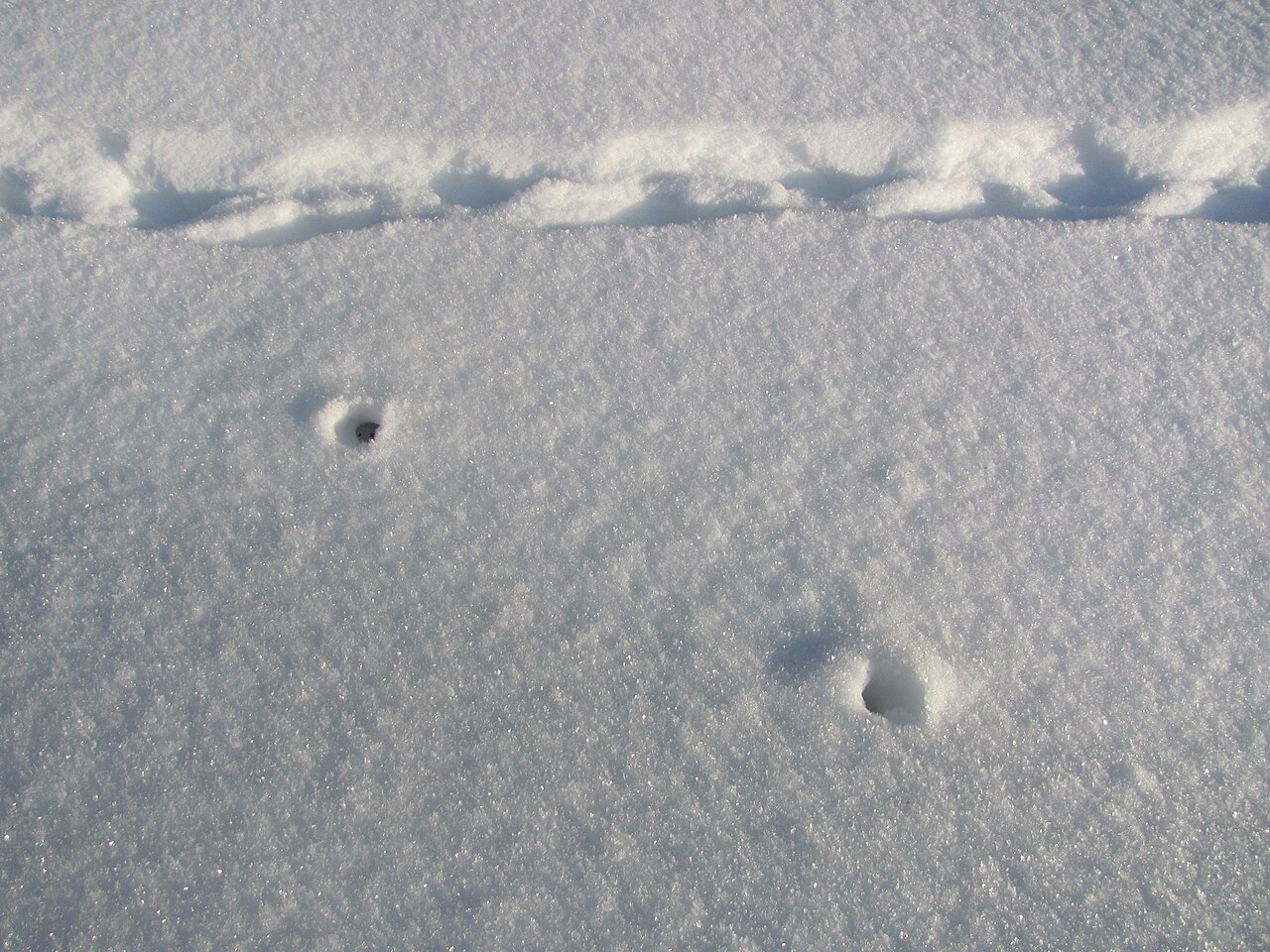
In its habitat

Head close-up
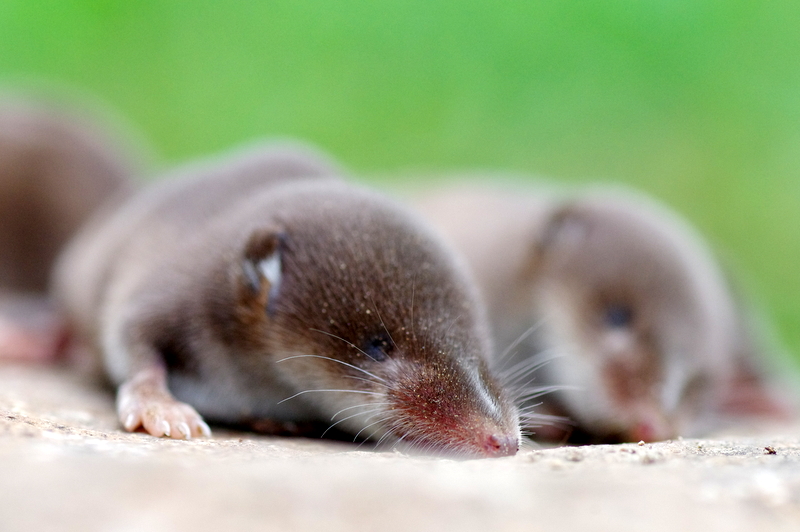
Identification
A mouse-sized shrew with a stocky body; the snout extends into a long, pointed, constantly moving tip with long whiskers, the eyes are small and black and the ears lie almost entirely within the fur. The coat is three-toned; against most other shrews this is the most useful field character, but it does not reliably separate the species from the Crowned Shrew (see Similar species): a dark brown to nearly black back, a distinctly paler reddish-brown flank band and a greyish-white belly, with soft but visible transitions. The tail is shorter than head and body, thick at the base and in young animals densely haired with a tuft at the tip; in old animals it is worn bare, which in the hand gives an approximate indication of age. In the hand the red-brown tooth tips are also visible, coloured by iron in the enamel; this character separates all Sorex species from the white-toothed shrews. Winter animals are clearly smaller than the same animals in the preceding summer.
Similar species
Millet's Shrew (Sorex coronatus) cannot be separated from the Common Shrew in the field. The names suggest that the difference between two and three tones is decisive, but the two species overlap so broadly in coat colour, head-body length, tail length and weight that an individual animal cannot be named; only chromosome or genetic analysis is conclusive. On the Iberian Peninsula the Iberian Shrew (Sorex granarius) is added, which likewise cannot be separated by appearance; a red-toothed shrew from northern Spain can be named there only on the basis of locality. What remains is locality and size, and these should be recorded: 'Common Shrew' within the area where only araneus is known, and otherwise 'Common/Millet's Shrew'. The Pygmy Shrew (Sorex minutus) can be separated: much smaller, with a shorter snout, a proportionally long and thick tail of at least two-thirds of head-body length and a less contrasted coat. The Greater White-toothed Shrew (Crocidura russula) is greyish-brown, sharply two-toned rather than three-toned, has larger protruding ears, white teeth and long loose hairs on the tail. The Water Shrew (Neomys fodiens) is larger, slate-black above and white below, with a keel of stiff hairs beneath the tail. A wood mouse or vole has a blunt muzzle, large eyes and obvious ears.
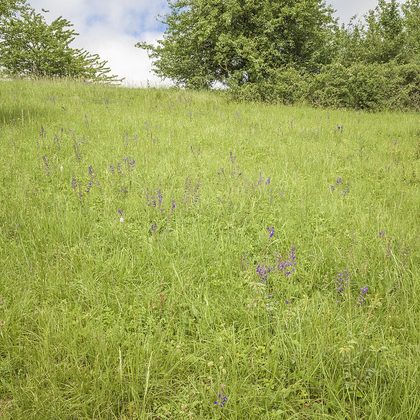
Habitat
Anywhere the ground is damp and the litter layer or vegetation is dense enough to provide cover: broadleaved and mixed woodland, woodland edges, rough herbage, hedge banks, flood-bank verges, rank grassland, reed and sedge fen, young plantations, railway embankments and neglected parts of gardens and parks. The species avoids bare arable land, closely mown grass and dry blown sand. In the mountains it occurs above the treeline wherever there is cover. Density depends mainly on a thick, damp layer of dead plant material with invertebrates.
Where the animal is most at home, classified with EUNIS — the European standard for habitats.





Distribution
From northern Spain and the Alps far into Siberia, and north to the North Cape; one of the most widely distributed mammals in Europe. The species is common in France, the Low Countries, Germany, Poland and Scandinavia, and in Britain on the mainland and on many islands. It is absent from Ireland, the Isle of Man and most of the Scottish outer isles, and also from Portugal. In Spain it occurs only in the eastern (Catalan) Pyrenees, south to the Montseny; it is absent from the Cantabrian Mountains and the Central System, where red-toothed shrews of this type are Millet's or Iberian Shrews. From northern France, Belgium and the southern Netherlands (South Limburg and parts of the south-west) southwards Millet's Shrew also occurs; in that overlap zone an animal is recorded as 'Common/Millet's Shrew' without further examination.
- Native
- dark = core range, pale = thinly spread
Way of life
Active in short cycles of about two to three hours, by day and night, with a slight preference for darkness; a shrew that does not eat for four hours dies. The diet consists of earthworms, beetle larvae, woodlice, centipedes, spiders, small snails and insect larvae, together about its own body weight a day. The species does not hibernate. In autumn the animal shrinks, including spine, organs and braincase, and grows again in spring; this metabolic saving occurs in almost no other mammal. Lifespan rarely exceeds eighteen months: born in summer, overwintering small and sexually immature, adult in spring, and dying in the second summer. From April to September two to four litters of five to seven young follow, after a gestation of about three weeks, in a grass nest under a stump or board. Outside the breeding season the Common Shrew is strictly solitary and defends a territory against conspecifics.
Where and when to look
The species is more often heard than seen. Walk a rank woodland edge or a bank in June and July and listen for the high, rattling shriek close to the ground; this is almost always an encounter between two Common Shrews. Lay sheets of corrugated iron or flat boards in rough ground and dense grass, leave them for a month and lift them carefully: runs converge under such a sheet and droppings lie there. The most reliable method remains the examination of pellets: collect pellets under an owl roost in winter, soak them and look for the jaws with the red tooth tips. In late summer dead shrews are found on paths; this offers the best opportunity to examine one at close range.
Conservation status
Least Concern (2016) and numerous throughout its range; in good years there are dozens of animals per hectare of damp rough ground. The species needs no specific protection but is sensitive to management: flail mowing, cutting an entire site every year, removal of dead wood and drainage remove the litter layer and rough margins, and with them cover and food. This affects shrews faster than larger mammals, because a shrew cannot go a day without food. Domestic cats kill many shrews, but this mortality does not appear to determine numbers. The greatest uncertainty concerns knowledge: because Sorex araneus, Sorex coronatus and Sorex granarius cannot be separated in the field, distribution maps in the overlap zone rest on trapping and laboratory work rather than on sightings.
Scientific name
Sorex araneus | Linnaeus, 1758
Linnaeus described the species in 1758 and placed it straight away in the genus where it still stands. Sorex is the Latin word for a shrew. araneus is Latin for 'spider'. Why Linnaeus chose it is not certain; he probably followed the old name mus araneus for the shrew, whose bite was believed to be as venomous as a spider's. The specimen the first description was based on came from Sweden, Uppsala.