All species › Hedgehogs, shrews and moles › Shrews › Laxmann's Shrew
Laxmann's Shrew | Sorex caecutiens
Noordse spitsmuis | Musaraña Careta
Laxmann's Shrew is a medium-sized Sorex of the northern forests, described in 1788 from the shore of Lake Baikal. Its range extends from Fennoscandia and eastern Poland across all of Siberia to Korea, Sakhalin and the Kuril Islands. In Siberian taiga with a thick moss layer it is often the most numerous shrew; in the European part of its range it is relatively scarce. The Latin caecutiens means 'dim-sighted'.
Tracks
No signs are known that belong to Laxmann's Shrew alone. Runs under the moss, droppings and footprints cannot be separated from those of other Sorex. The species is recorded by trapping studies, mostly with pitfall traps, and in owl pellets, in which Sorex skulls and jaws are recognisable by their red-brown tooth tips; assigning them to this species needs measurements and a specialist key.
Identification
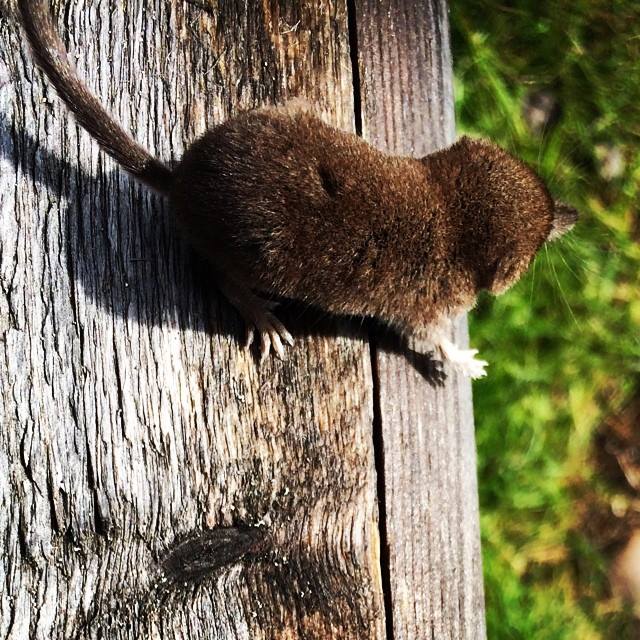
A Sorex intermediate in size between the Pygmy and the Common Shrew. Overwintered animals have a brown back, reddish flanks and a grey belly, often tinged pale yellow; in young animals the greyish-brown back merges gradually into the pale grey belly. A useful character is the tail: sharply bicoloured, in young animals as dark above as the back, in overwintered adults clearly paler than the back. Young of the year weigh about half as much as overwintered adults. The tooth tips are red-brown. The karyotype is 2n = 42. Head-body 5.0 to 7.3 cm, tail 2.8 to 4.5 cm, hind foot 10 to 12 mm, weight 4 to 12.5 g; young animals weigh 4 to 7 g.
Similar species
In northern Europe four other Sorex species live that cannot reliably be told from Laxmann's Shrew in the field. The Common Shrew (Sorex araneus) is larger, with a three-toned coat with a dark back. The Equal-toothed Shrew (Sorex isodon) is larger and uniformly dark. The Eurasian Pygmy Shrew (Sorex minutus) is smaller, with a relatively longer, thick tail and a shorter hind foot. The Eurasian Least Shrew (Sorex minutissimus) is much smaller still, with a tail at most half of head-body length. Because young of the larger species weigh as much in summer as adult Laxmann's Shrews, even in the hand the combination of tail colour, tail length, hind foot and weight is needed, and identification is often only certain from the skull and teeth. White-toothed shrews (Crocidura) are absent from most of the range and are recognised by their white teeth and prominent ears.
Habitat
Its core habitat is Siberian taiga with a thick moss layer, where Laxmann's Shrew is often the most numerous Sorex. In the north it also lives in shrub tundra. In the south of the European part of its range it inhabits old broadleaved forest with little grass or moss in the undergrowth. In the forest-steppe it is scarce. Within these forests it uses damp spots with litter, moss and dead wood, and bog margins.
Where the animal is most at home, classified with EUNIS — the European standard for habitats.



Distribution
From Norway, Sweden and Finland in the west through northern European Russia and all of Siberia to Kamchatka, Sakhalin, Kunashir and possibly Hokkaido, and south to Kazakhstan, Mongolia, north-eastern China and the Korean Peninsula. Eight subspecies are recognised. Two live in the guide area: S. c. laponicus in Fennoscandia, on the Kola Peninsula and in the northern taiga of European Russia east to the Pechora, and S. c. pleskei in the southern forests of eastern Europe, from Poland east to the Urals. At the south-western edge of the range it occurs in the Baltic states, Belarus, north-eastern Poland, including the Białowieża Forest, and northern Ukraine.
- Native
- dark = core range, pale = thinly spread
Way of life
Like other shrews, Laxmann's Shrew alternates short rest periods with active spells around the clock. In summer the longest active phases fall at night; in autumn and winter they shift to the morning. Its food is mainly spiders, centipedes, caterpillars and other larvae, and beetles, in proportions that vary by region: in Karelia it eats mainly adult beetles. In autumn, winter and spring the share of plant food rises steeply in Siberia, up to 73 per cent larch seed in stomach contents in the Kolyma basin. It is solitary. Young animals settle in the second half of summer and hold a territory through the winter; in spring mainly females keep territories and enlarge them with those of departed males, while adult males roam through the territories of several females. In captivity Laxmann's Shrews are less aggressive towards each other than Common Shrews. Mating runs from late April or early May to September, with up to four litters per season and usually five to seven embryos, more in the north. Young females of the year often breed, young males rarely. It does not hibernate.
Where and when to look
In the field Laxmann's Shrew cannot be identified with certainty, because throughout its European range it lives alongside other Sorex species. The best chance of a sighting is in mossy conifer forest and along bog edges in Fennoscandia, where in summer and autumn shrews sometimes dart across an open patch. If you trap shrews under licence, watch the tail: in an adult whose tail is clearly paler below and paler than the back, with reddish flanks, Laxmann's Shrew is a good candidate. Note tail length, hind foot and weight, and have doubtful cases confirmed from the skull. Records from Poland, the Baltic states and Belarus tell something about the south-western edge of the range.
Conservation status
Least Concern (LC, 2016) on the IUCN Red List. In Siberia the species is often dominant or subdominant in the shrew community; in the European part it is relatively scarce. No specific threats to the species have been identified. In the European part of its range it is tied to damp forest with a layer of moss or litter and to bog margins. It is listed on Appendix III of the Bern Convention.
Scientific name
Sorex caecutiens | Laxmann, 1788
Laxmann described the species in 1788 and placed it straight away in the genus where it still stands. Sorex is the Latin word for a shrew. caecutiens is Latin for 'dim-sighted', the present participle of caecutire, 'to be half blind', from caecus, 'blind', after the very small eyes. The specimen the first description was based on came from Russia, Siberia.