All species › Bats › Vesper bats › Greater mouse-eared bat
Greater mouse-eared bat | Myotis myotis
Vale vleermuis | Murciélago Ratonero Grande
The Greater Mouse-eared Bat is the largest bat in Europe. It takes most of its prey not in the air but from the woodland floor, mainly ground beetles. Maternity colonies are located in lofts in central Europe and in caves in southern Europe; winter is spent in caves and quarries. The sister species, the Lesser Mouse-eared Bat, is externally almost identical.

Tracks
Maternity colonies can be recognised by the droppings on the floor of the roost. A maternity colony numbers hundreds to many hundreds of animals and leaves a layer of droppings on the loft floor, sometimes centimetres thick, directly beneath the roosting site; the space smells sharply of ammonia, and the beams beneath the roost are dark and worn smooth. The droppings are large for a bat, a good centimetre long, black and brittle, and crumble into grit in which many glossy, blue-black fragments of ground-beetle exoskeleton are visible under a lens; this is characteristic of the species. Under a regular feeding perch, such as a beam in a barn, a porch or an overhanging rock, lie elytra, pronota and legs of large ground beetles, often Carabus, together in a small pile. Moth wings are much scarcer than under feeding perches of horseshoe bats. In quarries and caves the animals themselves hang: large, pale-bellied, often hanging free from the vault in loose groups, sometimes in clusters of dozens; the silhouette with the broad ears can be recognised at about five metres. On a bat detector the species gives a dry, hard tick, low and broadband; Myotis species cannot, however, be separated on sound alone, so detector records in this genus are not sufficient for identification.

In its habitat

Head close-up

Identification
A large, heavy bat: the forearm measures 55 to 67 mm and weight is 28 to 40 grams. The back is pale greyish brown and somewhat washed-out, and the belly is dirty white to pure white and sharply demarcated from the back, visible on a hanging animal at a few metres. The face is pink to flesh-coloured and almost naked. The ears are large, broad and long, with a long, pointed tragus of about half the ear length; ears and muzzle underlie the English and Spanish names. The wings are broad; the flight is heavy, slow and straight, usually low over the ground, with a searching, almost hovering wingbeat. In a roost the animal often hangs free, in the open space under the ridge or from a vault; in winter both free and in crevices.
Similar species
This is one of the most difficult species pairs in Europe. The Lesser Mouse-eared Bat (Myotis blythii) is the sister species in the southern part of the range (Iberia, southern France, Italy, the Balkans, the Near East); on the Iberian Peninsula the two occur together almost everywhere. The species differ only in averages: the Lesser Mouse-eared Bat is on average slightly smaller, has an on average shorter muzzle and often a pale spot in the middle of the crown. The distributions overlap, the two share caves and maternity colonies, and hybrids have been demonstrated. Without measurements, and usually even with them, an individual animal in the south of the range cannot be named with certainty; record it then as Myotis myotis/blythii. Other large species can be separated: the Serotine is dark brown with a dark face and hunts high and straight along the canopy; the Noctule is red-brown with short, round ears and flies high in open airspace; the long-eared bats have ears almost as long as the body. It differs from the horseshoe bats in lacking a nose-leaf and having a tragus.
Habitat
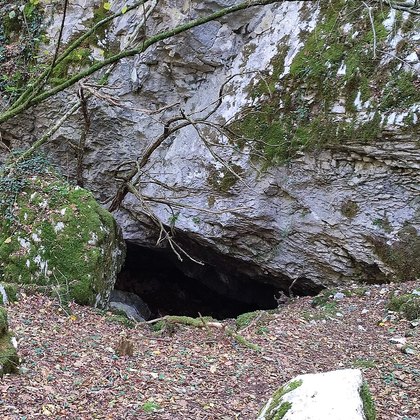
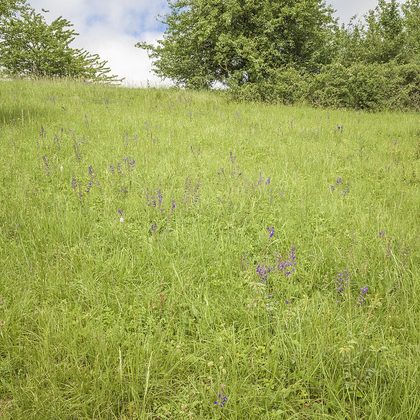
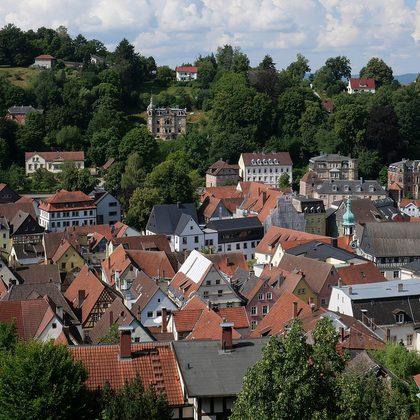
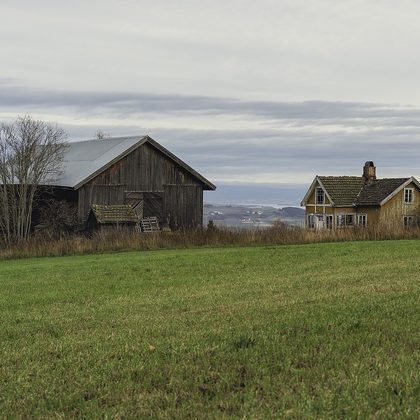
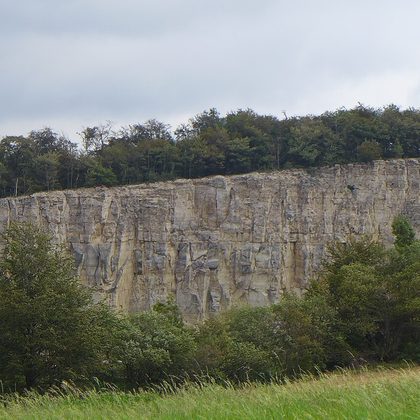
Hunting area and roost make different demands. For hunting a bare, open ground surface is needed on which walking ground beetles can be heard: old beech and oak woodland without undergrowth, open coniferous woodland with needle litter, and freshly mown or closely grazed grassland. A dense herb layer makes an area unsuitable. As a roost, in the north of the range large, warm, draught-free lofts are needed, such as those of churches, monasteries, castles and barns, whereas in southern Europe the maternity colonies hang in caves. Winter is spent in caves, marl quarries, mines and ice houses with high humidity and a stable temperature.
Where the animal is most at home, classified with EUNIS — the European standard for habitats.


Distribution
Central and southern Europe, from northern Spain and Italy to Poland and Ukraine; the northern limit runs through the Netherlands, Germany and Poland. In Britain the species was declared extinct in 1990; since 2002 a single male has hibernated there every year in West Sussex. In the Netherlands the maternity colonies have disappeared, but the marl quarries of South Limburg are still one of the most important hibernation sites in north-western Europe, used by animals that spend the summer in Belgium and Germany. In Belgium a small population survives in Wallonia and Limburg. South of the Ardennes the species rapidly becomes more numerous; in France, Spain and Italy it is one of the most numerous large bats. On the Iberian Peninsula it occurs almost everywhere, with maternity colonies in caves and buildings in Andalusia, Extremadura, Castile, the Iberian System, Catalonia, Navarre and along the Cantabrian coast, and also on the Balearics; because it shares colonies with the Lesser Mouse-eared Bat in many caves there, Spanish counts are usually published as Myotis myotis/blythii.
- Native
- dark = core range, pale = thinly spread
Way of life
Nocturnal; the animals emerge late and hunt up to twenty-five kilometres from the colony, a long distance for a bat. The species hunts by listening: flying low over the ground it picks up the sound of large, walking invertebrates and drops onto them. The diet therefore consists mainly of ground beetles, supplemented with cockchafers, craneflies, mole crickets, spiders and moths. In April and May the females form large maternity colonies, in lofts in central Europe and in caves in the south; one young is born in June and flies after just over three weeks. Males spend the summer alone or in small groups. From October to April there is hibernation in quarries or caves, where animals from hundreds of kilometres away gather; in late summer they swarm at the entrances, where mating also takes place. The species can live long: an age of thirty years has been recorded.
Where and when to look
In the north-west of the range the species is rare; it is easier to find in Wallonia, the Eifel, France and Spain. In Spain caves with known colonies in Extremadura, Andalusia, Aragón and Catalonia are suitable; the emergence can be watched at dusk from outside the cave. On a summer evening at a large church or monastery loft with a colony, the animals emerge one by one at dusk and fly heavily and low towards the woods. Ask permission and stay outside. Never enter a hibernation site yourself: disturbance during hibernation can kill animals and is illegal almost everywhere. Look instead under canopies and porches for small piles of ground-beetle remains; that sign indicates the species even where no bat has been seen.
Conservation status
Least Concern (2016) globally. In southern Europe the situation is reasonably favourable; in north-western Europe, at the edge of the range, the species has declined sharply. In Britain it was declared extinct in 1990; the single male that has hibernated there since 2002 is the smallest mammal population in Europe. In the Netherlands the maternity colonies disappeared during the twentieth century, and in central Europe numbers halved between 1950 and 1980 through the sealing of lofts, the use of timber-treatment chemicals on roof beams, disturbance of hibernation sites and the loss of open woodland floor and extensively grazed grassland. Since the 1980s the species has been recovering in Germany, France and Switzerland, as maternity roosts are protected and quarries are closed with bat-friendly grilles. In Spain the threats are the tourist development and closure of caves, visits during the breeding or hibernation period, renovation of lofts without mitigation, the loss of grazing that kept grassland short, and the decline of large ground beetles due to pesticides. Because large numbers are concentrated in a few caves, a single disturbance can have major consequences. The species depends on accessible buildings and on an open woodland floor. The species is listed in Annexes II and IV of the Habitats Directive, which requires the designation of Special Areas of Conservation for it, and is covered by the Bern Convention and the EUROBATS Agreement.
Scientific name
Myotis myotis | (Borkhausen, 1797)
Borkhausen described the species in 1797 as Vespertilio Myotis; because it was later moved to another genus, the author and year stand in brackets. Myotis is Greek, from mys, genitive myos, 'mouse', and ous, genitive ōtos, 'ear': 'mouse-ear'. The specific name repeats the genus name. The specimen the first description was based on came from Germany, Thuringia.