All species › Bats › Vesper bats › Whiskered bat
Whiskered bat | Myotis mystacinus
Baardvleermuis | Murciélago Ratonero Bigotudo
The whiskered bat is a small Myotis of woodland edges, villages, gardens and waterside habitats across much of Europe, extending to Anatolia, the Caucasus and northern Morocco. It gives its name to a group of species that are barely separable externally: Brandt's bat was recognised as a separate species in the 1970s, Myotis alcathoe in 2001, and populations in the Near East are now assigned to M. davidii. What older literature lists as 'whiskered bat' may therefore refer to more than one species.

Tracks
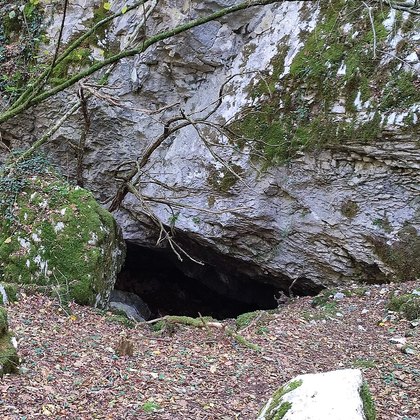
In buildings the bats roost in small cavities, cracks and gaps, behind cladding and shutters, under roofs and in cavity walls; elsewhere in rock crevices, under bridges, in tree holes and in bird and bat boxes. Beneath such a crevice there is sometimes a small amount of droppings: dark, dry pellets a few millimetres long that crumble into insect fragments. Because a colony changes roost frequently, the piles stay small. In winter the bats hang singly or in small groups in caves, mines, tunnels and crevices. On summer evenings the species can be seen at emergence, around sunset or up to about half an hour later, and hunting in agile flight along hedges, woodland edges and over calm water.
Identification
One of the smallest Myotis species of the guide area: forearm 32 to 36.5 mm, weight 4 to 7 g. The fur is long; the back is dark brown to brown, in some individuals tipped reddish or golden, the underside greyish. Face, ears and wing membranes are dark to black. The ears are fairly long, with four to five transverse folds, and when laid forward extend more than 2 mm beyond the muzzle; the tragus is long, narrow and pointed. The wing attaches at the base of the toes, and the foot is small compared with that of Daubenton's bat. Juveniles are darker than adults, from blackish to grey. Echolocation consists of frequency-modulated calls of 3 to 6 ms, starting at 75 to 120 kHz and ending at 28 to 30 kHz; this pattern is similar in all small Myotis species.
Similar species
The whiskered bat belongs to the mystacinus complex, which has been split into several species over recent decades. Brandt's bat (M. brandtii) is on average slightly larger (forearm 33 to 38 mm), often has a golden sheen on the back and paler skin at the base of the ear; the reliable characters are the shape of the penis and the structure of the small upper premolars, which are relatively tall in Brandt's bat. Myotis alcathoe is smaller and has paler, browner facial skin; M. davidii replaces or overlaps with the whiskered bat in the Near East, where the boundary between the two has not yet been established. Among these species the identification of a female or a juvenile in the field is often not conclusive, and where they occur together, DNA is usually needed for certain identification of the split-off species. An observation without the bat in the hand or without genetic material is then recorded as Myotis mystacinus group. Daubenton's bat (M. daubentonii) has a pink to light brown face, a paler underside and clearly larger feet. On a bat detector the whiskered bat cannot be reliably separated from other small Myotis species.
Habitat
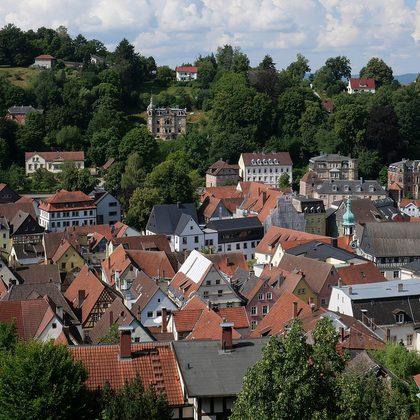
The species uses a wide range of landscapes: semi-open farmland with hedges and tree lines, woodland edges, orchards, gardens, villages and the banks of still and slow-flowing water. In the south of its range it is more closely tied to woodland (beech, oak and coniferous forest). It occurs from sea level to over 2000 m, for example in the Moroccan Rif and High Atlas. Summer roosts are in buildings, rock crevices, under bridges, in trees and in boxes; winter roosts in caves, mines, tunnels and rock crevices at 2 to 8 °C with high humidity. Heaps of large boulders can also serve as hibernation sites.
Where the animal is most at home, classified with EUNIS — the European standard for habitats.




Distribution
As currently defined, the whiskered bat occurs in Europe up to about 64°N, from southern Scandinavia to the north of the Iberian Peninsula and Greece, including Corsica and Crete; one form (M. m. caucasicus) in Turkey, Lebanon and the Caucasus into northern and north-eastern Iran, and one form (M. m. occidentalis) in the south of the Iberian Peninsula and northern Morocco. In Africa the species is known from only a few localities. Because the related species were split off only recently, older distribution data cannot always be assigned to a single species, and in the Near East the boundary with M. davidii is still unclear.
- Native
- dark = core range, pale = thinly spread
Way of life
The whiskered bat hunts in agile flight for flying insects averaging about 7.5 mm: mainly midges and other flies, hymenopterans and moths, to a lesser extent beetles, and also spiders and caterpillars taken from leaves. The bats travel up to 5 km in the evening to their foraging area, which averages about 230 ha; occasionally they hunt in daylight. Maternity colonies usually number 20 to 60 females, sometimes several hundred, and are often shared with common pipistrelles; males spend the summer alone, except in the Balkans, where small mixed colonies occur. Young are born between mid-June and July. Mating takes place from late July, at swarming sites in front of caves in autumn and in hibernacula into early spring; embryonic development begins only after hibernation. Females are sexually mature at one year. The species is sedentary or a short-distance migrant, usually moving no more than 50 to 100 km; the longest known movement is 625 km, in France. The maximum known age in the wild is 23 years.
Where and when to look
On summer evenings you can watch hunting bats along hedges, woodland edges and over ponds and streams. A bat detector shows that it is a small Myotis, but not which one; record an observation without the bat in the hand as Myotis mystacinus group. Certain identification rests on characters of the teeth and penis, examined only during licensed trapping studies, and in parts of the range on DNA. Hibernation sites are not entered in winter; disturbance costs the bats fat reserves.
Conservation status
Least Concern (LC, 2016). The species is widespread and no range-wide threats have been identified. Following the split of Brandt's bat and M. alcathoe, a reassessment is needed. Local declines have been reported due to roost loss, disturbance of underground roosts and the conversion of orchards to housing. In North Africa the species is used in traditional medicine; at present this is not considered a threat. Populations in Great Britain and Germany appear stable. The species is listed in Annex IV of the Habitats Directive and is covered by the Bern Convention and the EUROBATS Agreement.
Scientific name
Myotis mystacinus | (Kuhl, 1817)
Kuhl described the species in 1817 as Vespertilio mystacinus; because it was later moved to another genus, the author and year stand in brackets. Myotis is Greek, from mys, genitive myos, 'mouse', and ous, genitive ōtos, 'ear': 'mouse-ear'. mystacinus means 'moustached', from Greek mystax, 'upper lip, moustache', after the dark hair around the muzzle; it is not an eponym. The specimen the first description was based on came from Germany, Hanau.