All species › Lamiales › Rainbow plant family › Byblis pilbarana
Byblis pilbarana
Of all Australia's carnivorous plants, this one grows in the least likely place. The Pilbara is among the hottest regions on earth, with summers running towards fifty degrees and rainfall of around three hundred millimetres a year. Yet a Byblis grows there: Byblis pilbarana holds on in moist crevices at the foot of the rocky hills that stand like islands above the plain. It is the only carnivorous plant confined to the Pilbara and at the same time the worst-documented species of the genus — its description appeared in 2014 in a book work that is not available online.
Identification
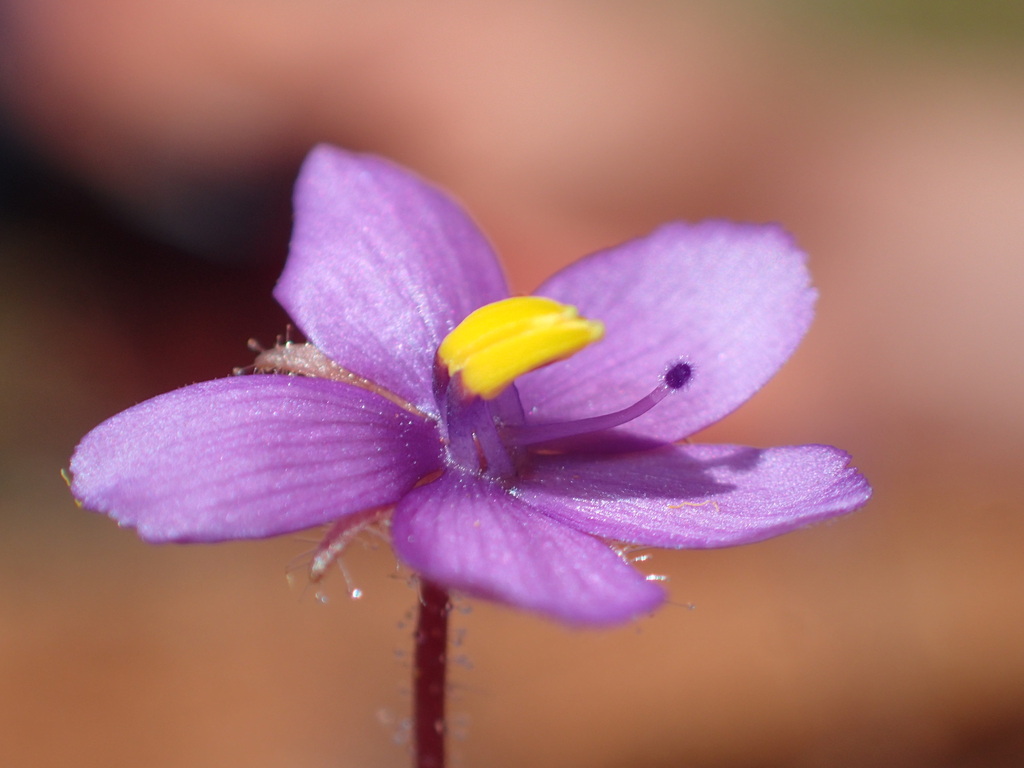
What can be said with certainty about its build is limited, and that here is not negligence but the state of knowledge. It is an erect plant with a stem that is strikingly short and thick for the genus, which makes it look more compact than its northern relatives. The leaves are, as in all Byblis, thread-shaped, round to elliptic in cross-section and set along their whole length with stalked sticky glands and, between them, smaller sessile glands; in strong light the green turns reddish. The five stamens curve to one side and the anthers are longer than the filaments — the only floral character known from a verifiable source, and one that places the species with B. filifolia and B. rorida rather than with the small-flowered B. liniflora. Reliable measurements for plant, leaf and flower are missing from the accessible literature, so those fields are left empty here.
Similar species
Within its country there is no other Byblis to confuse it with: this is the only species of the genus in the Pilbara, and the nearest relatives stand hundreds of kilometres to the north. On paper the comparison is harder. Byblis filifolia reaches the neighbourhood of Port Hedland and likewise has anthers longer than the filaments; it grows far larger and taller, however, and has no short, thick stem. Byblis rorida is recognised by the long glandular setae of 0.7 to 1.5 mm on the sepals. According to its describer, the separation of this species rests mainly on the seed. A record is therefore only solid with photographs of plant, calyx and seed attached.
The trap and how it works
A passive flypaper trap, exactly as in the other species of the genus. The stalked glands each carry a clear droplet; neither leaf nor gland moves and no stimulus is processed. Insects touching the droplets are held fast and, in struggling, reach only more sticking points. Digestion is the work of the far smaller sessile glands between the stalks, which release enzymes once prey is lying on them and then take up the liberated nitrogen and phosphorus. In this setting the strategy makes particular sense: these are thin, leached soils in rock crevices, where nitrogen and phosphorus are hardly to be had and where insects do gather in numbers at what little water there is.
Habitat and ecology
Moist crevices and fringes along the margins of inselbergs: isolated rocky hills standing above the semi-desert plain, where rainwater runs off the stone and lingers in the joints. Only in such places, in a region with three hundred millimetres of rain, is there moisture for long enough to carry an annual carnivorous plant through its growing season. The soil is thin and sandy and dries out completely outside the wet window. In the fixed codes: wet rock with seeping water (R1) in a seasonally dry landscape (D4) on sand (D1).
Distribution and elevation
The Pilbara in Western Australia, with the best-known site on an inselberg south of Port Hedland. The herbarium additionally records the species from Dampierland and from the Great and Little Sandy Deserts, so the picture is wider than that single hill, but sparse everywhere. It is therefore endemic to Australia and within Australia confined to the dry north-west. No reliably documented altitudinal limit exists; the elevation field is left empty.
- Recorded (one-degree cells)
Forms and variation
Nothing has been published on wild variation, and with a handful of known sites nothing is to be expected. The greenish leaves turn reddish in strong light, but that is a response to the site and not a form. What is at issue is whether the species holds up at all: field workers who have examined all the north-western populations consider it possible that B. pilbarana, together with B. filifolia, B. rorida and B. guehoi, forms one highly variable species. That is a hypothesis; for now the Australian census lists accept the species as it stands. No varieties, colour forms or natural hybrids have been described.
Where and when to see it
The southern winter and early spring, roughly June to September, are the only workable window: the heat is bearable then and flowering plants have been reported in August. Search not on the plain but at the foot and along the edges of rocky hills, where run-off water collects. Bear in mind that the groups are very small — at the best-documented site twenty to thirty plants were counted and nothing at all elsewhere on that hill. Do not walk through the crevices themselves, because an entire population may stand within a few square metres; record and photograph from the edge.
Conservation status
The Red List treats the species as Least Concern, and the Western Australian Herbarium likewise records it as not threatened; that judgement rests on herbarium records from several regions of the dry north-west. In the field the picture looks tighter: the only well-described site held a few dozen plants. The Pilbara is moreover a mining landscape, and the rocky hills the species depends on are precisely where iron ore is extracted. Changes in run-off along those margins and in the fire regime of the surrounding spinifex country are the factors to follow.
Scientific name
Byblis pilbarana | Lowrie & Conran, 2014
Described by Allen Lowrie and John G. Conran in 2014. The species was discovered near Port Hedland in Western Australia, with the first finds on the north-eastern edge of 'Red Rock', where 20 to 30 plants were recorded at the time. The species name pilbarana refers to the Pilbara region of Western Australia, where the species occurs.
World Checklist of Vascular Plants (WCVP), via Plants of the World Online (POWO), Royal Botanic Gardens, Kew.