How the traps work
Each species' fact card names a trap mechanism in one word — snap trap, pitfall trap, flypaper trap. This page goes one layer deeper: for each genus in this guide, what actually happens mechanically, chemically and physiologically between the first contact with prey and the uptake of nutrients. It is the same question, answered ten different ways — often by independently evolved solutions to the same problem. For what falls just outside these ten genera, see the page on Utricularia and the edge cases.
Cephalotus — the pitfall trap, reinvented
The entrance of Cephalotus follicularis's pitcher is a thickened, ribbed collar with inward-pointing, claw-like teeth interspersed with nectar glands; behind it lies a band of small, downward-facing papillae that make climbing back out nearly impossible. The lid keeps rainwater out — so the digestive fluid stays undiluted — and carries alternating translucent and dark red patches: the translucent "windows" look like an exit from inside, so trapped insects fly at them again and again and fall back in. Further down the wall is smooth, so prey slides off; at the base, two kidney-shaped, dark red glandular zones probably supply both the fluid and the digestive enzymes (esterases, phosphatases and proteases) and absorb the resulting nutrients. Genetically this is an independent reinvention of the pitfall trap: Cephalotus belongs to the Oxalidales, a wholly different order from the Nepenthaceae and the Sarraceniaceae, and is — together with the bromeliad Brocchinia — one of only two carnivorous plants outside the Lamiales, Caryophyllales and Ericales. Genomic studies show that these independent lineages still mostly recruited the same gene families to build a pitfall trap — as if there were only a limited number of ways to invent carnivory.

Drosera — two speeds of glue
Sundews combine two movements on very different timescales. A single tentacle touched by prey bends inward extremely fast — within a fraction of a second in D. glanduligera, within seconds in most species — driven by an action potential that ends at the base of the tentacle and triggers the movement there. Only afterwards, and only when a chemical cue is added, does the slower response follow: the whole leaf curls around the prey, taking around half an hour in D. capensis; some species, such as D. filiformis, cannot bend their leaves at all. That slow movement is driven by auxin, which pumps protons into the cell wall, lowers its pH and activates the wall protein expansin — making cells on one side of the leaf stretch faster than the other, so the leaf bends. Electron microscopy shows the glue itself contains a network of nanofibres and nanoparticles, including calcium, magnesium and chlorine, which increase its toughness and stretch — the mucilage can stretch to nearly a million times its own volume without breaking. Prey usually suffocates within about fifteen minutes as the sticky layer clogs its spiracles; the leaf then secretes esterase, peroxidase, phosphatase and protease to digest it.

Dionaea — counting, snapping, digesting
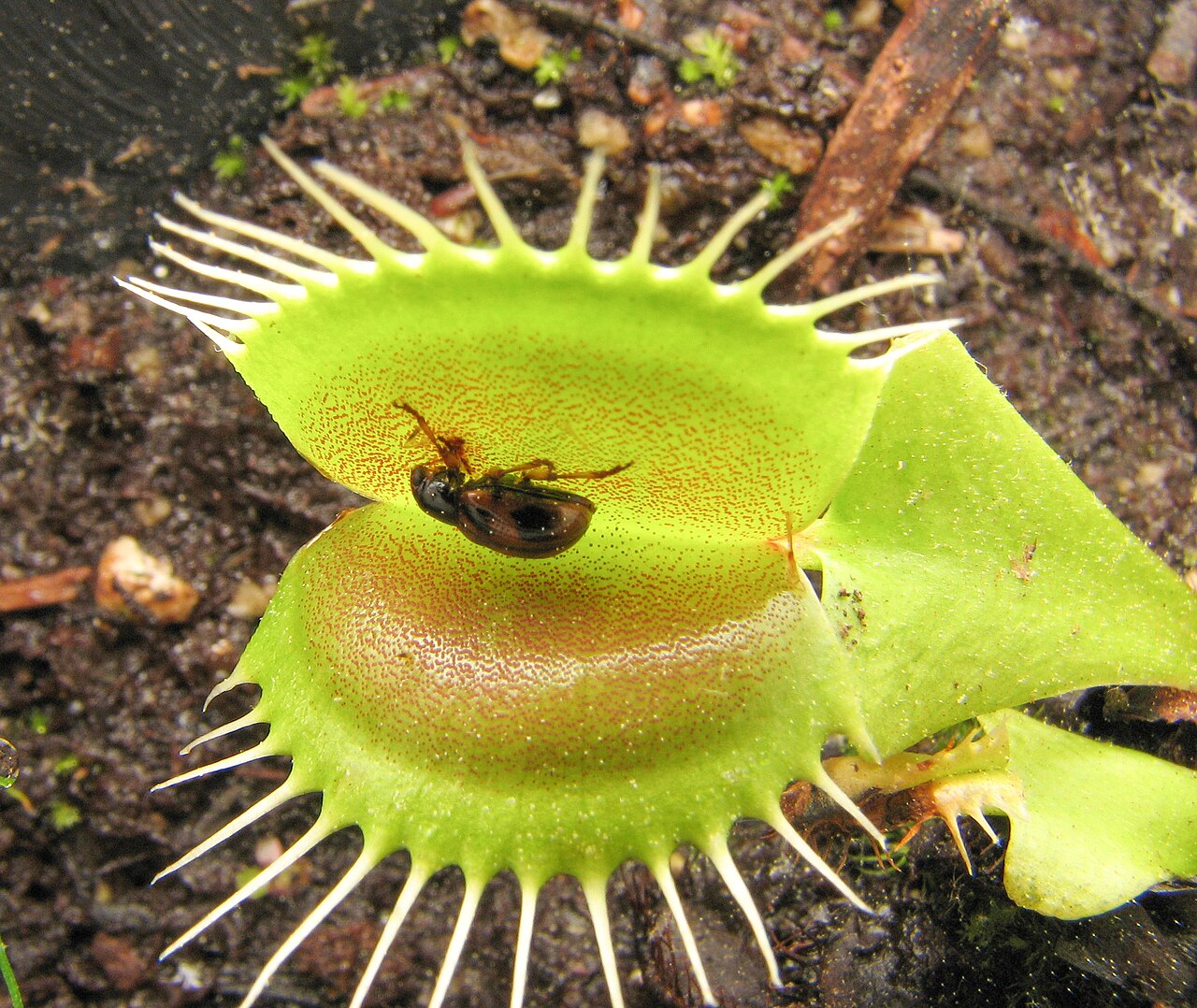
The Venus flytrap only closes once two of its six trigger hairs are touched within about twenty seconds, or the same hair twice in quick succession — a double threshold that stops the trap snapping shut on raindrops or dust. The plant "remembers" the first touch for a few seconds, a form of short-term memory that rests on an electrical signal. On the second stimulus, an action potential carrying calcium ions races across both lobes; under the so-called acid-growth theory, cells in the outer layers then pump protons into their cell wall, acidifying and loosening it so it rapidly takes up water. This makes the two lobes suddenly flip from convex (open) to concave (closed) — a mechanically unstable transition, comparable to an inverted contact lens, which Forterre and colleagues described in a 2005 paper in Nature as an elastic buckling or "snap-buckling" movement. The whole closure takes roughly a tenth of a second. Only once the trigger hairs have been stimulated five times in total, usually because the trapped prey keeps struggling, does the production of digestive enzymes begin, controlled by jasmonic acid — the same hormone ordinary plants use to defend themselves against being eaten.
Nepenthes — slipping, sticking and lodgers
The rim of the pitcher, the peristome, is often brightly coloured to attract prey, but offers no grip at all: once condensation forms a thin film of water on it, insects can no longer walk on it and slide inside — an effect the literature calls "aquaplaning". Anything that survives that lands on a waxy, mirror-smooth inner wall on which holding on is nearly impossible. At the bottom waits a fluid that is not simply water: it contains viscoelastic biopolymers that keep their stickiness "even when significantly diluted by water", plus at least 29 digestive proteins, including proteases, chitinases, pathogenesis-related proteins and thaumatin-like proteins. Naphthoquinones in the fluid suppress bacteria and fungi that would otherwise compete with the plant for the nutrients. In a few species this trap has grown into a genuine relationship with an animal: N. bicalcarata houses the carpenter ant Camponotus schmitzi in its hollow tendrils, which removes large prey before it can putrefy; N. lowii rewards tree shrews with a sugary exudate on its lid and, according to a 2009 study, gets between 57 and 100 percent of its leaf nitrogen from their droppings; and the pitcher of N. hemsleyana is shaped to reflect sound like an acoustic mirror, tuned precisely to the echolocation of the woolly bat that roosts inside it by day and leaves its droppings behind.

Drosophyllum — glue without movement
Unlike Drosera, no part of Drosophyllum lusitanicum's trapping leaves moves at all: the glandular hairs constantly ooze a sticky droplet and simply wait. The outward-curled shape of the young leaf ("circinate vernation", the same principle as an unrolling fern frond) is a fixed growth trait, not a response to prey. An insect that gets stuck becomes further entangled through its own struggling and dies of exhaustion or suffocation; only then does the leaf secrete enzymes that dissolve it. What makes this species genuinely unusual is its habitat: of all the flypaper-trap plants, this is almost the only one that grows in dry, well-drained soil — gravel or shale substrates, often rich in silicon, in clearings among scrub and pine forest, rather than the waterlogged, nutrient-poor ground most other carnivorous plants depend on. Genetically, Drosophyllum is more distant from Drosera than the resemblance suggests: molecular evidence places the genus instead alongside the Dioncophyllaceae and Ancistrocladaceae — the family of Triphyophyllum, one of the borderline cases on the edge-cases page. The passive flypaper trap was therefore invented twice, independently: here, and, driven quite differently, in Drosera.

Darlingtonia — a window that is not a door
The cobra lily does not lure prey with a conspicuous scent but with the shape of its hood itself: the curved, snake-head-like top carries several translucent "false exits" that insects fly at again and again looking for a way out, until they fall down exhausted. The forked "tongue" protruding from the opening has long been regarded as a landing pad for prey, but research in which the tongue was removed showed this makes no difference to the amount of prey biomass caught — the actual function of that appendage therefore remains unsettled. What clearly does work: smooth walls and hairs inside the tubular pitcher make climbing back out nearly impossible, the curled lid (operculum) hides the real opening, and downward-pointing hairs push prey further into the trap — the same building blocks used by Sarracenia, its closest relative within the trumpet-pitcher family. It was long assumed that Darlingtonia, like Heliamphora, relies almost entirely on bacteria and other residents of the trap fluid for digestion; more recent research shows the plant does in fact secrete at least one proteolytic enzyme of its own, alongside whatever the microbes contribute.

Sarracenia — four zones, perhaps a narcotic
A trumpet pitcher's tube is built in zones, each with its own job. At the top, the peristome lures insects with nectar and scent onto a smooth, unreliable rim. Anyone who walks further in reaches a zone of tiny, downward-pointing hairs that cut off any way back, and below that a zone of coarser, also downward-pointing hairs that make climbing back out of the digestive fluid impossible. The alkaloid coniine — known as the poison in hemlock — has been found in the nectar of S. flava and, it later turned out, seven other species; concentrated extracts paralyse ants in the lab, but it has not been demonstrated that coniine at the concentrations naturally present in the nectar actually narcotises insects. Researchers suspect a dual role, as both attractant and narcotic, but that remains a hypothesis for now. Actual digestion combines the plant's own enzymes, secreted by glands in the upper zones, with the bacteria living in the fluid at the bottom. In S. purpurea, rainwater fills the tube, creating a complete, small-scale food web of invertebrates and bacteria in that fluid — a system biologists use to study, in miniature, the nutrient cycling of a whole ecosystem. S. psittacina takes a different approach entirely: instead of an upright tube, this species has a low-lying, parrot's-beak-shaped lobster-pot trap, with inward-pointing hairs that block the way back out; when flooded, it catches tadpoles and small fish alongside insects.

Heliamphora — an overflow and borrowed enzymes
Where Sarracenia, Darlingtonia and Nepenthes let fluid build up until the pitcher would overflow, Heliamphora is the only one of the three genera in the trumpet-pitcher family to have a small drainage hole, or, in one group of species, a slit in the side, that keeps the fluid level constant like a sink overflow. A lid is entirely absent; instead, a small "nectar spoon" at the top of the leaf lures insects to the rim, after which downward-pointing hairs force them further into the tube. The most distinctive feature lies in digestion: of the roughly 24 species, 23 lack the ability to make their own digestive enzymes and depend on symbiotic bacteria to break down prey. Only H. tatei is the exception: this species does produce its own proteolytic enzymes and also has wax scales that improve the trap. That makes Heliamphora a rare example, within a single genus, of how carnivory can shift from "let the bacteria do the work" to "do it yourself" — exactly the two strategies also discussed for Darlingtonia above.

Byblis — glue that moves a little after all
At first glance Byblis looks strikingly like Drosera and Drosophyllum: thread-like leaves covered in glistening sticky droplets. The resemblance is misleading, though — rainbow plants belong to the order Lamiales, while sundews and the Portuguese sundew sit in the Caryophyllales; this is the third time on this page that the same flypaper trap has been independently invented. The leaf carries two types of glands: stalked glands that supply the sticky droplet, and sessile glands, five to ten times more numerous, that secrete the digestive juices. A 2005 study showed that Byblis genuinely digests its own prey with enzymes from those sessile glands — so this is not a purely passive, waiting plant. What is more, it later emerged that B. liniflora's tentacles do in fact move: as soon as they detect food, they collapse inward and bring the prey into contact with the digestive glands — an active response that makes the older classification as a "purely passive flypaper trap" outdated, and one that, quite separately from Drosera, evolved an active mechanism all over again. As with Roridula (see the edge-cases page), every Byblis species hosts a specialised assassin bug of the genus Setocoris, which feeds on the trapped prey alongside the plant — with the difference that Byblis, unlike Roridula, also digests independently and so does not depend on the bug.

Pinguicula — glue without jasmonic acid
The leaf of a butterwort carries two types of glands that act one after the other. Stalked glands, with a few secretory cells on a single stalk cell, produce the constantly visible, glistening mucilage droplets that attract insects — probably because the leaf then looks as though it is wet. Once prey gets stuck, reservoir cells at the base of those same glands release extra mucilage, while the struggling only activates more glands. Only once digestion is under way and nitrogen is released do the sessile glands — lying flat against the leaf surface — spring into action, secreting eight enzymes including amylase, esterase, phosphatase, protease and ribonuclease. Some species can also curl the leaf edge slightly inward through a slow, thigmotropic response to touch, bringing more glands into contact with the prey; exactly how long that curling takes is not recorded. What Pinguicula notably does not do stands out: unlike Dionaea and Drosera, which control digestive-enzyme production via jasmonic acid, butterworts do not appear to use that hormone for it — the same end result, reached by a different biochemical route.

Add up the mechanisms and a pattern emerges: the same five solutions — snapping, drowning, sticking, passively or actively — keep reappearing in genera that are not related to one another. The flypaper trap alone has been independently invented three times within this guide (Drosera, Drosophyllum, Byblis), and the pitfall trap twice more (Cephalotus versus the trumpet-pitcher family and Nepenthes). What differs is often not the trap itself but who does the final, chemical part of the job: the plant with its own enzymes, controlled by jasmonic acid or not, or a lodger — a bacterium, a bug, a tree shrew — that takes over or supplements digestion.