All species › Caryophyllales › Sundew family › Drosera aquatica
Drosera aquatica
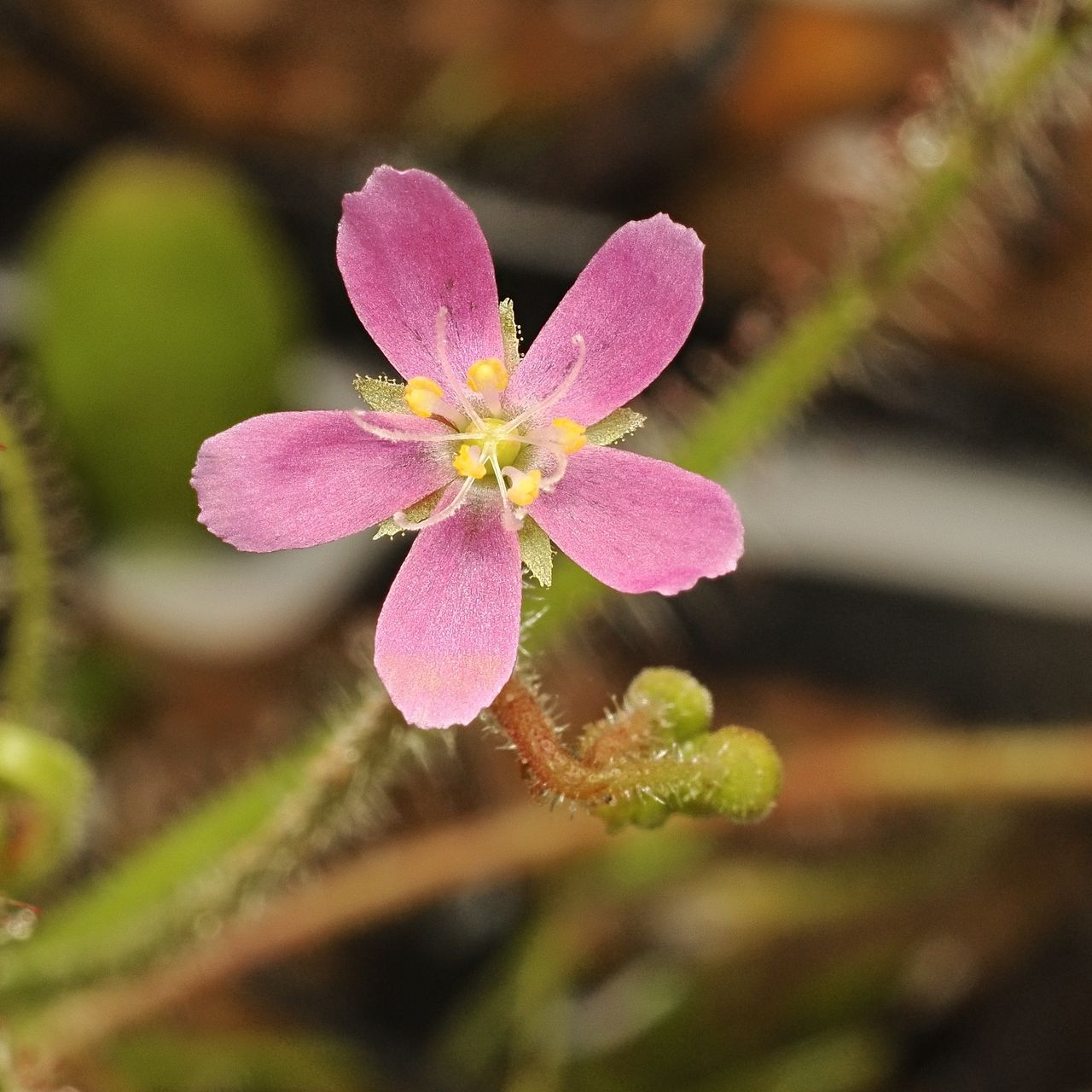
A sundew that can float. Drosera aquatica was described in 2014 by Allen Lowrie in his Carnivorous Plants of Australia Magnum Opus, and takes its name from a trait that is exceptional in the genus: the plant can live entirely in water, floating on the surface of the monsoon floodwaters. Note that it is not a south-western species but one from tropical northern Australia.
Identification
An annual sundew of section Arachnopus, the group around Drosera indica. Plants of that section usually have an erect or sprawling stem with long, narrow, linear leaves covered along their whole length with stalked glands, and bear flowers in racemes opposite the leaves. Specific measurements, flower colour and flowering time of D. aquatica could not be found in the sources accessible for this guide; Lowrie's description (2014) is, as far as known, the only detailed source, so all measurement fields are left empty.
Similar species
Within section Arachnopus Lowrie described several new species in 2014 that at first sight resemble one another and Drosera indica, including D. aurantiaca, D. barrettiorum, D. cucullata and D. glabriscapa. Floating or submerged growth in floodwater is the most distinctive feature of D. aquatica; reliable identification requires flower and seed characters from the original description.
The trap and how it works
An active flypaper trap spread along long, narrow leaves. The stalked glands carry sticky droplets in which small flying insects become stuck; the tentacles then bend towards the prey and secrete digestive enzymes. How capture works when the plant floats or stands partly submerged has, as far as known, not been studied; the glands above water in any case function as ordinary flypaper traps.
Habitat and ecology
Seasonal waters of the monsoon climate (W7): depressions and flats that flood in the wet season and dry out completely in the dry season. The plant grows there as an annual: it germinates with the rains, grows and flowers during the wet season and dies when the water disappears, leaving only seed to bridge the dry season.
Distribution and elevation
Endemic to northern Australia: the Northern Territory and the north of Western Australia. For Western Australia FloraBase lists the Darwin Coastal, Northern Kimberley and Victoria Bonaparte bioregions, in the far north-east of the state. The label 'south-western Australia' in the base list is therefore incorrect.
- Recorded (one-degree cells)
Forms and variation
No subspecies or varieties have been described. The species belongs to a group that until recently was largely lumped under Drosera indica; in 2014 Lowrie split it into a series of separate species. How stable that classification is remains for further study to show.
Where and when to see it
The wet season in the tropical north runs roughly from December to April; then the depressions are flooded and the chance of finding this species is greatest. Many of those areas are hard to reach at that time because of flooding. Be aware of crocodiles near water in this part of Australia, and do not enter Aboriginal land without permission.
Conservation status
Assessed as Least Concern (LC) on the IUCN Red List and listed as not threatened in Western Australia. Not in CITES. Because the species was described only in 2014 and the area is remote, little is known about numbers and trends. This text rests on the brief data in FloraBase and Wikipedia; Lowrie's original description (2014) is the only detailed source and could not be consulted for this guide.
Scientific name
Drosera aquatica | Lowrie, 2013
Described by Allen Lowrie, described December 2013, published 2014, in "Carnivorous Plants of Australia Magnum Opus", volume 3, p. 1268. The precise type locality could not be established. The species is endemic to the Northern Territory and Western Australia (Kimberley region). From the Latin aquatica ("living in water") — refers to its aquatic growth habit: the plant can grow fully submerged or floating on the surface of floodwaters during the Australian monsoon.
World Checklist of Vascular Plants (WCVP), via Plants of the World Online (POWO), Royal Botanic Gardens, Kew.