All species › Caryophyllales › Sundew family › Drosera burkeana
Drosera burkeana
A small, inconspicuous rosetted sundew with an enormous range: from southern Africa into the tropics, and on Madagascar. Drosera burkeana was described in 1848 by Planchon from material collected by Joseph Burke, who gathered plants in the South African interior in the 1840s. It is a sundew of the wet summer in grassland.
Identification
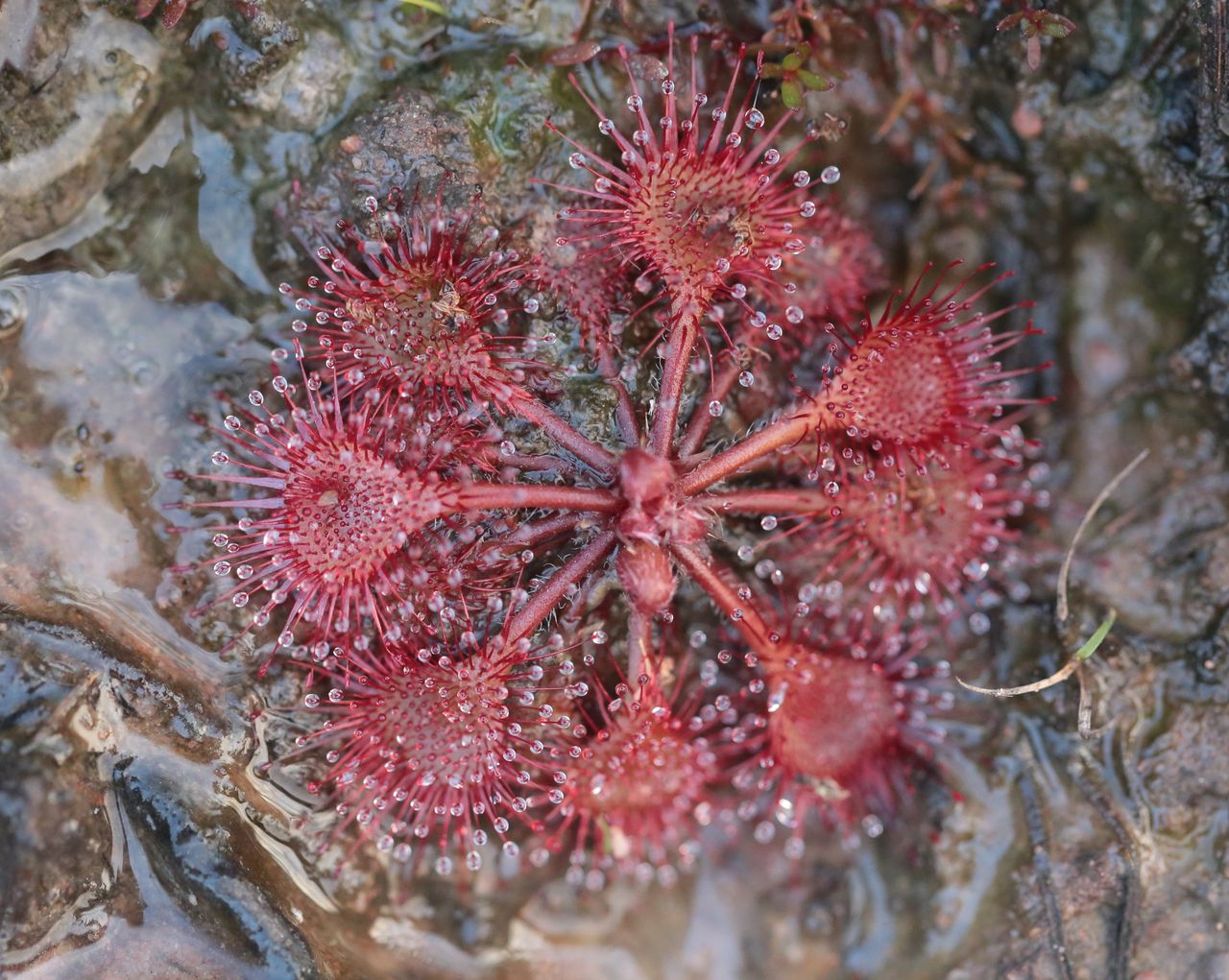
A flat rosette of short, broad, obovate to almost round blades on a short petiole, with red tentacles. The scape rises from the centre of the rosette and carries a few white to pink flowers. Reliable published measurements were not available for this text; the measurement fields are left empty.
Similar species
Drosera dielsiana, D. collinsiae and D. natalensis have longer, more spatulate leaves. Drosera madagascariensis forms a stem with scattered leaves on long petioles. Outside Africa the round blade superficially resembles that of D. rotundifolia, but that species does not occur in Africa.
The trap and how it works
An active flypaper trap. The round blades lie flat on the wet ground and catch mainly crawling and low-flying small insects such as springtails and gnats. After contact the tentacles bend towards the prey and the glands digest the soft parts.
Habitat and ecology
Seasonally wet places in grassland, savanna and open woodland: waterlogged hollows, seeps and marsh margins (W4, W7, B6). In the dry season the rosette often dies back or survives in a resting form.
Distribution and elevation
Tropical and southern Africa, from northern South Africa into East and Central Africa, and Madagascar. Altitudinal limits were not found.
- Recorded (quarter-degree cells)
Forms and variation
Across so large a range the species varies in size and flower colour (white to pink). No varieties are recognised in current lists; local forms are insufficiently studied.
Where and when to see it
Search in the rainy season in waterlogged hollows in grassland where water stands after rain. The rosettes are small and lie flat; they are best seen on hands and knees.
Conservation status
Assessed on the IUCN Red List as Least Concern; not in CITES. The large range makes the species little vulnerable, although wet grasslands are lost locally to agriculture and building.
Scientific name
Drosera burkeana | Planchon, 1848
Described by Jules Émile Planchon in 1848, in Annales des Sciences Naturelles, Botanique, series 3, volume 9, p. 192. Magaliesberg (rendered "Macalisberg" in older literature), North West Province, South Africa, collected by J. Burke. Named after James Burke, the collector of the type material.
World Checklist of Vascular Plants (WCVP), via Plants of the World Online (POWO), Royal Botanic Gardens, Kew.