All species › Caryophyllales › Sundew family › Drosera coccipetala
Drosera coccipetala
A Cape rosetted sundew with an unusual flower colour. The name coccipetala means 'with scarlet petals': where most Cape relatives flower white or pink, this species has red to orange-red flowers. Paul Debbert described it in 2002, as one of the series of new Cape sundews he published around the turn of the century.
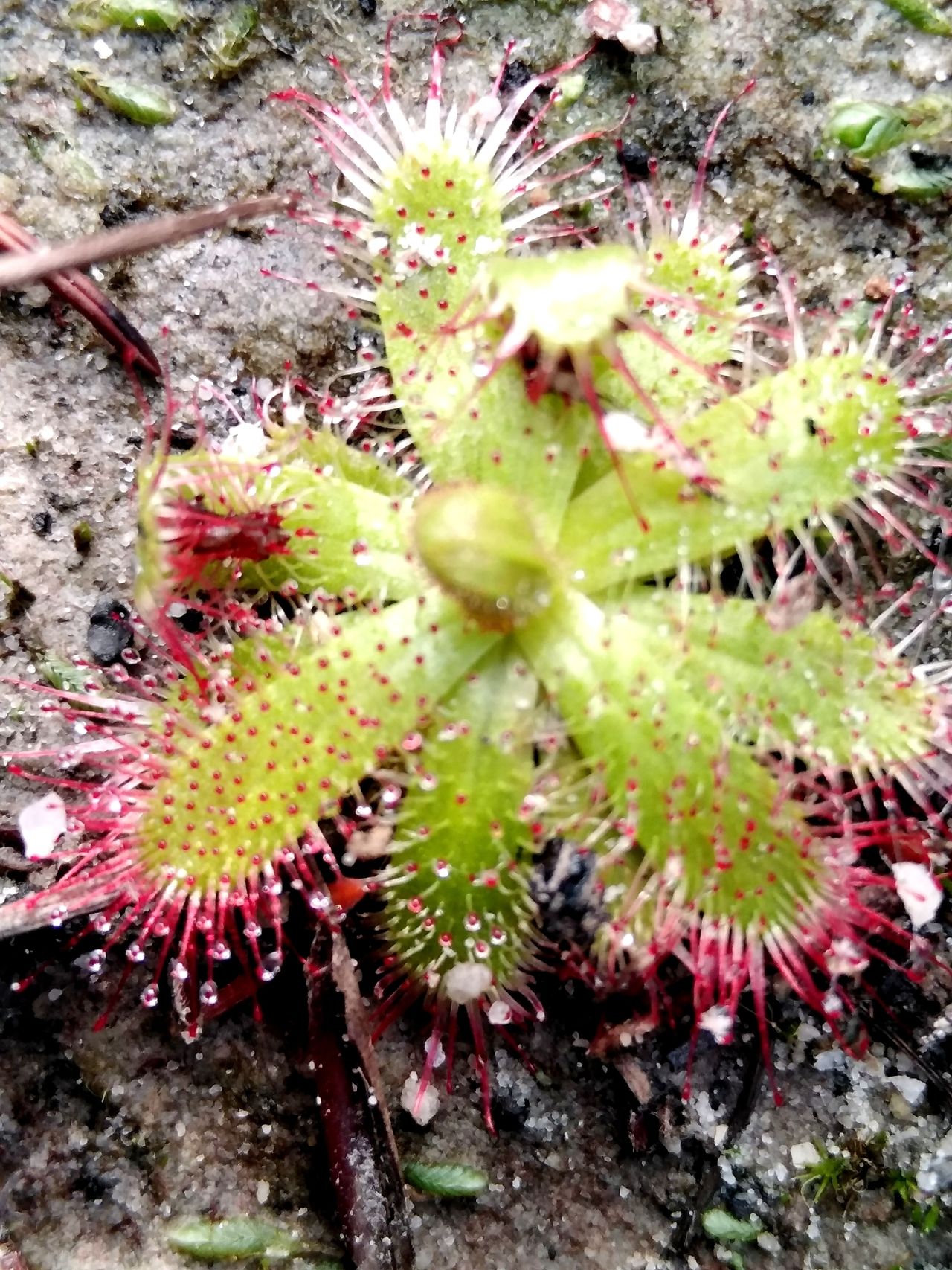
Identification
A small rosetted sundew with glandular, spatulate to wedge-shaped trapping leaves and a scape with scarlet to orange-red flowers; the flower colour is the most striking character. Reliable measurements from the original description were not available for this text; the measurement fields are left empty, except for flower colour.
Similar species
In the vegetative state the species is hard to tell from other small Cape rosetted sundews such as D. trinervia and D. aliciae. In flower the red to orange corolla is the best character; beware, however, of rare red colour forms of D. trinervia and of D. cistiflora, the latter with much larger flowers and a leafy stem.
The trap and how it works
An active flypaper trap: stalked glands with sticky droplets hold small insects, after which the tentacles bend towards the prey and the glands secrete digestive enzymes.
Habitat and ecology
Like most Cape rosetted sundews a winter grower of seasonally wet places in fynbos: seeps and wet, open sandy ground (W7, R1, B5). Specific habitat data are scarce.
Distribution and elevation
Endemic to the Cape Provinces of South Africa. A more precise range could not be established from the sources consulted; altitudinal limits were not found.
- Recorded (one-degree cells)
Forms and variation
The species is on the list of accepted species, but as with several of Debbert's taxa its position in the modern revisions of the Cape rosetted sundews (Fleischmann and colleagues) is not clear in every respect. Some authors see it as closely related to, or a colour variant within, the D. trinervia complex. This text follows its acceptance as a species, with reservations.
Where and when to see it
Search in spring on sunny days for small rosetted sundews with conspicuously red or orange flowers. Photographs of rosette, leaf base and flower help identification and the understanding of this little-known species.
Conservation status
Not assessed for the global IUCN Red List and not listed in CITES. Little is known about numbers and trend. The general threats to Cape fynbos — alien trees, a disturbed fire regime, drying out and conversion to farmland — apply here too.
Scientific name
Drosera coccipetala | Debbert, 2002
Described by Debbert in 2002, in Linzer Biologische Beiträge, volume 34, no. 1, p. 795. South Africa, Western Cape, Caledon, on sandy loamy soils. Collected by Debbert (no. 127); holotype at Munich (M), isotype at Berlin (B). From the Latin coccineus ("scarlet") and petala ("petals") — "red-petalled".
World Checklist of Vascular Plants (WCVP), via Plants of the World Online (POWO), Royal Botanic Gardens, Kew.