All species › Caryophyllales › Sundew family › Drosera hyperostigma
Drosera hyperostigma
One of the orange-flowered pygmy sundews, a group that turns whole patches of laterite orange in the south-west Australian spring. The name hyperostigma refers to the stigmas, which in this species are conspicuously enlarged and egg-shaped — the character on which Neville Marchant and Allen Lowrie distinguished the species in 1992.
Identification
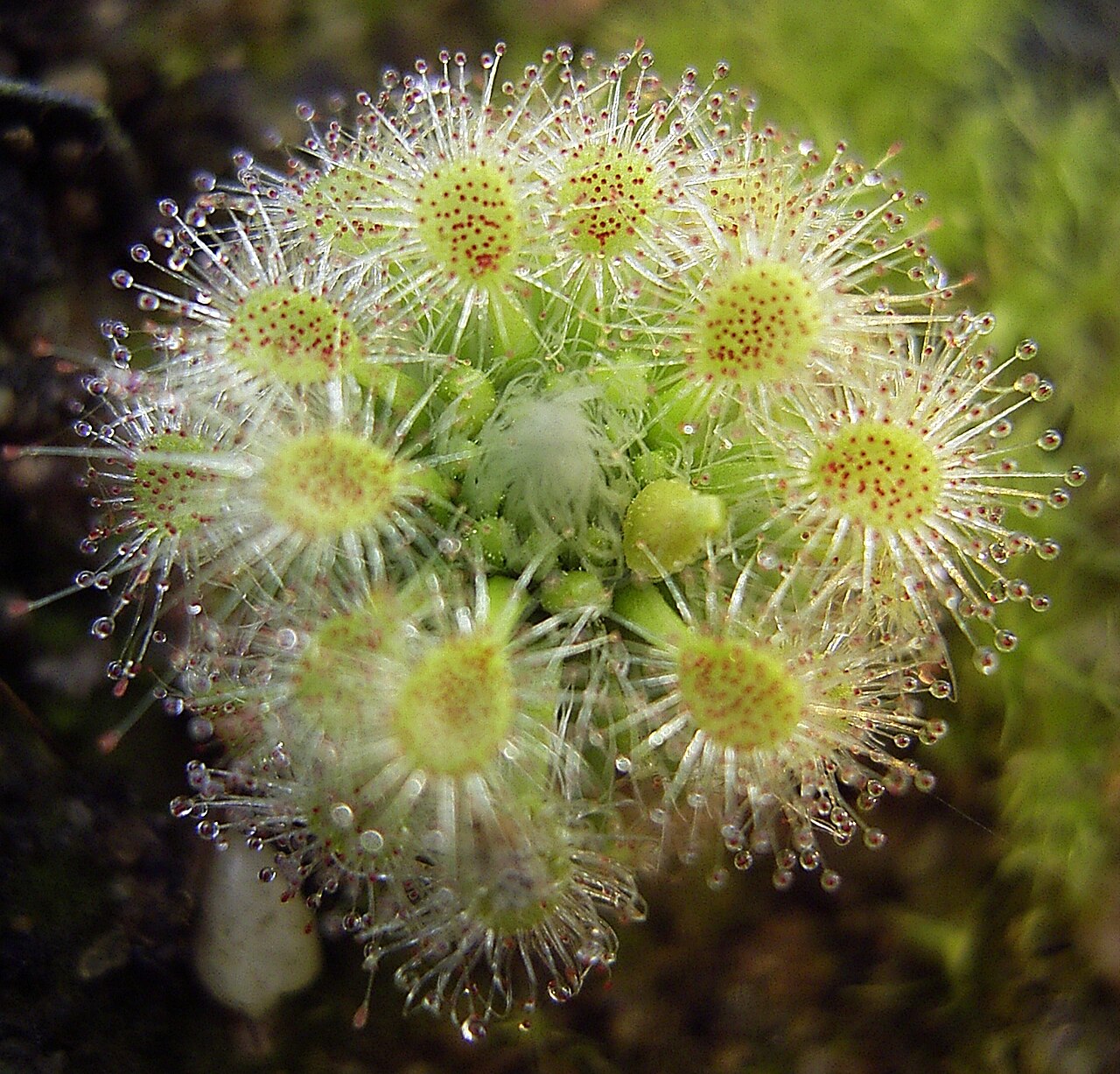
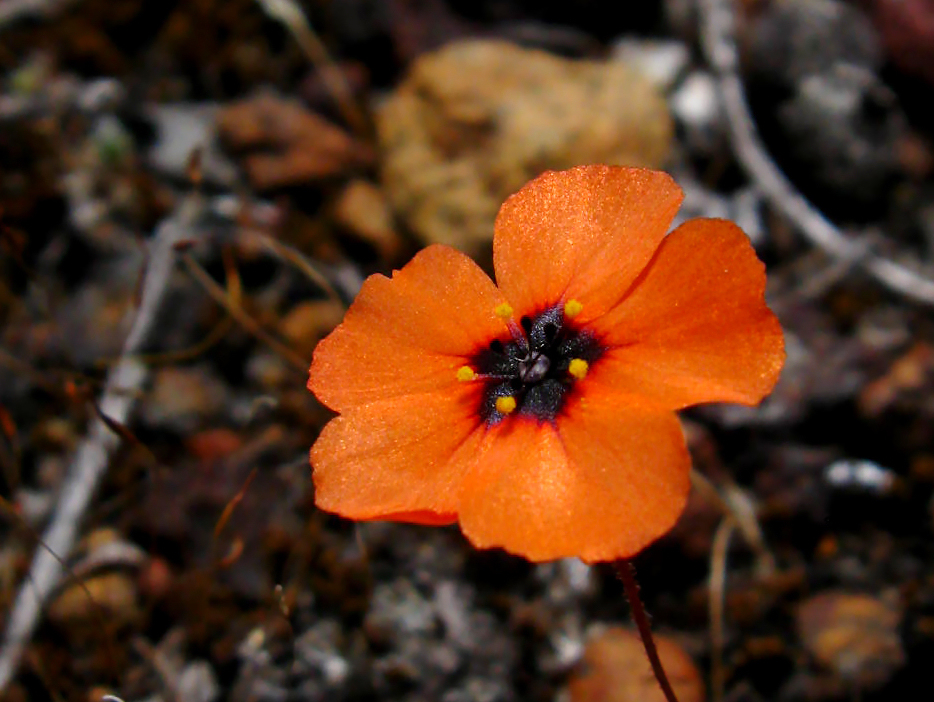
A flat, fibrous-rooted rosette about 1.5 cm across; flowering plants reach up to 5 cm tall. At the heart of the rosette, as in all pygmy sundews, sits a tuft of white stipules. The flowers are orange with broad, wedge-shaped petals and a black centre. With a hand lens you see black filaments and long, thin black styles each carrying an egg-shaped stigma, rounded at the tip and tapering towards the attachment. Flowering in October and November.
Similar species
The closest look-alike is Drosera platystigma, also an orange-flowered species of the Darling Scarp with egg-shaped stigmas. The difference is in the colour: in D. hyperostigma filaments and styles are black, in D. platystigma white. D. leucoblasta has narrower, straight petals and thickened stigmas ranging from light orange to black. Without flowers these species cannot be separated.
The trap and how it works
An active flypaper trap in miniature. The small leaf blades carry stalked glands with a sticky droplet; long marginal tentacles seize the prey and bend towards the centre, where shorter glands take over digestion. On the open, dry laterite where the plant grows the catch is mainly springtails, mites and the smallest flies.
Habitat and ecology
Well-drained laterite and silica sand in open situations (D3, D1, B5), often among low heath. The plant grows through the wet winter, flowers in spring and rests in summer, withdrawn to a bud inside the protective stipules.
Distribution and elevation
Endemic to south-west Australia. Its centre lies on the Darling Scarp east of Perth, but FloraBase also records it for the Geraldton Sandplains (Lesueur Sandplain subregion), the Avon Wheatbelt (Katanning) and the Esperance Plains (Fitzgerald), and for the Swan Coastal Plain around Perth.
- Recorded (quarter-degree cells)
Forms and variation
No subspecies or varieties have been described. Like most pygmy sundews the plant forms gemmae in the heart of the rosette at the end of the growing season, which are flung away by raindrops and grow into new plants.
Where and when to see it
Go in mid-October on a sunny day to open laterite on the Darling Scarp; the flowers open only in sun and stand out well against the rust-brown ground. Take a hand lens to look at the black styles — the only field character that reliably separates it from D. platystigma. Do not walk across the open ground between the heath: the little rosettes grow there in large numbers and are hardly visible.
Conservation status
On the global IUCN Red List the species is listed as Least Concern (LC); in Western Australia it is regarded as not threatened. It is not listed in CITES. The Darling Scarp lies on the edge of the Perth metropolitan area; building, gravel extraction and overly frequent burning are the main threats to its laterite flora in general.
Scientific name
Drosera hyperostigma | Marchant & Lowrie, 1992
Described by N.G. Marchant & Lowrie in 1992, in Kew Bulletin, volume 47, no. 2, p. 324 — the same publication as D. helodes. On O'Brien Road, about 6 km north of Toodyay Road, Central Rural District of Western Australia. Collected by A. Lowrie on 8 November 1983 — just days before the type material of D. helodes, probably during the same field trip. From the Greek hyper ("above, excessive") and stigma — probably referring to a distinctive or enlarged stigma structure, though this is not literally confirmed in a source.
World Checklist of Vascular Plants (WCVP), via Plants of the World Online (POWO), Royal Botanic Gardens, Kew.