All species › Caryophyllales › Sundew family › Drosera nana
Drosera nana
The dwarf of the Drosera indica alliance. Allen Lowrie described Drosera nana in 2014 as one of many new species into which he divided the northern Australian members of section Arachnopus. The name, from the Latin nanus, 'dwarf', refers to the small size of mature plants compared with their relatives.
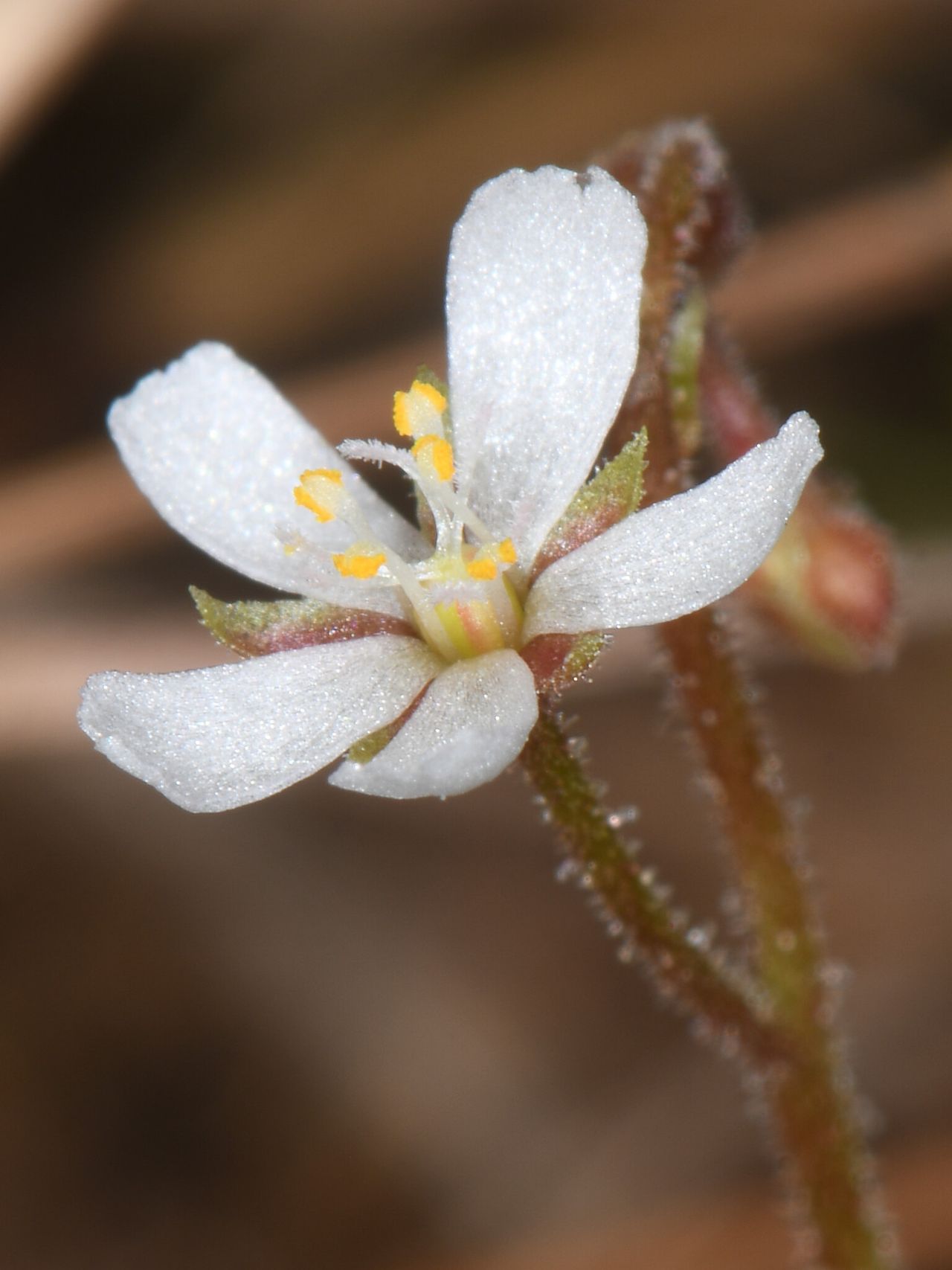
Identification
An annual with, like all members of section Arachnopus, long, narrow trapping leaves along a stem, but in a clearly smaller format than the other species of the group. We found no measurements of plant, leaf or flower, nor flower colour or flowering time, in any accessible source; those fields are left empty. The small size at full flowering is the main field character.
Similar species
Other annual species of section Arachnopus in northern Australia, such as Drosera hartmeyerorum and the species formerly included in D. indica, are larger. Young plants of those species can resemble D. nana; only flowering, mature plants can be recognised reliably, and even then the key in Lowrie's work is needed.
The trap and how it works
An active flypaper trap. The long leaves carry stalked glands with sticky droplets along their whole length; small insects stick to them, after which the tentacles and sometimes the whole leaf bend towards the prey. In this small species the prey is small gnats, springtails and ants.
Habitat and ecology
We found no specific habitat data. Annual species of section Arachnopus grow in the tropical north in sandy, seasonally wet hollows in savanna and open woodland, and the codes follow that general picture (W7, B6, D1). The plant germinates in the wet season and survives the dry season as seed.
Distribution and elevation
Endemic to northern Australia: the north of Western Australia and the Northern Territory.
- Recorded (one-degree cells)
Forms and variation
No subspecies or varieties have been described. The species is part of a far-reaching revision of section Arachnopus, in which the former concept of a single widespread D. indica has broken up in Australia into a series of separate species.
Where and when to see it
Search in the wet season, when the annual plants are above ground and flowering, along the edges of temporary pools and wet sandy hollows. Because the species is small it is easy to walk past; look low and into the light, so that the droplets on the leaves shine.
Conservation status
On the global IUCN Red List the species is listed as Least Concern (LC). It is not listed in CITES. As an annual of seasonally wet places it depends on the yearly wet season and intact hydrology. Uncertainty: the available sources give no measurements, flower colour, flowering time or habitat description; this text is therefore deliberately short.
Scientific name
Drosera nana | Lowrie, 2013
Drosera nana was described by Allen Lowrie, published (dated December 2013, issued 2014) in Carnivorous Plants of Australia Magnum Opus, volume 3, p. 1272. The holotype (PERTH 8988994) was collected in Australia, Northern Territory, on Fog Bay Road near Dundee Downs, on 16 April 2013, by A. Lowrie, D. Murfet, R. Nunn and G. Bourke. The habitat is described as sandy soils of seasonally flooded watersheds and herbfields. The name is derived from Latin "nanus", "dwarf", referring to the small mature size of this species compared with other species in section Arachnopus.
World Checklist of Vascular Plants (WCVP), via Plants of the World Online (POWO), Royal Botanic Gardens, Kew.