All species › Caryophyllales › Sundew family › Drosera platystigma
Drosera platystigma
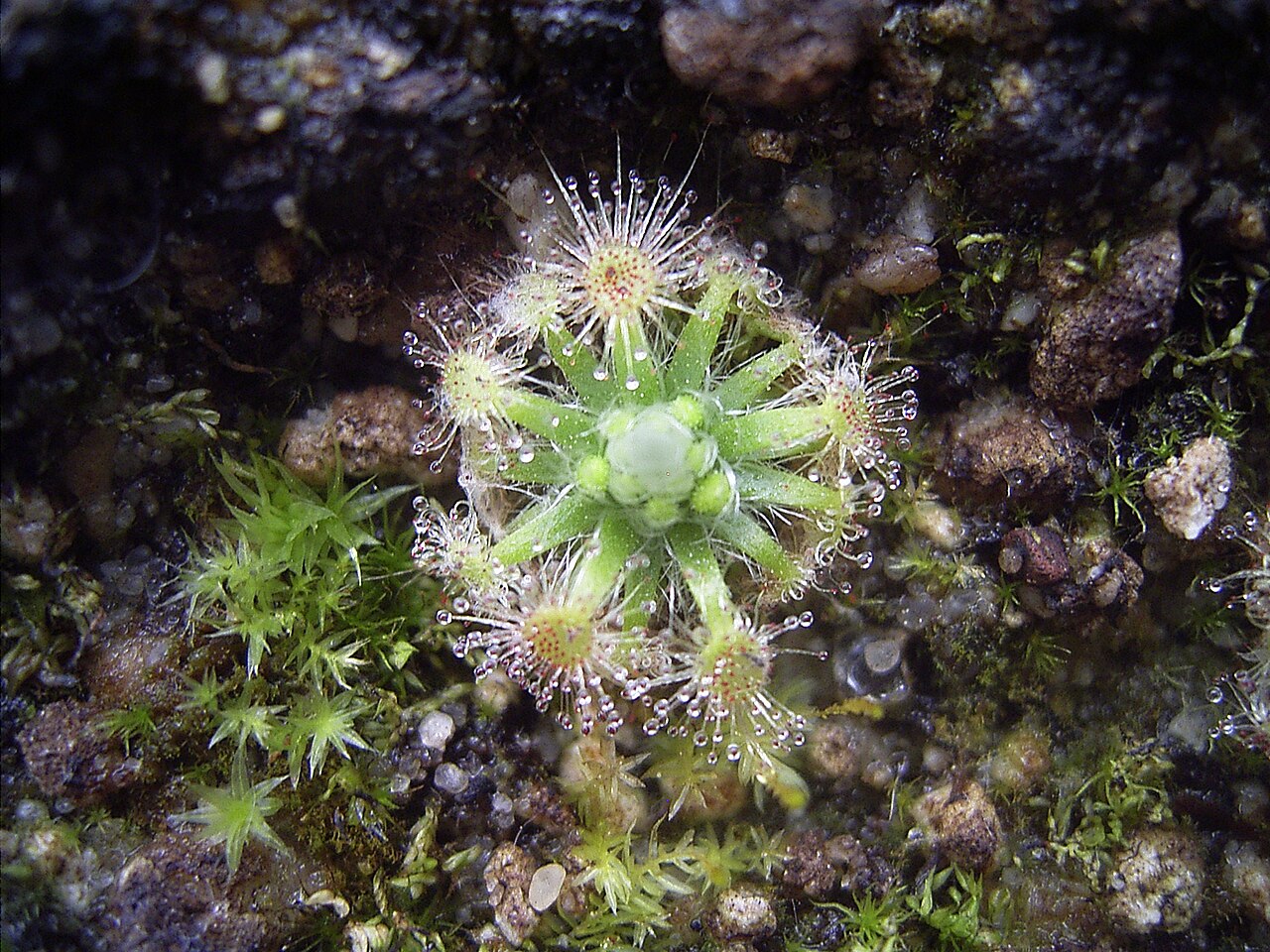
A pygmy sundew with one of the most striking flowers in the whole genus: glossy orange with a black centre and black veins radiating from the middle. Drosera platystigma is widespread in south-west Western Australia, but without its flower it is an inconspicuous reddish-brown rosette no more than two centimetres across.
Identification
A flat rosette up to 2 cm across; with the inflorescence the plant reaches 6 cm. The petioles are relatively broad and olive green, the round blades tawny to brick red. The flowers are metallic orange with a black centre and radiating black veins. The best character lies in the heart of the flower: the styles and filaments are white, and the stigmas — usually three, sometimes up to five — are broadly obovate with a rounded tip, on elongated styles. Hence the name: platys is 'broad', stigma the stigma. Flowering October to December.
Similar species
There are more orange-flowered pygmies. The hardest is Drosera hyperostigma, which has the same broad obovate stigmas on long styles; the difference is the colour of styles and filaments: black in D. hyperostigma, white in D. platystigma. Other orange species such as D. miniata and D. leucoblasta have narrower or differently shaped stigmas. A lens is essential in this group.
The trap and how it works
An active flypaper trap in miniature. Each leaf blade, often no larger than a pinhead to a few millimetres, carries stalked glands on its margin and upper surface, each holding a glistening sticky droplet; the marginal tentacles are usually the longest. A small animal that touches the droplets sticks fast, after which the tentacles bend towards the centre of the blade and press the prey against the digestive glands. The glands secrete enzymes and absorb nitrogen, phosphorus and minerals from whatever dissolves. Given the scale, the catch consists of the very smallest: springtails, mites, aphids, thrips and minute midges moving over or just above the sandy ground.
Habitat and ecology
A wide range of soils, but mostly clayey and sandy, often yellowish ground or sand mixed with laterite (D3), in heath, scrub and open woodland (B5, B6). The species is less particular than many relatives, which accounts for its wide distribution.
Distribution and elevation
Endemic to south-west Western Australia: from the coastal plain around Perth through the wheatbelt to near Albany and Ravensthorpe. FloraBase lists the Avon Wheatbelt, Esperance Plains, Geraldton Sandplains, Jarrah Forest, Swan Coastal Plain and Warren bioregions. Altitudinal limits are not published.
- Recorded (quarter-degree cells)
Forms and variation
The species was described in 1844 by Johann Georg Christian Lehmann. No subspecies or varieties are recognised. In the field it can hybridise with related pygmies; Drosera × carbarup, for instance, has been described as a natural hybrid of D. occidentalis and D. platystigma. Like all pygmy sundews it forms gemmae in the centre of the rosette in winter.
Where and when to see it
Go out from late October to early December, around midday and in sunshine: the orange flowers open only in warm, clear weather and can then be seen from metres away, while the rosettes themselves vanish into the laterite. Kneel down and look into the flower with a lens — the white styles and broad stigmas are the only reliable character against D. hyperostigma.
Conservation status
Assessed as Least Concern (LC) on the IUCN Red List; not listed in CITES, and rated not threatened in FloraBase. The species has a large range and tolerates a broad range of soils. Clearing of the wheatbelt has nonetheless cost much habitat; in that landscape it now grows mainly on road verges and in remnant bush.
Scientific name
Drosera platystigma | Lehmann, 1844
Drosera platystigma was described in 1844 by the German botanist Johann Georg Christian Lehmann, in his work Pugillus Plantarum, volume 8, page 37. The species occurs in a small area in the extreme southwest of Australia, including near Albany, Busselton, the Stirling Range and Bannister, on clayey sand or laterite and loam soils in open heathland; the precise type locality, collector and collection date could not be established with certainty. The epithet platystigma is descriptive, combining the Greek platys ("broad") and stigma ("stigma"), referring to this species' distinctly broad floral stigmas.
World Checklist of Vascular Plants (WCVP), via Plants of the World Online (POWO), Royal Botanic Gardens, Kew.