All species › Ericales › New World pitcher plant family › Heliamphora pulchella
Heliamphora pulchella
Of all the marsh pitcher plants of the table mountains, Heliamphora pulchella is among the smallest, and the epithet — Latin for 'pretty' — is for once no exaggeration. It grows on the Chimantá massif and on a series of surrounding tepuis, where the rosettes form dense, low mats in waterlogged peat cushions and crevices that from a distance look more like moss than like carnivorous plants.
Identification
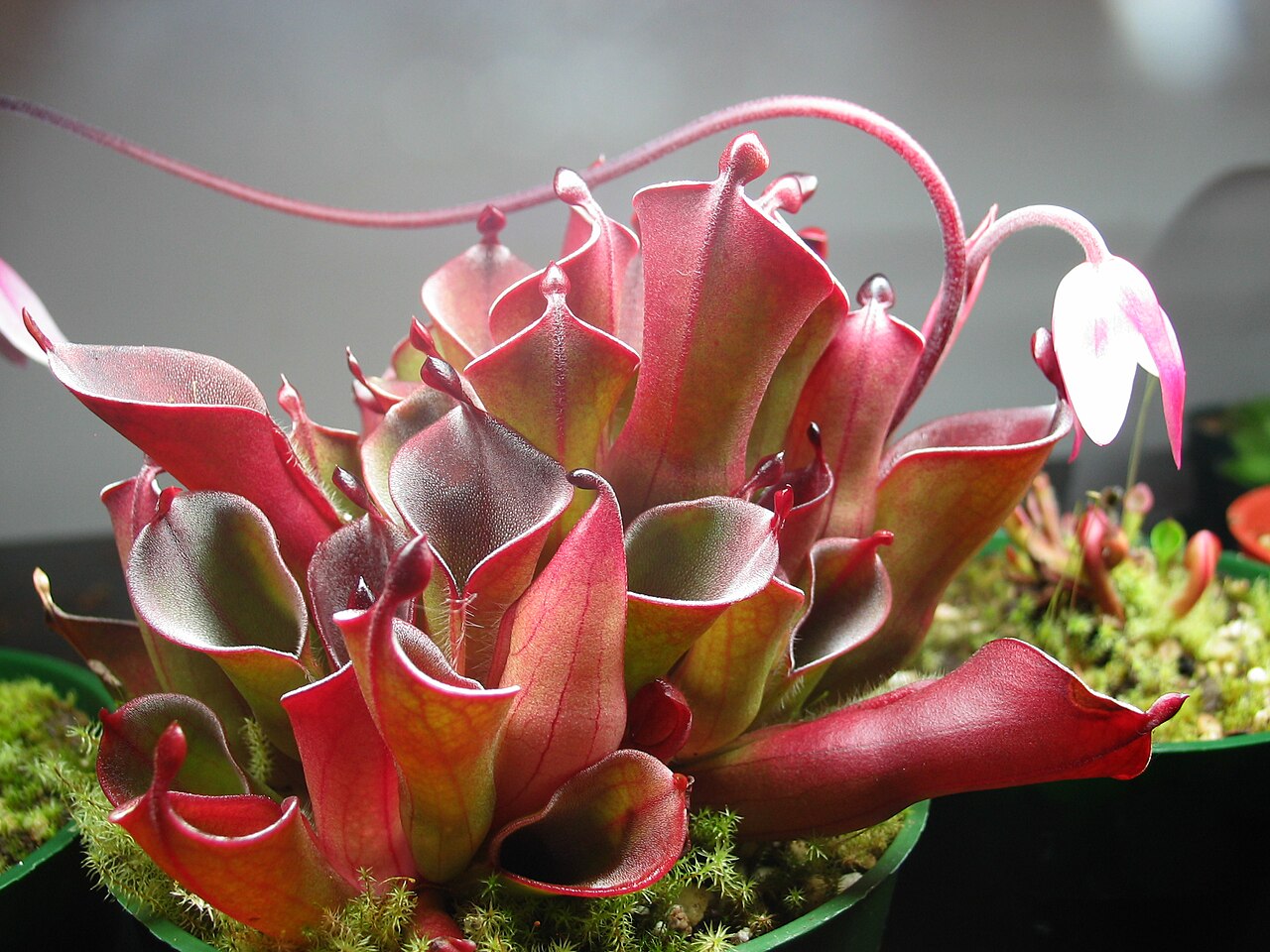
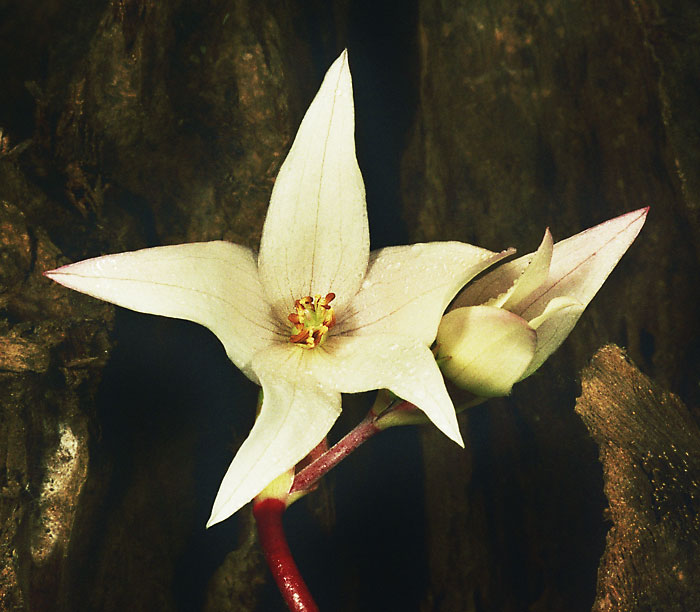
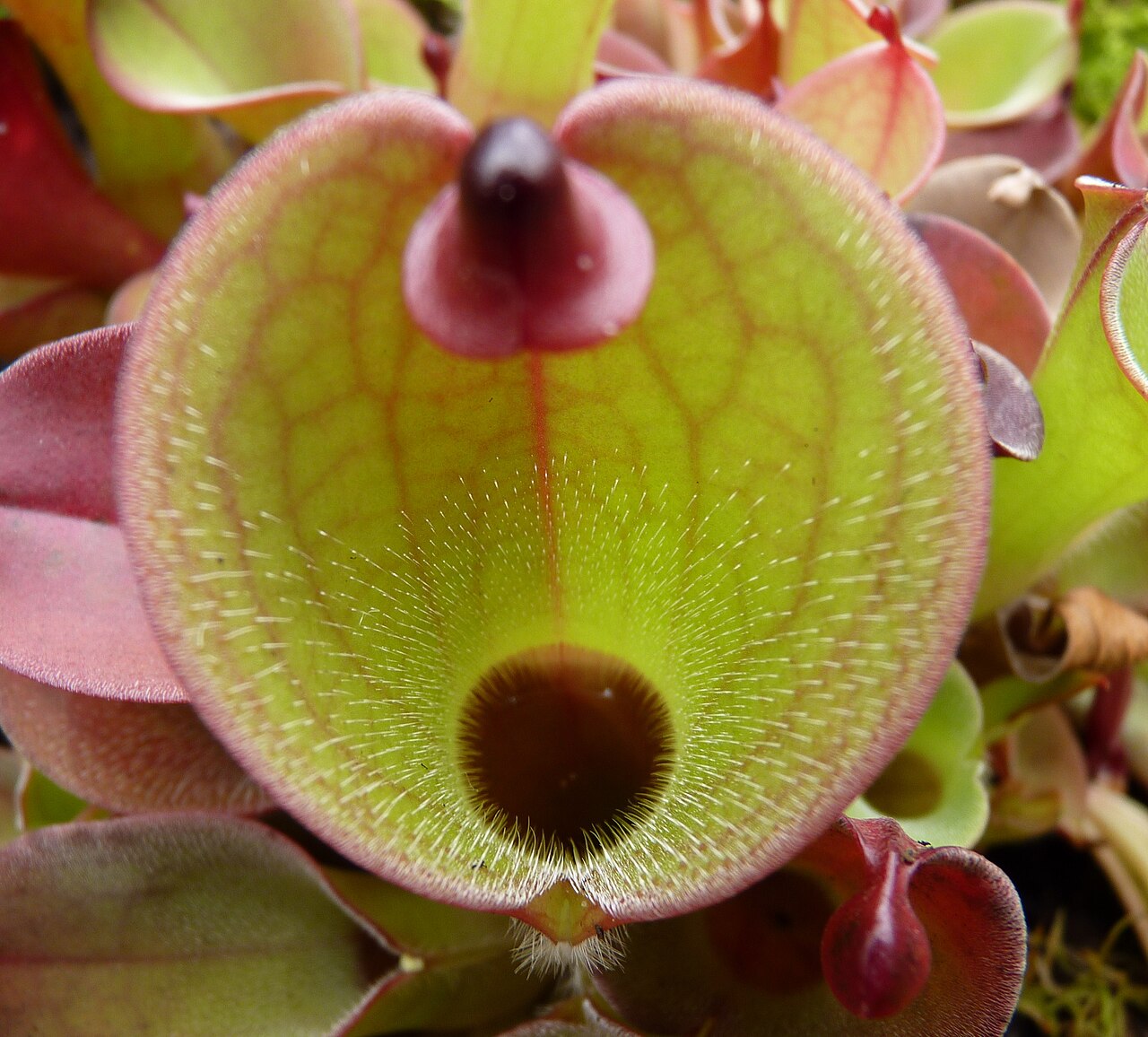
A rosette of relatively small, erect pitchers, each formed from a single leaf grown shut into a funnel with a seam down the front. Two characters make the species recognisable. First the nectar spoon: it is attached broadly to the back rim of the pitcher instead of sitting on a slender stalk, so that it looks like a little cap set on the pitcher. Second the pitcher interior, which in most populations is densely covered with conspicuous, downward-pointing retentive hairs; in strong light the whole pitcher turns deep red while that field of hairs remains visible as a velvety layer. In shade the plants stay yellow-green to red-veined. The inflorescence is a one-sided raceme on a slender scape held well above the low rosette, with nodding pale flowers whose tepals change colour and stiffen as flowering proceeds.
Similar species
The closest relative is Heliamphora minor of Auyán-tepui, and in photographs the two are barely separable. In the field geography decides: H. minor grows only on Auyán-tepui, H. pulchella on the Chimantá massif and the tepuis around it. Structurally, H. minor has its spoon on a slender stalk up to 5 mm long and an almost glabrous pitcher interior, while this species has the spoon broadly attached and the interior densely hairy. Heliamphora chimantensis occurs on the same massif, but with pitchers 20 to 35 cm long it is far larger, stays plain green and has a red spoon.
The trap and how it works
A pitfall that is small but fully equipped. The plant makes few digestive enzymes of its own; bacteria in the pitcher fluid break down the prey — mostly ants and other small insects — and the plant takes up the nitrogen and phosphorus released. The nectar spoon secretes a sugary fluid above the opening and draws the insect to exactly the wrong place. The dense retentive hairs on the inner wall are the most pronounced part of the trap in this species: all point downwards, so an insect sliding in is checked again at every attempt to climb back.
Habitat and ecology
The summit plateaus of the tepuis (R4), a landscape of bare sandstone with hollows and fissures in which acid peat and bog moss accumulate (W1). The species also grows on wet rock faces where seepage runs permanently over the stone and the roots hold in a thin layer of organic matter (R1). In every case the substrate is extremely poor in nutrients and constantly leached by the high rainfall. The climate is cool and all but permanently wet; cloud covers the plateaus for much of the day, and it is on the shaded, waterlogged ground that the species forms its densest mats.
Distribution and elevation
Endemic to Bolívar state, Venezuela, on the Chimantá massif — including Abacapá, Akopán, Amurí, Churí, Murey, Tirepón and Toronó — and on a series of tepuis around it such as Angasima, Aprada, Araopán and Upuigma. Records run from about 1850 to 2550 m. That makes it one of the more widely spread species of the genus, though all of it lies within one cluster of plateaus. The genus as a whole is confined to the table mountains of the Guiana Shield and their margins, in Venezuela, western Guyana and northern Brazil.
- Recorded (one-degree cells)
Forms and variation
Variation between the plateaus is considerable and largely unnamed. The clearest case is the population of Amurí-tepui, which lacks the characteristic retentive hairs inside the pitcher; those plants have not been formally described and are for now kept within the species. Beyond that the tepuis differ in rosette size and in colour, from yellow-green through red-veined to almost wholly deep red in plants in full light — differences due partly to exposure, partly to the mountain. No natural hybrids of this species have been formally described, although a second species of the genus grows on the massif.
Where and when to see it
Reachable only by helicopter or a multi-day trek, within Canaima National Park, and in practice only with a permit and a guide. Once on top, look low: this species does not rise above the vegetation but fills the wet hollows and the foot of rock faces with continuous, low mats, where larger species stand out instead. The best moment is a brief clearing, when the pitchers light up in direct sun and the red plants stand out sharply against the green ones in the crevices. Watch too for the slender scapes: they often persist after the flowers have faded and betray the mats from a distance. The flowering period is not established in the literature.
Conservation status
The species has not been assessed for the IUCN Red List and appears in no CITES appendix; that holds for the whole genus. Of the five species in this series it has the widest known range — a set of plateaus rather than one mountain — and it forms extensive, dense mats on the wet ground, which points to large populations. The area lies within a national park and World Heritage site and cannot be entered without a permit, which in practice limits collecting sharply; cultivated plants, moreover, come almost entirely from seed and tissue culture. The absence of an assessment here reflects the inaccessibility of the area and the youth of the name, not a documented decline.
Scientific name
Heliamphora pulchella | Wistuba, Carow, Harbarth & Nerz, 2005
Described by Andreas Wistuba, Bernd Carow, Ulrike Harbarth and Joachim Nerz in 2005, in Das Taublatt 53(3): 42–50. The type area lies on the Chimantá massif and surrounding tepuis in Venezuela. The species name pulchella is Latin for "pretty, lovely" and refers to the attractive appearance of this small pitcher plant.
World Checklist of Vascular Plants (WCVP), via Plants of the World Online (POWO), Royal Botanic Gardens, Kew.