All species › Caryophyllales › Tropical pitcher plant family › Nepenthes boschiana
Nepenthes boschiana
One of the oldest names in the genus to come from Borneo: Nepenthes boschiana was described in 1839 by Pieter Willem Korthals, the Dutch botanist who travelled for the Natural Sciences Commission in the Netherlands Indies, in his treatise 'Over het geslacht Nepenthes'. The name honours Johannes van den Bosch, then governor-general. The plant comes from the Meratus Mountains in south-eastern Borneo, and the people there knew it long before Europeans described it: old sources record the local name 'daoen sompitan', 'blowpipe leaf', and unopened pitchers were used against inflamed eyes. It is a robust species with long, waisted pitchers.
Identification
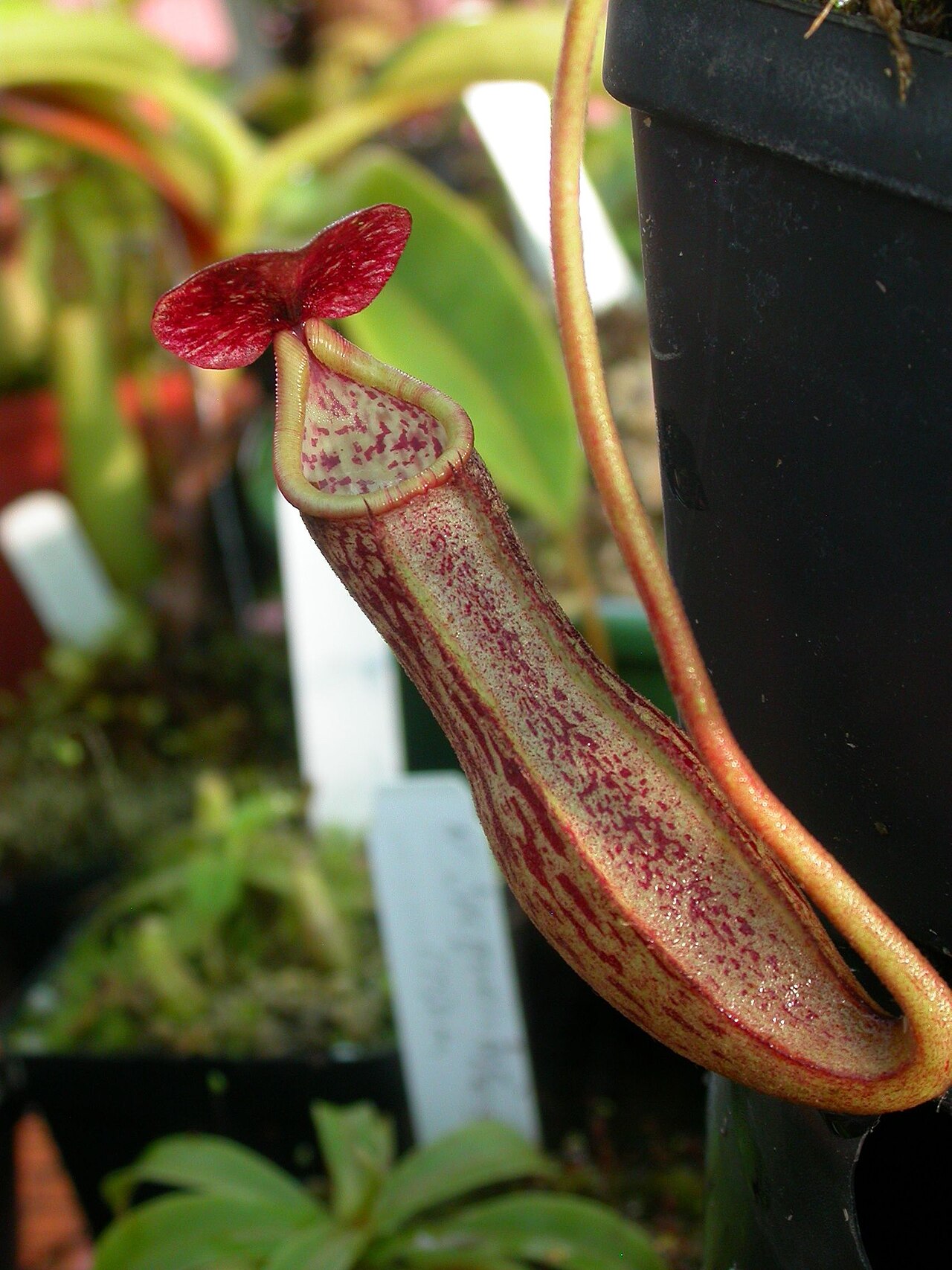
A shrub or climber to about five metres. Short shoots bear broad, oblong leaves to 28 cm long and 10 cm wide; on the climbing shoots they become narrower and lanceolate, 16 to 26 cm long. The lower pitchers are 17 to 22 cm long and have a distinctive waist: the lower half is ellipsoid and about 4 cm wide, halfway up the pitcher narrows to about 2 cm, and the upper half is cylindrical to slightly funnel-shaped. Two narrow, fringed wings run down the front. The upper pitchers are 15 to 30 cm tall, carry only two ridges instead of wings, and have a peristome with a wavy outer edge bearing up to seven lobes on each side. The lid is orbicular, to over 6 cm, with a keel along the midrib.
Similar species
Most authors consider Nepenthes faizaliana of Sarawak its closest relative. Within the N. maxima complex, which also includes N. chaniana, N. epiphytica and N. platychila, N. boschiana stands out by its waisted lower pitchers and its peristome with a wavy, lobed outer edge. Historically the name has often been misapplied: various plants from elsewhere in Borneo and Sumatra were identified as N. boschiana during the nineteenth and twentieth centuries. N. borneensis, described in 1989, is regarded as a synonym.
The trap and how it works
A pitfall with the usual construction of the genus: nectar glands on the peristome and under the lid lure insects, the ribbed peristome turns slippery when moist, and a fluid at the bottom digests the prey. The winged lower pitchers stand on the ground and take mainly walking animals; the upper pitchers hang higher and take more flying insects. The waist of the lower pitchers, where the wall narrows, might make it harder for escaping prey to climb back, but this has not been studied. No prey study of this species has been published. Work on other species of the genus has shown that the peristome works by 'aquaplaning': a thin film of water on the finely ribbed surface makes it so slippery that the adhesive pads of insect feet can no longer grip. The trap therefore works best when it is damp, which in cloud forest is almost always the case.
Habitat and ecology
Open, low forest on ridges and slopes, between about 780 and 1880 m (B1, B5). Flora Malesiana describes the habitat as open, stunted forest on limestone hills; nineteenth-century accounts speak of 'sterile, open and stony' ground. What is characteristic in any case is the combination of plenty of light, a poor soil and the humid mountain air. Since the geology of the Meratus range is varied and the sources do not fully agree here, no rock code has been assigned in this guide.
Distribution and elevation
Endemic to Borneo and confined to the Meratus Mountains in the province of South Kalimantan, where it is known from a few summits. This agrees with the guide's own species list. Because the species is endangered, this guide gives no more precise localities.
- Recorded (one-degree cells)
Forms and variation
No varieties or forms have been validly described. Pitcher colour ranges from green to yellowish green with more or fewer red to purple blotches, and plants in open sites colour more strongly. No natural hybrids of N. boschiana are known.
Where and when to see it
The Meratus Mountains are a long, forested chain in south-eastern Kalimantan, where the Dayak Meratus live in villages at the foot of the mountains; treks to the summits are made with local guides. Search open ridges and low forest for the waisted lower pitchers on the ground and the long upper pitchers in the scrub. Do not share localities and take nothing: the species is endangered and sought after in trade.
Conservation status
The IUCN Red List assesses the species as Endangered. Its range is small, confined to one mountain area, and the Meratus Mountains are under pressure from logging, mining and clearance in the foothills. Forest fires in dry years also threaten the higher parts. As a member of Nepenthes it is listed in CITES Appendix II, so international trade requires a permit. For enthusiasts it is worth knowing that almost all species of the genus are now available through tissue culture; anyone wishing to grow a plant has no need of wild ones.
Scientific name
Nepenthes boschiana | Korthals, 1840
Nepenthes boschiana was described in 1839 by Pieter Willem Korthals in his monograph "Over het geslacht Nepenthes", discovered on Mount Sakoembang in a sterile, open and stony habitat. Mount Sakoembang, the species' endemic range in the Meratus Mountains, South Kalimantan, Indonesian Borneo. The species is named after Johannes van den Bosch (hence the common name "Bosch's pitcher-plant"); the local Indonesian name "daoen sompitan" translates as "blow-pipe-leaf".
World Checklist of Vascular Plants (WCVP), via Plants of the World Online (POWO), Royal Botanic Gardens, Kew.