All species › Caryophyllales › Tropical pitcher plant family › Nepenthes gracillima
Nepenthes gracillima
The most graceful pitcher plant of the peninsula, and one of the slenderest in the whole genus: 'gracillima' means 'very slender'. Henry Ridley, director of the Singapore Botanic Gardens and a tireless collector, described the species in 1908 from the highest mountains of the Malay Peninsula. It has narrow leaves barely a centimetre wide and long, thin pitchers that shade from green to ivory white. The taxonomy of this plant and its closest relatives has long been a tangle, and in part still is.
Identification
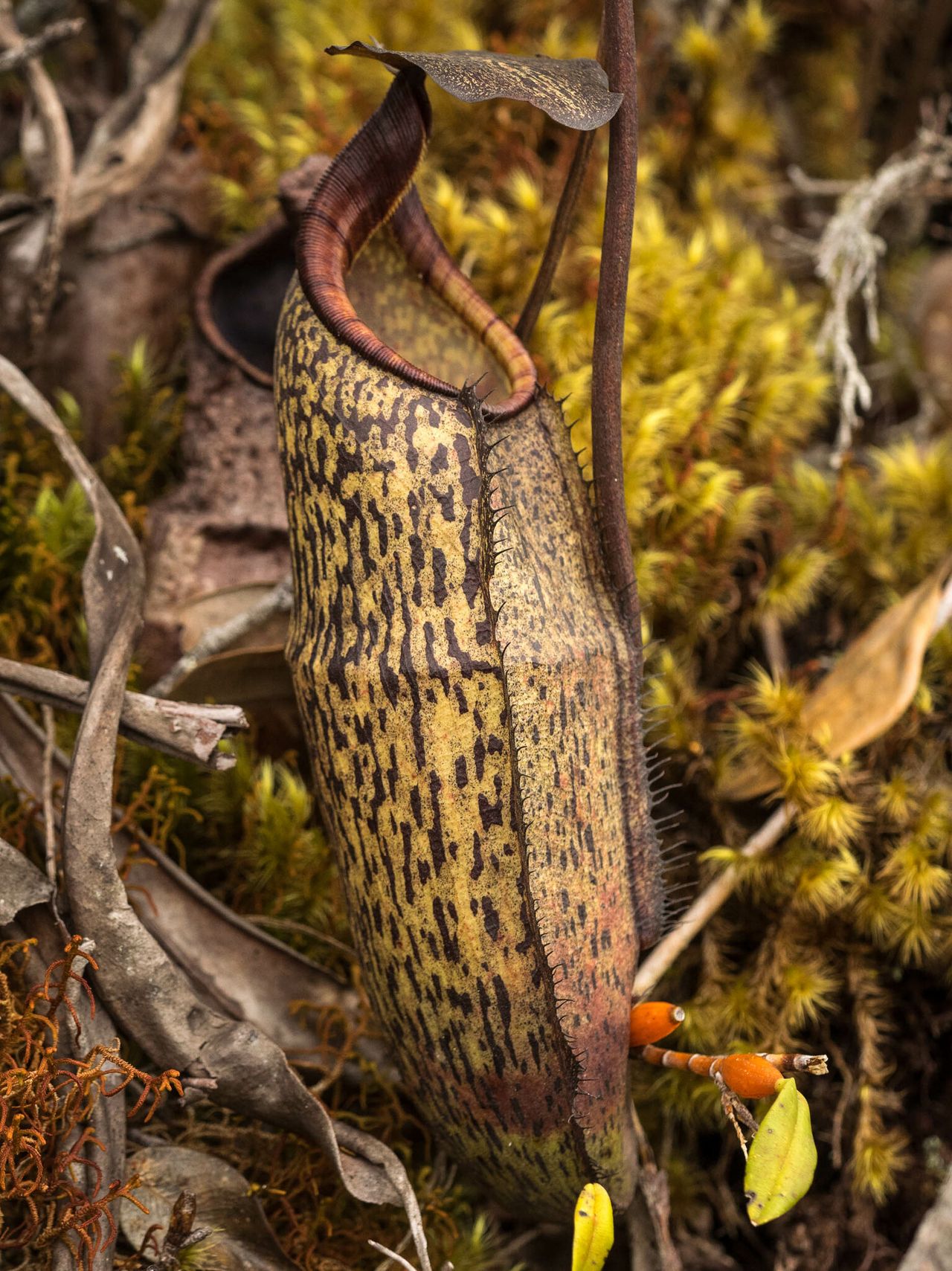
A wispy climber one to five metres tall, with thin stems two to five millimetres thick. The leaves are thinly leathery, sessile, lanceolate to oblanceolate, usually only 5 to 10 cm long and one to one and a half centimetres wide. Lower pitchers are small, 5 to 10 cm tall, funnel-shaped below and cylindrical above, with narrow wings about two millimetres wide. Upper pitchers are long and narrow, 6 to 15 cm, rarely to 17.5 cm tall but often barely two centimetres wide; they lack wings and have a thin peristome of one and a half to three millimetres. The lid is round to broadly ovate and small, with an unbranched spur two or three millimetres long. Upper pitchers are pale green below and become pale yellow to ivory white above, with rose markings.
Similar species
The closest relative, and the trickiest, is Nepenthes ramispina of the western Main Range. According to Cheek and Jebb (2001) it is larger, with broader, oblong-obovate leaves, longer and slenderer upper pitchers with a spur branched into a tuft (simple and under three millimetres in gracillima), numerous unrimmed glands of unequal size under the lid (rimmed and evenly 0.4 to 0.6 mm in gracillima) and a hairy stem and midrib. The name Nepenthes alba, given by Ridley to plants with white upper pitchers, is a synonym for Cheek and Jebb; other authors keep it separate. From Nepenthes macfarlanei it is easily told by its much smaller, slimmer pitchers and the absence of white hairs under the lid.
The trap and how it works
A pitfall trap on a small scale. The slender upper pitchers, with their narrow mouth and thin peristome, catch mainly small flying insects; the pale, almost white colour of the upper part stands out against the dark green of the scrub and may play a role in luring. The small lower pitchers with their narrow wings sit close to the ground and catch crawling animals. The lid bears rimmed nectar glands of nearly equal size. No specific study of prey or digestive fluid in this species was found in the literature consulted.
Habitat and ecology
Open places or scrub on quartzitic soils or heavily weathered rock, from 1300 to 2100 m (R4, B6, B1). These are the lean, sunny summits and high plateaus of the peninsula's eastern mountains, with their low, dense vegetation of shrubs and mosses. The plant climbs or scrambles through that low vegetation and tolerates plenty of sun.
Distribution and elevation
Endemic to the Malay Peninsula. According to Cheek and Jebb (2001) the species is confined to the eastern mountain ranges, notably Gunung Tahan, the peninsula's highest mountain, and Gunung Tapis. Other authors, who delimit the species differently, also cite sites elsewhere in the highlands; those differences depend on how gracillima, alba and ramispina are separated. Our own list says 'highlands', which is compatible with both views.
- Recorded (one-degree cells)
Forms and variation
Formally no varieties are recognised. Nepenthes gracillima var. major, an old name of Ridley's, belongs according to Cheek and Jebb to Nepenthes ramispina, not to this species. Plants with wholly white upper pitchers were described as alba; whether that is a separate species, a form or merely an extreme of ordinary colour variation is disputed. Pitcher colour otherwise ranges from pale green to ivory, with more or less rose marking.
Where and when to see it
The species grows on the highest and remotest summits of the peninsula, and a visit means a multi-day trek with a guide, for example the climb to Gunung Tahan through Taman Negara National Park, for which permits and a licensed guide are compulsory. The reward is an open plateau with low scrub, where the slender ivory pitchers hang among the branches. Look carefully: the plants are fine and easily overlooked in the dense vegetation.
Conservation status
The Red List assesses the species as Least Concern. Its main sites lie in remote, protected high mountains, and it faces few threats. As a member of Nepenthes it is nonetheless listed in CITES Appendix II, so international trade in wild plants requires a permit. In the long run climate change is a concern for summit plants, which have nowhere higher to go as temperatures rise.
Scientific name
Nepenthes gracillima | Ridley, 1908
Nepenthes gracillima was described in 1908 by Henry Nicholas Ridley, in "On a collection of plants made by H.C. Robinson and L. Wray from Gunong Tahan, Pahang" (The Journal of the Linnean Society: Botany 38(266): 301-336). Mount Tahan (Gunung Tahan), Pahang, Peninsular Malaysia, where H.C. Robinson and L. Wray assembled the collection that led to the species' description. The name is the Latin superlative of "gracilis" ("slender"), meaning "the most slender", reflecting this species' especially delicate structure.
World Checklist of Vascular Plants (WCVP), via Plants of the World Online (POWO), Royal Botanic Gardens, Kew.