All species › Caryophyllales › Tropical pitcher plant family › Nepenthes latiffiana
Nepenthes latiffiana
Two species, one paper, two tributes. In 2020 M.N. Faizal, A. Amin and colleagues described in the journal Webbia two new pitcher plants from the hills of Terengganu, on the east side of the Malay Peninsula. One they named after Dome Nikong, who first found its population and who appears as co-author on the name of the other; that other, Nepenthes latiffiana, honours Abdul Latiff Mohamad, emeritus professor of botany at the Universiti Kebangsaan Malaysia and one of Malaysia's best-known botanists. It is a climber of rocky slopes at around 1000 m.
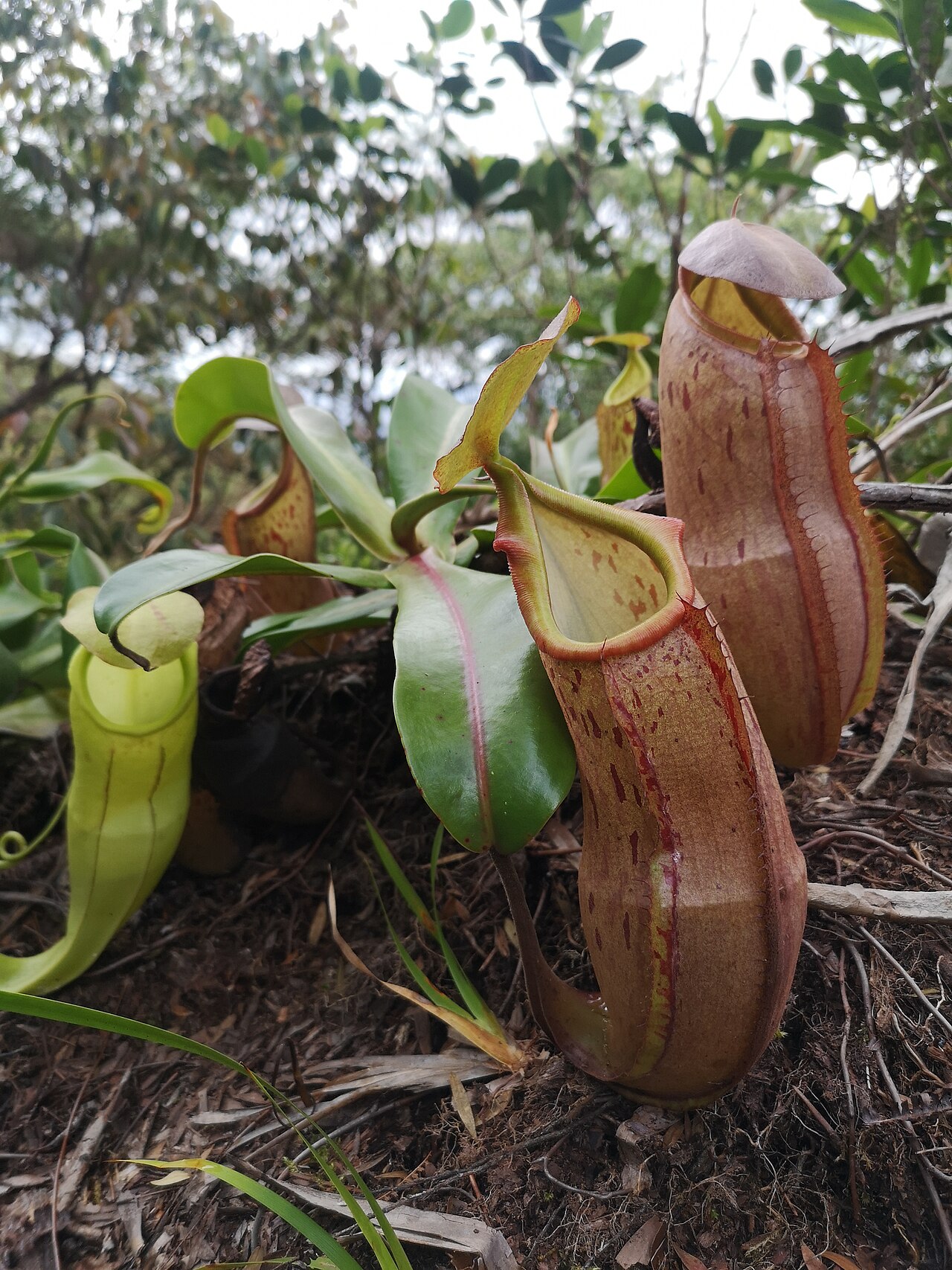
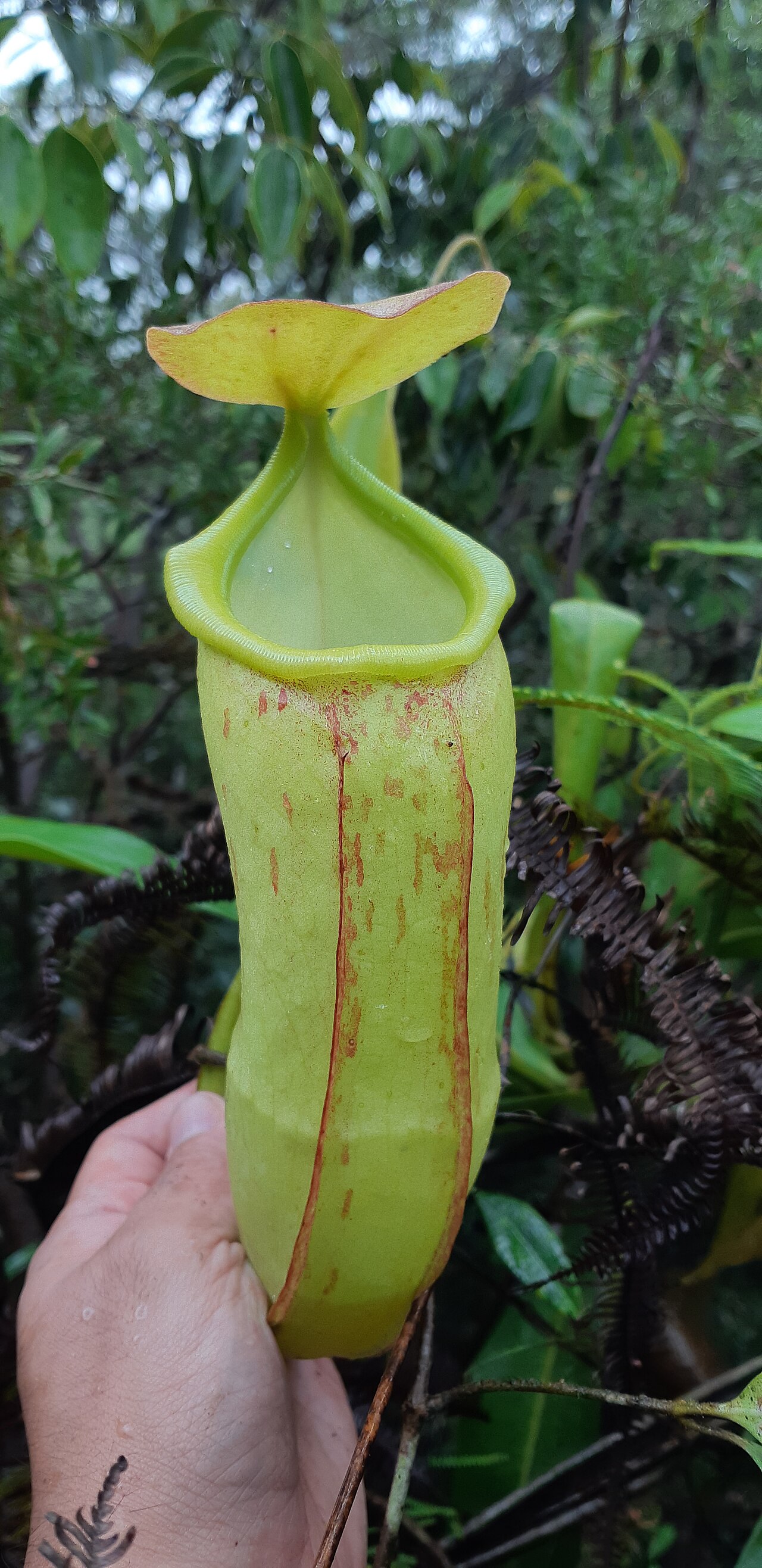

Identification
A climbing plant that grows on the ground as part of the understorey on hill slopes. According to the description the species differs from its closest relative mainly in the structure of the peristome, the ribbed rim around the mouth. As in related montane species there are two pitcher types: lower pitchers standing on or just above the ground, broader below and with wings down the front, and upper pitchers on the climbing stems, slimmer and more funnel-shaped. The description includes a line drawing showing the habit, inflorescence and leaf shape. No verifiable source with measurements was found for this guide, so the measurement fields are left empty.
Similar species
According to the describers Nepenthes sanguinea is the species to compare it with; N. latiffiana differs from it in peristome morphology. N. sanguinea is a widespread montane species of the peninsula, known for its often blood-red pitchers. The same Terengganu hills hold N. domei, described at the same time, which belongs to the affinity of N. benstonei and has round, squat lower pitchers that sink partly into the substrate, with a narrow, sometimes lanceolate lid. The description also compares the leaf micromorphology of the two new species.
The trap and how it works
An ordinary montane pitcher trap: a slippery peristome with nectar glands, nectar under the lid, and digestive fluid at the bottom. The peristome, the distinguishing character in this species, is the part of the pitcher that most determines how well it catches: the ribs hold a film of water on which insects slide. The lower pitchers stand in the understorey and mainly catch crawling prey; the upper pitchers hang higher in the low vegetation and also catch flying insects.
Habitat and ecology
Understorey on hill slopes with a rocky substrate, at about 1000 to 1100 m (B5, B3). The associated vegetation is dominated by the ferns Dicranopteris linearis and Dipteris conjugata and the sedge Machaerina maingayi, together with rattans, Pandanus and Leptospermum flavescens. That is a typical cover of open, poor ground in the hills: ferns forming dense mats, and shrubs that do best on nutrient-poor, often sandy or rocky soil.
Distribution and elevation
Endemic to the Malay Peninsula, in the state of Terengganu; the type comes from Setiu district. The species grows at about 1000 to 1100 m. With N. domei, described at the same time, it brought the number of pitcher plants on the peninsula to fifteen. Precise sites are not given here.
- Native
Forms and variation
No varieties or forms are distinguished, and no natural hybrids are mentioned in the sources consulted. Because the species was described only in 2020 and is known from one small area, little has yet been published on variation within the population. Hybrids with N. sanguinea or N. gracilis, which cross readily elsewhere on the peninsula, are conceivable but not demonstrated.
Where and when to see it
The interior of Setiu and the Terengganu hills are remote; a trip to the slopes around 1000 m needs a permit from the state forestry department and a local guide. Watch the vegetation: where dense mats of Dicranopteris ferns and Dipteris grow with Leptospermum shrubs on rocky ground, the chance is greatest. The wet monsoon on the east coast falls roughly from November to January; outside it the trails are easier going.
Conservation status
The species is not evaluated for the Red List (Not Evaluated) in the source this guide uses. What is known: it was described only in 2020 and as far as is known occurs only in a small area in the hills of Terengganu. Logging, road building and collection for trade are the obvious risks for such small populations. As a member of the genus it is listed in CITES Appendix II; international trade in wild plants requires a permit.
Scientific name
Nepenthes latiffiana | Faizal, Amin & Dome, 2020
Nepenthes latiffiana was described in 2020 by Mohd Norfaizal Ghazalli, Amin Asyraf Tamizi and Dome Nikong, published in Webbia, volume 75, issue 1, where the species featured on the journal's cover. A restricted area near Setiu, Terengganu, Peninsular Malaysia, on hill slopes with rocky substratum at 1,000-1,100 m elevation. The specific epithet honours the retired Professor of Botany at Universiti Kebangsaan Malaysia, Emeritus Professor Dato' Dr. Abdul Latiff Mohamad.
World Checklist of Vascular Plants (WCVP), via Plants of the World Online (POWO), Royal Botanic Gardens, Kew.