All species › Caryophyllales › Tropical pitcher plant family › Nepenthes pudica
Nepenthes pudica
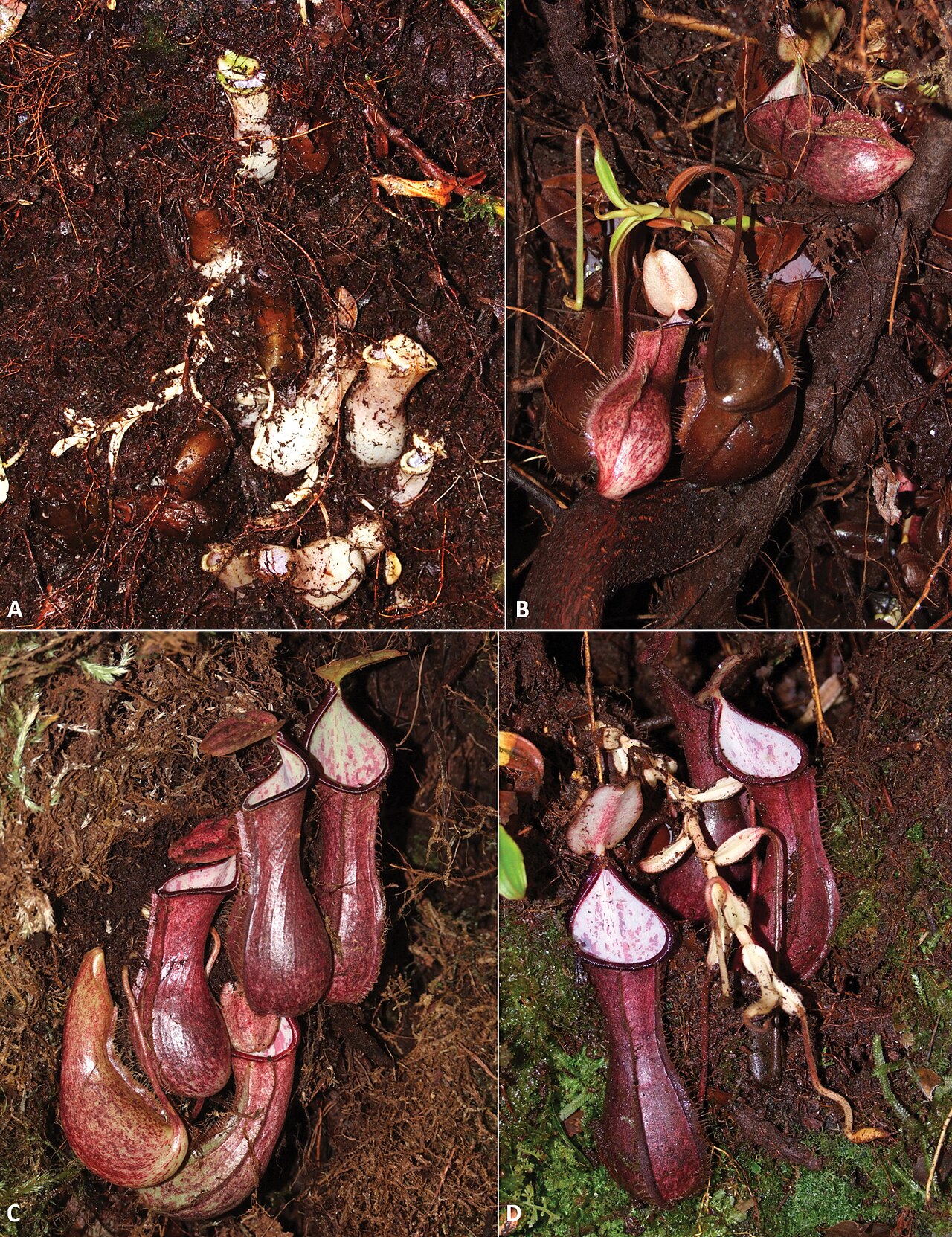
The pitcher plant that hides its traps underground. Nepenthes pudica was described in 2022 by Martin Dančák, Ľuboš Majeský and colleagues from the uplands of North Kalimantan, and it does something known from no other pitcher plant: it produces pale, underground shoots without chlorophyll, bearing well-developed, bellied pitchers that sit in the soil or in cavities in the ground. Above ground the plant makes hardly any lower pitchers. The name pudica, Latin for 'shy' or 'modest', refers to these hidden traps.
Identification
Above ground it is a fairly ordinary climber: glabrous stems 4 to 6 mm thick, with short internodes to 4 cm, and climbing shoots that can reach some twenty metres. What makes the species unique lies below the surface: short, underground shoots without chlorophyll, with reduced leaves, bearing bellied lower pitchers. These pitchers sit in the soil or in cavities among roots and stones, often with only the lid and mouth just below or at the surface. Above ground hardly any lower pitchers are produced, only pitchers on the climbing shoots. As the full description was not consulted for this guide, no pitcher measurements are given.
Similar species
The authors place the species in the group around Nepenthes hirsuta and Nepenthes hispida, lowland species of Borneo with hairy, bellied lower pitchers. N. pudica differs from all its relatives in its underground shoots with pitchers and its almost complete lack of above-ground lower pitchers. Anyone in the area who finds a plant with only climbing shoots and upper pitchers would do well to look carefully in the litter around its base: the underground pitchers may be there.
The trap and how it works
The first known case of functional underground traps in a pitcher plant. The pitchers in the soil work as pitfalls like all Nepenthes pitchers, with a peristome, a lid and digestive fluid, but their prey is different: the authors found mainly ants, alongside other invertebrates living in litter and soil. It is an example of how a carnivorous plant can move its trap to where the prey is. Hiding the pitchers might also be linked to the seasonal dryness of the ridges, where the soil stays damper than the air, but that is a hypothesis.
Habitat and ecology
Mountain ridges at 1100 to 1300 m, in forest that can become seasonally drier (B1, D4). It is an unusual combination for a pitcher plant: most mountain species grow in permanently wet cloud forest. On these ridges the topsoil dries out at certain times, and a pitcher underground then loses less moisture than one in the air.
Distribution and elevation
Endemic to Borneo and, as far as is known, confined to the Mentarang Hulu district in the province of North Kalimantan, in the remote interior. This agrees with 'Borneo, North Kalimantan' in the guide's own species list. The area is sparsely populated, mountainous and little explored. Borneo is the centre of diversity of the genus, with more than forty species, most of them endemic and many confined to a single mountain or range.
- Native
Forms and variation
No varieties or wild forms have been described, and since the species has been known only since 2022, little can be said about variation. No natural hybrids have been published. The underground shoots are a fixed character, not a chance growth form of plants in a particular place. Like all pitcher plants the species is dioecious: there are male and female plants, and both must be in flower for seed to set. The small, inconspicuous flowers are borne in racemes or panicles and are pollinated by insects; the seeds are light and dispersed by wind.
Where and when to see it
Mentarang Hulu district is very hard to reach, and its uplands require several days' trekking with local guides. Never dig up plants to see the underground pitchers: it damages both plant and site. Anyone looking for the species had better watch for upper pitchers on climbing shoots in the ridge forest and look carefully through the litter around the base of the plant.
Conservation status
There is no IUCN assessment of this species (Not Evaluated). What is known: it is recorded from one remote district, and there only from a few ridges. Because the species is newly known, the risk of illegal collecting is real, as with other new pitcher plants. Kayan Mentarang National Park lies in the same region, but whether the sites fall within protected land has not been published. As a member of Nepenthes it is listed in CITES Appendix II. Newly described pitcher plants often quickly become sought after in the trade, and experience with other species shows that this can lead to the plundering of small populations before tissue culture meets the demand.
Scientific name
Nepenthes pudica | Dancak & Majesky, 2022
Nepenthes pudica was described in 2022 by Martin Dančák, Michal Majeský, Václav Čermák, Michael Golos, Bartosz Płachno and Wewin Tjiasmanto, in PhytoKeys 201: 77-97. The species attracted international attention as the first known Nepenthes species to form pitchers underground. A handful of localities in the Mentarang Hulu district, North Kalimantan, Borneo, at 1,100-1,300 m elevation; no single, specific type locality could be established more precisely. The specific epithet is Latin for "shy" or "modest", referring to the species' tendency to conceal its pitchers.
World Checklist of Vascular Plants (WCVP), via Plants of the World Online (POWO), Royal Botanic Gardens, Kew.