All species › Caryophyllales › Tropical pitcher plant family › Nepenthes tomoriana
Nepenthes tomoriana
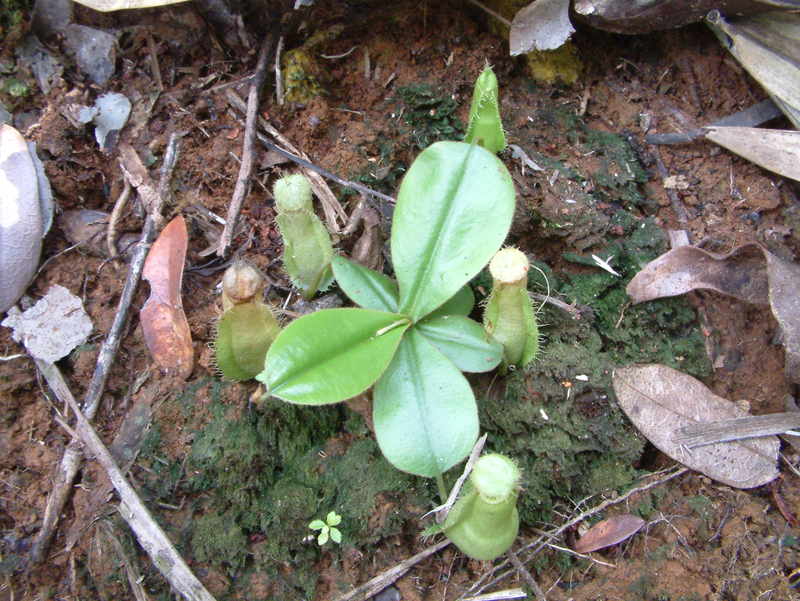
One of the few lowland species of Sulawesi, where most pitcher plants grow in the mountains. Nepenthes tomoriana was described in 1928 by B.H. Danser in his monograph of the pitcher plants of the Netherlands Indies, and is named after Tomori Bay on the east coast of Central Sulawesi, where the type material came from. It is a small, inconspicuous plant with pitchers of at most nine centimetres, growing on open, poor ground over ultramafic rock, from sea level to a few hundred metres.


Identification
A climber to five metres that starts as small rosettes. The rosette leaves are oblanceolate, 7 to 9 cm long; on climbing stems they become narrowly strap-shaped, 10 to 12 cm long and 1.5 to 3 cm wide. The lower pitchers are ellipsoid, 5 to 8.5 cm tall and up to 4.5 cm wide, with two strikingly broad, fringed wings of 5 to 8 mm and a narrow, rounded peristome of about 2 mm. The upper pitchers are almost cylindrical, slightly funnel-shaped, 7.5 to 9 cm tall and about 2 cm wide, without wings but with two ridges, and with a very narrow peristome whose ribs are barely visible. The lid is round to slightly broader than long, about 2 cm. The difference between lower and upper pitchers is linked to growth stage: young plants and rosettes form lower pitchers, and only when the stem begins to climb do upper pitchers appear, their tendrils often coiling around a support.
Similar species
The lowlands of Sulawesi also hold the very widespread Nepenthes mirabilis, which has larger pitchers, usually with a broader, clearly ribbed peristome, and occurs in many more habitats. N. tomoriana is smaller and finer in all parts, with a very narrow peristome and small, round lids. A cross between the two species has been documented at Bogor Botanic Gardens, showing that they are closely enough related to hybridise.
The trap and how it works
A pitfall on a small scale. The lower pitchers, with their broad, fringed wings, stand on the ground and catch walking animals; the wings act as a ladder to the mouth. The upper pitchers hang in the scrub and catch flying insects. Since the peristome is so narrow and its ribs so inconspicuous, the 'slide' is limited here; the smooth inner wall probably plays a larger part. Nectar glands lie on the peristome and under the lid. Nothing has been published on the prey.
Habitat and ecology
Open scrub on ultramafic soil, and occasionally in mangrove swamps, from sea level to about 400 m (R3, B5). Ultramafic rock, rich in magnesium and heavy metals, surfaces on a large scale in eastern Sulawesi and supports a low, open vegetation there. For a small, light-loving pitcher plant that vegetation offers room that tall rainforest lacks.
Distribution and elevation
Endemic to Sulawesi and, as far as is known, confined to Central Sulawesi, around Tomori Bay in the east of the province. This agrees with 'Sulawesi (Tomori area)' in the guide's own species list. The ultramafic lowlands of eastern Sulawesi are extensive, so the species probably occurs at more sites than documented. Sulawesi lies east of Wallace's Line, in the transition zone between the Asian and Australian floras and faunas, and holds far fewer pitcher plants than Borneo; all the more striking, then, that a large share of the island's species is endemic.
- Recorded (one-degree cells)
Forms and variation
No varieties or wild colour forms have been described. Plants in full sun are generally redder and stockier than plants in the shade of shrubs. A hybrid with N. mirabilis is known from Bogor Botanic Gardens; whether that cross also occurs in the wild has not been established for this guide. Like all pitcher plants the species is dioecious: there are male and female plants, and both must be in flower for seed to set. The small, inconspicuous flowers are borne in racemes or panicles and are pollinated by insects; the seeds are light and dispersed by wind.
Where and when to see it
The Tomori Bay area lies on the east coast of Central Sulawesi and can be reached by road from the Kolonodale region. On open, reddish-brown ultramafic ground with low scrub, search for small, winged lower pitchers on the ground and slender upper pitchers in the shrubs; they are small and only stand out close up.
Conservation status
The IUCN Red List assesses the species as Least Concern. At the same time the ultramafic lowlands of eastern Sulawesi are among the world's most important nickel-mining areas, and that mining is expanding fast, which may directly affect this species' habitat. As a member of Nepenthes it is listed in CITES Appendix II. For enthusiasts it is worth knowing that almost all species of the genus are now available through tissue culture; anyone wishing to grow a plant has no need of wild ones.
Scientific name
Nepenthes tomoriana | Danser, 1928
Described by B.H. Danser in 1928, likely in the same monograph as N. tobaica ("The Nepenthaceae of the Netherlands Indies"); the exact publication reference could not be established with certainty. Tomori Bay, Sulawesi, Indonesia — the source of the type material. No precise coordinates or elevation for the type itself are known; the species overall occurs at 0-500 m, endemic to Sulawesi. Named after Tomori Bay on Sulawesi, the source of the type material.
World Checklist of Vascular Plants (WCVP), via Plants of the World Online (POWO), Royal Botanic Gardens, Kew.