All species › Lamiales › Bladderwort family › Pinguicula casperiana
Pinguicula casperiana
In the Serranía de Cuenca, the limestone uplands between Castile and Aragon, grows a butterwort that went under another name until 2020. Pinguicula casperiana was separated in that year from P. mundi, on the basis of flower, fruit and seed characters and of genetic differences supporting the split.
Identification
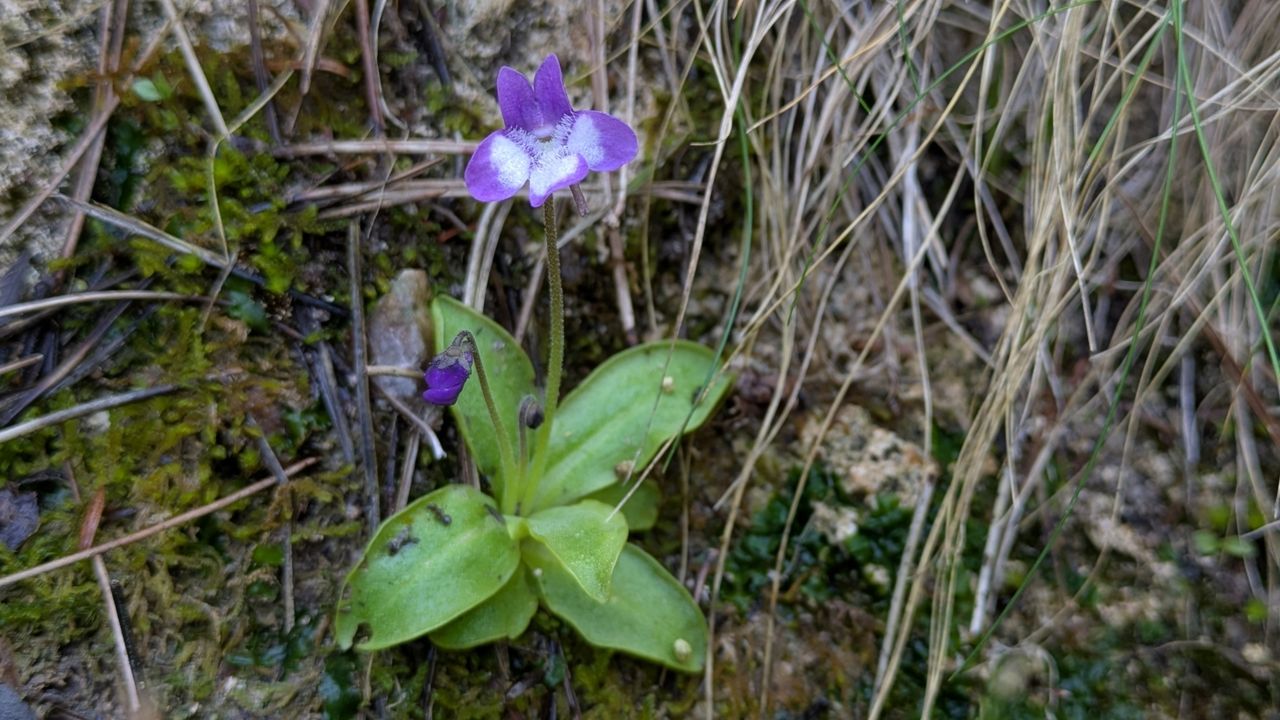
A rosette of yellow-green, oblong leaves, greasy to the touch, glistening with glandular droplets and with margins curled upward; on wet walls they are held obliquely. The scapes are glabrous and each carries one two-lipped flower with a two-lobed upper lip, a three-lobed lower lip and the long cylindrical spur characteristic of this group. Reliable measurements for plant, corolla and spur of this taxon could not be traced to a checkable source for this guide and are therefore not given; the original description in Phytotaxa does supply them, but was not freely available while this account was compiled.
Similar species
The nearest relative is Pinguicula dertosensis from the Ports de Tortosa-Beseit, and the species also stands close to P. mundi, from which it was separated. That is exactly what makes identification difficult: all three are Iberian rock butterworts with long spurs and violet flowers, and the differences lie in flower detail, fruit shape and seed coat. Geography helps most: P. casperiana is the plant of the Serranía de Cuenca, P. mundi that of the Sierra de Alcaraz and the Calar del Mundo, and P. dertosensis that of the north-east.
The trap and how it works
A flypaper trap in a cool limestone gorge. The leaf carries stalked glands with a sticky droplet and, between them, sessile glands supplying digestive enzymes once prey is lying on them. In the permanently humid air along a dripping wall, mosquitoes, midges and gnats fly in quantity, and they make up most of the catch. After a catch the leaf margin rolls towards the prey so the digestive fluid stands in a shallow dish; on a steep or overhanging face that is the difference between digesting and losing it. The limestone and tufa the plant sits on supply almost no nitrogen of their own.
Habitat and ecology
Rocky, calcareous mountain habitats: dripping limestone and dolomite walls, tufa deposits at springs, and shaded gorge faces with water seeping through permanently. Sites lie in the middle to upper zone of the massif and generally face north, out of reach of the summer sun. The plant tolerates no drought: where the water fails in a dry year, the population goes. In the surrounding sierra, bone-dry and hot in summer, these wet walls form sharply bounded islands with their own moisture-loving flora.
Distribution and elevation
The Serranía de Cuenca, across the provinces of Cuenca and Guadalajara in Castilla-La Mancha, in the central-eastern Iberian Peninsula. The range is small and restricted to the limestone gorges of that massif. Our own species list gives only 'Spain' for this taxon; that is too coarse, since the species is defined precisely by its confinement to this one upland, and records from other Spanish sierras belong with the related species.
- Recorded (one-degree cells)
Forms and variation
No wild varieties are recognised — for a taxon described only in 2020 that would be premature anyway. Such variation as exists follows the site: plants on the wettest, most shaded faces grow larger and flower more freely than plants in a merely damp crevice. More significant is the taxonomic movement around it: this is the second split within the Iberian rock butterworts in a short span, and further populations in adjoining sierras may yet be revised. Older literature on the Serranía de Cuenca carries these plants under P. mundi.
Where and when to see it
May and June, while winter water is still working through the limestone. Search the north-facing gorges and the headwaters of the streams, at the points where water leaves the wall and the rock shines. Look up: the rosettes often hang above eye level in a crevice or on a tufa lip. Do not step onto the tufa deposits at the foot of the wall — they are soft and brittle and do not grow back. Photograph flower, fruit and leaf and record the locality precisely; for a newly described species a good observation is worth a great deal.
Conservation status
The species has not been assessed for the global Red List, which is hardly surprising for a taxon of 2020; there is therefore no international category, and CITES does not apply. What is known: an Iberian endemic with a small range in one limestone massif, tied to permanently wet faces wholly dependent on spring discharge. The threats follow: the tapping of springs, falling water tables in longer droughts, road and water works through the gorges, and recreational pressure where climbing routes and canyoning run along wet walls. While an assessment is lacking, the empty field says nothing here about safety.
Scientific name
Pinguicula casperiana | Crespo, Martínez-Azorín, Alonso & Sáez, 2020
Described by Manuel B. Crespo, Mario Martínez-Azorín, Miguel Ángel Alonso and Llorenç Sáez in 2020. The type area lies in the Serranía de Cuenca, in the border area of the Spanish provinces of Cuenca and Guadalajara, where the species was long confused with the related Pinguicula mundi and P. dertosensis. The species name casperiana, like P. casperi, honours the German taxonomist Siegfried Jost Casper.
World Checklist of Vascular Plants (WCVP), via Plants of the World Online (POWO), Royal Botanic Gardens, Kew.