All species › Lamiales › Bladderwort family › Pinguicula caussensis
Pinguicula caussensis
The Causses of southern France are arid limestone plateaus cut into deep gorges by the Tarn and the Jonte. On the wet, north-facing walls of those gorges grows Pinguicula caussensis, in French the grassette des Causses — a plant carried as a subspecies of the long-leaved butterwort until 2016.
Identification
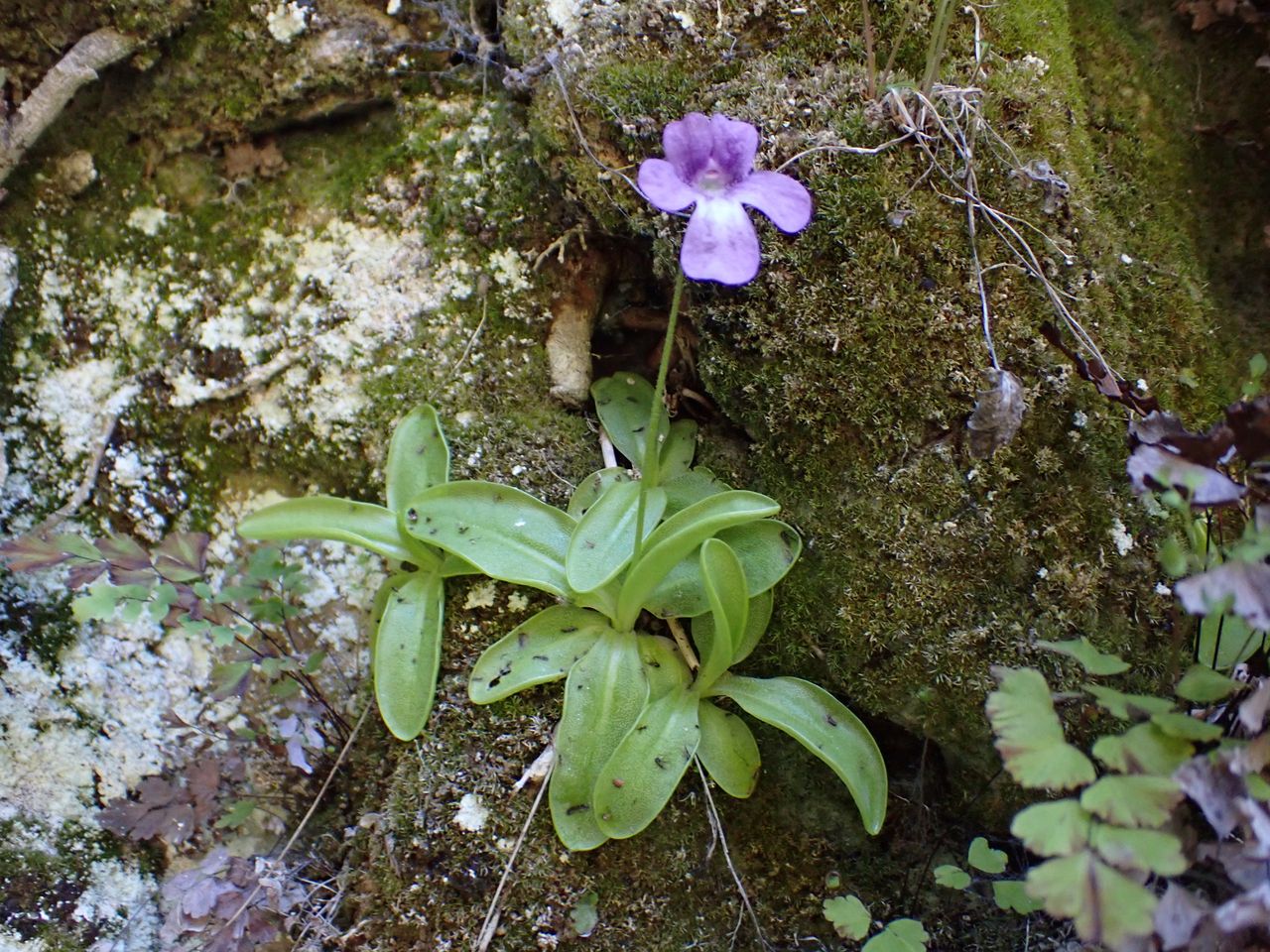
A rosette of yellow-green, oblong leaves with a glistening glandular coat that feels greasy; the margin is curled upward, and on a vertical wall the leaves hang obliquely or almost straight down. Glabrous scapes rise from the centre, each with one two-lipped flower with a violet corolla, a paler throat and the long slender spur characteristic of the long-leaved butterwort group. Reliable measurements for plant, corolla and spur could not be traced to a checkable source for this guide and are therefore not given. The plant flowers in spring and then produces longer summer leaves.
Similar species
The species belongs to Pinguicula longifolia in the broad sense and was until recently treated as a subspecies of it; typical P. longifolia grows in the Pyrenees, hundreds of kilometres to the south-west, so field confusion does not arise. Further east, in the south-western Alps, P. reichenbachiana occupies comparable wet limestone. In the Causses themselves there is no second butterwort to confuse it with: a rosette of sticky leaves on a dripping gorge wall in the Gorges du Tarn or the Gorges de la Jonte is this species.
The trap and how it works
A flypaper trap on a permanently wet limestone wall. The leaf bears stalked glands with a clear adhesive droplet and, between them, sessile glands that deliver digestive enzymes only once prey is lying on them. In the cool humid air of a deep gorge, mosquitoes and gnats are present all season and make up most of the catch. After a catch the leaf margin rolls slowly over it so the digestive fluid does not run off the wall. The limestone supplies almost no nitrogen, so what the plant spends on growth and flowering comes very nearly all from these insects.
Habitat and ecology
Dripping, north-facing limestone walls in gorges and canyons, where water that has sunk through the plateau reappears at the face. The plant roots in crevices and in moss cushions on the rock, often in overhanging or deeply shaded sections the sun never reaches directly. On top of the Causses the landscape is bone dry and steppe-like in its poverty; the gorges below are cool and humid, and it is precisely that contrast that makes the habitat possible. Drying out, or exposure after shade is removed, ends a population.
Distribution and elevation
The limestone plateaus of the Causses and the gorges of the Tarn and the Jonte in southern France, in the departments of Lozère and Aveyron, with sites across more than ten communes in and around the Cévennes national park. The range is small, elongated and follows the gorge walls. Our own species list gives only 'France (southern France)'; that is true, but the species is in fact strictly tied to this one plateau country, not to southern France in general.
- Recorded (one-degree cells)
Forms and variation
No wild varieties are recognised. What varies is plant size and number of flowers, which track the moisture and shelter of the patch of wall. The taxonomic status has changed, though: in 2016 the plant was raised from subspecies of P. longifolia to a species of its own, and older French floras and records still list it under the old name. Anyone using historical data should allow for that; in both cases the same plants on the same walls are meant.
Where and when to see it
Spring, while the winter's water is still emerging from the walls: May is usually a good month. Search the deep, north-facing sections of the gorges from the road or riverside path, watching for dark wet bands on the pale limestone. Binoculars are essential here, because the rosettes usually hang far above the path. Do not climb the walls — they are loose, the plant roots in fragile moss cushions, and the gorges are heavily visited by climbers, which is load enough on these sites.
Conservation status
The species counts as of least concern. That rests largely on the gorge walls being unreachable and unbuildable and on much of the range lying inside the Cévennes national park, where the species has been monitored for years. The vulnerabilities remain: the entire world range consists of the walls of a few gorges, every site depends on water seeping through the limestone plateau, and longer summer droughts reduce that supply. On top of that, climbing routes and via ferratas touch exactly the wet, shaded sections of wall the plant occupies. CITES does not apply.
Scientific name
Pinguicula caussensis | (Casper) Roccia, 2016
Originally described in 1966 as a subspecies of Pinguicula longifolia by Siegfried Jost Casper; raised to the distinct species Pinguicula caussensis by Fabrizio Roccia in 2016. The type area lies on the Causses, the limestone plateaus of southern France (the departments Aveyron, Gard, Hérault and Lozère). The species name caussensis refers directly to the Causses, also reflected in the French common name "Grassette des Causses".
World Checklist of Vascular Plants (WCVP), via Plants of the World Online (POWO), Royal Botanic Gardens, Kew.