All species › Lamiales › Bladderwort family › Pinguicula tejedensis
Pinguicula tejedensis
The Sierra Tejeda and the neighbouring Sierra de Almijara are marble and dolomite mountains rising steeply from the coast of Málaga. High in them, on wet rock beside the springs, grows Pinguicula tejedensis, a butterwort given a name of its own only in 2020.
Identification
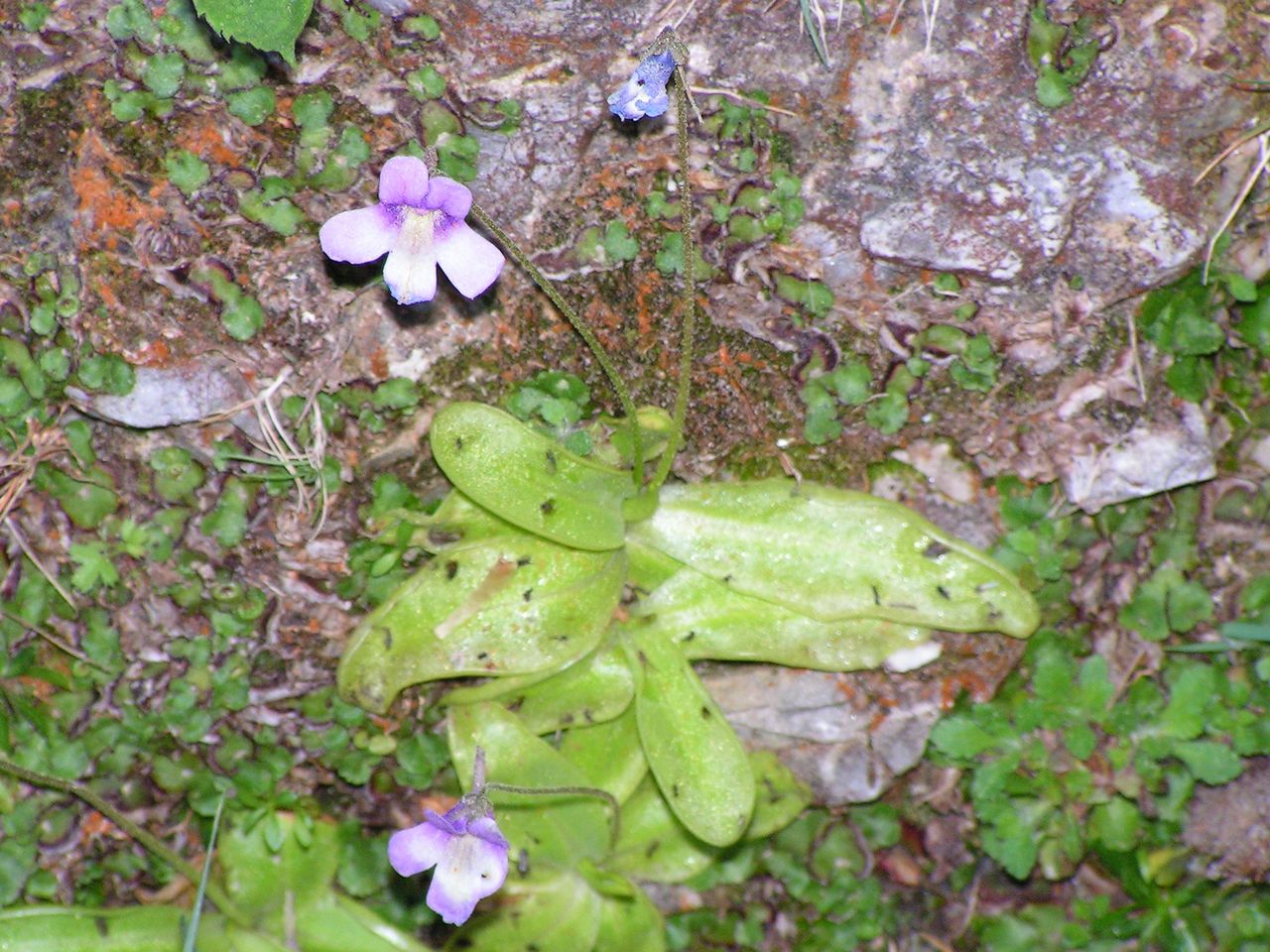
A rosette of yellow-green, oblong leaves with a glistening glandular coat that feels greasy and a margin curled upward; on a steep wall the leaves are held obliquely. Glabrous scapes rise from the centre, each with one two-lipped flower: a two-lobed upper lip, a three-lobed lower lip with a paler throat, and a spur behind. Reliable measurements for plant, corolla and spur were not freely available while this guide was compiled and are therefore not given. The species was described on flower characters, fruit shape and seed coat, supported by molecular differences.
Similar species
According to its describers the nearest relative is Pinguicula submediterranea, from which the species is readily separated on the characters given there. More important in the field is its history: the plants of the Sierra Tejeda were formerly placed with P. dertosensis, a species that in fact belongs more than four hundred kilometres to the north in the Ports de Tortosa-Beseit. Anyone consulting older Andalusian literature will therefore still meet that name. In the Baetic ranges themselves the other species to reckon with is P. vallisneriifolia, much larger and producing stolons.
The trap and how it works
A flypaper trap on soaked dolomite. The leaf bears stalked glands with an adhesive droplet and, between them, sessile glands that release digestive enzymes once prey is lying on them. The catch consists of midges, gnats and springtails living in the humid air around a spring or wet wall. In response to prey the leaf margin rolls slowly over it, so the digestive fluid stands in a shallow dish instead of running off the slope. On these bare, permanently flushed rocks no nitrogen is to be had from the substrate; what comes in arrives through the air and sticks to the leaf.
Habitat and ecology
Wet rocky, calcareous ground high in the mountains: dripping dolomite and marble faces, spring mouths, seepage between boulders, and damp patches above the treeline. The species was described from the higher parts of both sierras and is thus a decidedly montane plant. The surrounding landscape is markedly dry and hot in summer, so the wet places form sharply bounded islands in which ferns and mosses also persist that are wholly absent from the terrain around them.
Distribution and elevation
The high parts of the Sierra Tejeda and the Sierra de Almijara in the province of Granada, in southern Andalusia, at the edge of what are called the Baetic ranges. The range is small and lies inside a protected natural park. Our own species list gives only 'Spain'; for a plant whose entire world population sits in two adjoining sierras that is too little. The name refers directly to the Sierra Tejeda, source of the type.
- Recorded (one-degree cells)
Forms and variation
No wild varieties are recognised; for a taxon of 2020 that would be premature. The visible differences between plants follow the site: on the wettest faces they grow larger and flower more freely. The taxonomic context is worth noting: this species was described together with P. casperiana in one paper, and with the slightly earlier P. saetabensis they form a run of segregations that has turned the Iberian rock butterworts from a single widespread species into a set of local endemics.
Where and when to see it
May and June, while melt and winter water are still working through the rock. Search high in the sierra at the springs and wet faces, in north-facing corries where the snow lies longest. Look up and sideways rather than down: the rosettes often sit above eye level in a wet crevice. The terrain is steep, loose and sunny; carry water, keep to the paths and use binoculars rather than climbing. Record the locality and photograph flower, leaf and fruit.
Conservation status
The species has not been assessed for the global Red List, which is usual for a taxon of 2020; there is therefore no international category, and CITES does not apply. What is known is nonetheless enough to gauge its vulnerability: the entire range covers two adjoining sierras, the sites are small and depend on spring discharge that falls away in dry years. That the area is a protected natural park helps against building and reclamation, but not against falling groundwater, abstraction upstream and longer summer droughts. Collection of wild plants is a further concern with a newly described species.
Scientific name
Pinguicula tejedensis | Crespo, Martínez-Azorín, Alonso & Sáez, 2020
Described by Manuel B. Crespo, Mario Martínez-Azorín, M. Ángeles Alonso and Llorenc Saez in 2020. The species is endemic to the Sierra de Tejeda and the Sierra de Almijara, in Granada province, Spain, where it grows on limestone rocks at spots where water emerges. The name refers directly to the type locality: the Tejeda mountain range (Sierra de Tejeda).
World Checklist of Vascular Plants (WCVP), via Plants of the World Online (POWO), Royal Botanic Gardens, Kew.