All species › Waders, gulls and terns › Auks › Black guillemot
Black guillemot
Cepphus grylle | Zwarte zeekoet | Arao aliblanco
The tystie is the odd one out among the auks: it does not pack onto open ledges but nests in scattered pairs among boulders, and it stays inshore all year. In summer it is sooty black with a large white wing patch and vivid red legs.

Voice
Thin, high whistles, a drawn-out tseeee closer to a squeaking hinge than to a seabird, given in long series by displaying birds on the water below the colony. Calling birds show the red gape as they do it. The sound carries poorly and is best heard on a calm early morning.
Recording: Gunther Tschuch — CC BY-SA 4.0 · Wikimedia Commons
Identification
Summer adults are uniform sooty black with a sharply defined white oval on the wing coverts and bright red legs; the gape is red as well and is shown off in display. The bill is thin, straight and black. In winter the head, neck and underparts turn almost white and the mantle is finely barred black and white, while the white wing patch stays. Immatures have that patch broken with dark. The underwing is white, dark on every other European auk.
Confusion species
No other European auk combines a large white patch on the upperwing with red legs, and those two together settle it. Common Guillemot and Razorbill are bigger and longer-bodied, lack both features, and show a dark underwing rather than a white one. In winter the gap widens: the tystie becomes a pale, almost white bird with a barred mantle, while Guillemot and Razorbill keep a dark mantle and a black-and-white face pattern. Little Auk is far smaller, stub-billed, and shows white scapular lines instead of a wing patch.
Habitat
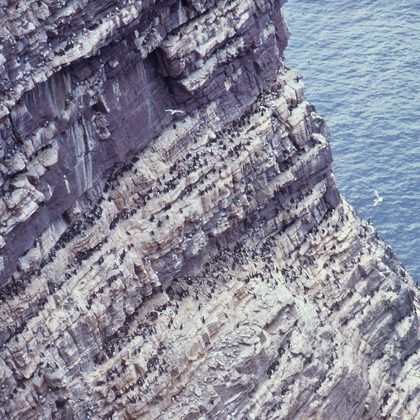
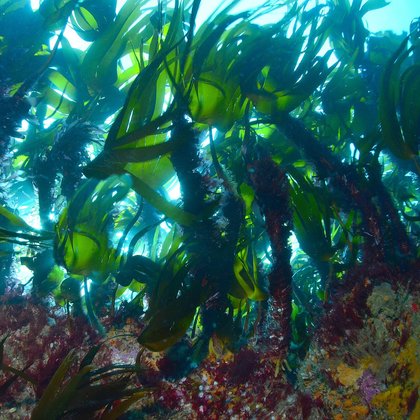
Rocky shores and boulder beaches, and where natural cavities are scarce also harbour walls, piers and quays. It does not form dense colonies but nests in loose pairs, in a crevice or under a boulder. It feeds close inshore over shallow rocky ground, rarely more than a few kilometres out, diving for butterfish (Pholis gunnellus), gobies and crustaceans.
Where the bird is most at home, classified with EUNIS — the European standard for habitats.

Range and movements
Breeds in Iceland, Norway, the Faroes, Scotland, Ireland and the Baltic, north to Svalbard and Greenland. In Britain and Ireland it is a resident of the north and west, common on Orkney, Shetland, the Hebrides and along the Irish coast, thinning out southwards to the Isle of Man and a few pairs in Cumbria and Anglesey. Unlike most auks it barely migrates and stays near the breeding site as long as the water is open.
- Resident
- Breeding (summer)
- Winter
- Passage
- dark = core range, pale = thinly spread
Where and when to look
Look in harbours rather than out to sea. At Oban, Stromness, Portpatrick and half the piers of Shetland the birds sit on the quay wall and swim between the boats, and a March or April morning gives display, red gapes and the whistling calls at a few metres. In late summer scan the same water for juveniles, which are grey-mottled and easily passed over.
Conservation status
Not globally threatened and numerous in Scotland and Iceland, but the Baltic population is declining. The risks are drowning in gillnets, oil pollution, and on islands the predation of nests by introduced American Mink and rats; mink removal on British islands has brought quick local gains. Because the birds feed close inshore they are unusually exposed to small, local pollution events.