All species › Storks › Storks › Black stork
Black stork
Ciconia nigra | Zwarte ooievaar | Cigüeña negra
The Black Stork is a large, shy bird that keeps away from people: it breeds in old, quiet woodland and feeds alone along streams and pools. Extremadura and Portugal hold a large share of the western European population, and even there seeing one remains a matter of patience.

Voice
Rather silent. The commonest call is a high, indrawn chee-lee that sounds like a long intake of breath, and a hoarse hiss when threatened. At the nest the adults alternate flowing loo-loo-loo series with plaintive notes, and in display the male gives a run of wheezy squealing calls that swell and then die away, with something of a raptor about them. It clatters its bill only seldom and weakly, far from the loud rattle of a White Stork; the young do clatter when excited.
No freely licensed recording is available for this species yet.
Identification
The outline is that of a stork, but the plumage is black with green and purple gloss over neck, back and wings, and only the belly and the undertail coverts are white. In flight, then, you see a dark body with a white wedge at the rear underside and wings black both above and below. The bill is long, straight and bright red, the legs are red and the bare ring around the eye is red as well. Young birds have a greenish-brown bill and legs and a matt plumage without gloss, with a lightly scaled head and neck. It flies with neck and legs extended, soars on flat wings with the primaries spread like fingers, and is a little smaller and narrower winged than the White Stork.
Confusion species
White Stork shares the outline and the manner of flight, but is white with black flight feathers only; in Black Stork the white is confined to the belly and the armpits, so against the light the bird looks wholly dark. Glossy Ibis is far smaller and dark, with a downcurved bill and quicker wingbeats. Common Crane also flies with neck and legs extended, but is grey, travels in noisy flocks and shows a paler forewing. Grey Heron pulls its neck in when flying and never has a red bill. At long range a soaring Black Kite can suggest a similar shape, but it has a forked tail and a much shorter neck.
Habitat
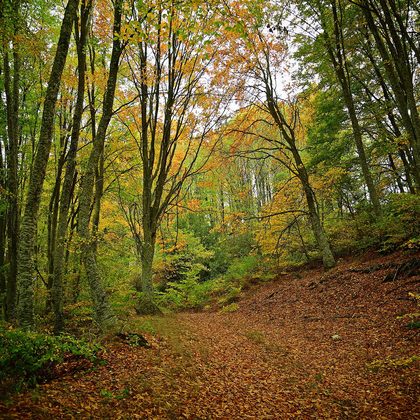
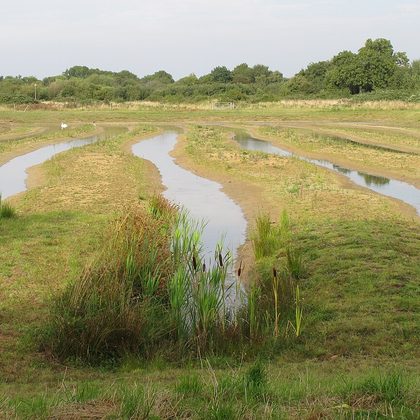
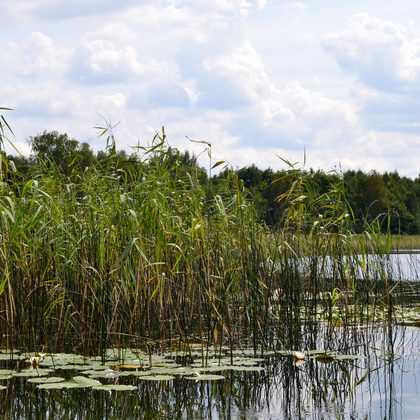
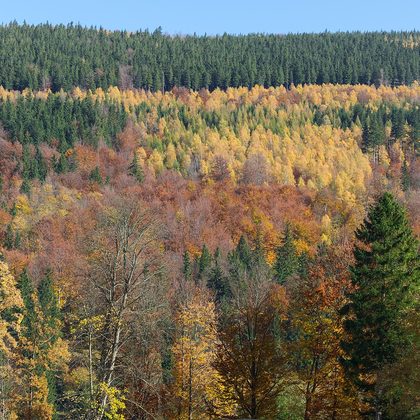
Breeds in old, undisturbed woodland — oak, beech, mixed and coniferous forest — and in Iberia also on rock faces, always well away from human traffic. It feeds alone in shallow water: streams and small rivers with a stony bed, the tails of reservoirs, pools, wet grassland and rice fields, where it wades slowly and takes fish, amphibians, grass snakes and water insects. It therefore needs two things at once: quiet forest for the nest and a network of clean water in which to feed.
Where the bird is most at home, classified with EUNIS — the European standard for habitats.

Range and movements
Breeds in a broad belt from Iberia and central Europe eastwards into Russia, with its strongholds in Extremadura and Portugal in the west and in Poland, the Baltic states and Belarus in the east; southwards it reaches Greece and Turkey. In the Netherlands it is a passage migrant in very small numbers, seen each year in May and above all in August, when non-breeding young birds wander; there are no breeding records, but the nearest pairs are in the Belgian Ardennes and just over the German border. European birds winter in the Sahel, though a growing share of the Iberian population stays in the south-west of the peninsula.
- Resident
- Breeding (summer)
- Winter
- Passage
- Migration direction
- dark = core range, pale = thinly spread
Where and when to look
In the Netherlands take up a watchpoint in the second half of August on the edge of the Veluwe or the Meuse valley, between about ten and two, when the thermals get going and migrating birds soar over high. In Extremadura, Monfragüe gives the most from March to June: stand at the Salto del Gitano at sunrise, when the birds leave the rock face for the river. Stay away from breeding woodland; a small disturbance is enough to make a pair desert the nest.
Conservation status
Not globally threatened (IUCN: Least Concern). In Spain the species is listed as endangered in the national catalogue of threatened species and as vulnerable in the national Red Book. The main pressures are felling and forestry work in the breeding woods during the nesting season, disturbance near the nest, collision and electrocution on power lines, and the drying out of streams and pools. In eastern Europe the population holds steady or falls slowly depending on the country, while in Iberia it has grown slowly since the 1980s.