All species › Passerines › Bulbuls › Common bulbul
Common bulbul | Pycnonotus barbatus
Grauwe buulbuul | Bulbul naranjero
Across North Africa the Common Bulbul sets the soundtrack of gardens, oases and village squares: a plain brown, long-tailed songbird with a surprisingly full and clear whistled phrase. Since 2013 it has also bred on the Spanish side of the Strait of Gibraltar, making it the first bulbul to walk into mainland Europe under its own steam.

Voice
The song is a short, loud and liquid run of eight to ten whistled notes, about two seconds long and slightly rolling; classically rendered as doctor-quick, doctor-quick. From first light it is the first thing you hear in a Moroccan garden. The contact call is a sharp, penetrating chip-chip-chip, turning into a rasping tchrr when alarmed. Heard year round, most of all from February to June.
No freely licensed recording is available for this species yet.
Identification
Slim, with a fairly large head and a long, straight tail that stretches the silhouette — about Starling size, but far longer behind. The head is sooty brown to blackish and runs down below the eye and over the throat; that dark hood is sharply set off against the dull brown mantle and wings. Underparts are dirty grey-white, slightly darker across the breast; the undertail coverts are white in North African birds and yellow in the races of the Sahel and East Africa. The bill is thin, black and gently decurved, with stiff bristles at the base. Sexes alike; juveniles are duller, with a browner hood and rusty feather edges on the wing. When excited the bird raises its crown feathers so that the head looks briefly peaked, but it has no true crest.
Confusion species
In Morocco and southern Spain there is no real confusion species: a Starling-sized bird, uniformly brown, dark-headed and long-tailed, hopping low through a bush, is a Common Bulbul here. Seen as a silhouette against the sky it recalls a female Blackbird, but Blackbird is bulkier, has a yellow or horn bill, and works the ground in hops rather than the inside of a shrub. From Egypt and Sinai eastwards the picture changes: White-spectacled Bulbul takes over, with a blacker head, a conspicuous white eye-ring and bright yellow undertail coverts. The Red-whiskered Bulbul flying free in Valencia always shows a pointed black crest, a red cheek spot and red undertail coverts, and is never plain brown.
Habitat
Almost anything with shrubs or trees that is not closed canopy: gardens and parks, hotel grounds, orchards, olive and argan plantations, oleander scrub along dry riverbeds, maquis, market gardens and oases. It avoids closed forest and open desert equally firmly. About three quarters of the diet is fruit — figs, dates, mulberries, olives, oleaster berries — with flowers, nectar and insects added, which makes it one of the most important seed dispersers of the Maghreb. The nest is a loose cup in the fork of a shrub or low tree, one to a few metres up.
Where the bird is most at home, classified with EUNIS — the European standard for habitats.



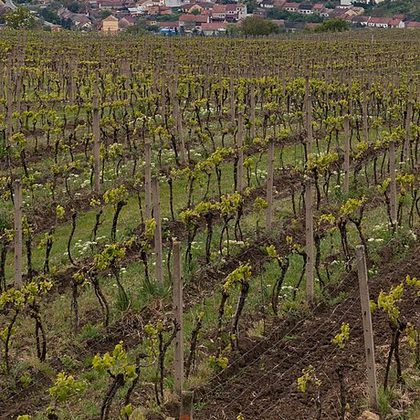
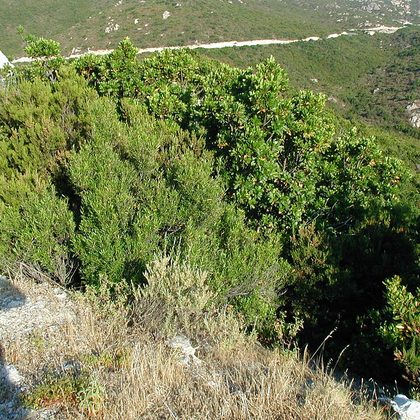
Range and movements
The whole of North Africa, from Morocco and Western Sahara through Algeria, Tunisia and Libya into Egypt, and from there in other races across the Sahel and East Africa deep into the tropics — so the range reaches far beyond the map area. Within Europe it breeds in Ceuta and Melilla, with about ten pairs, and since 2013 also on the Spanish mainland at the Strait of Gibraltar near Tarifa, with a few pairs reaching Málaga province. The first Spanish record dates from 1975; the birds are sedentary and are spreading slowly.
- Resident
- Winter
- Passage
- Migration direction
- dark = core range, pale = thinly spread
Where and when to look
The easy route is a breakfast terrace in Marrakesh, Agadir or Tunis: from sunrise males sing from the top of an oleander or a lamp post and allow approach to a few metres. To find it in Europe, work the gardens and tamarisks around Tarifa and the mouth of the Río Jara in spring and listen for the whistled phrase; there it is still a matter of patience and a handful of pairs.
Conservation status
Not globally threatened (IUCN: Least Concern) and common to very common over almost all of its range. The species profits from gardens, irrigation and urban greenery and is expanding rather than declining in North Africa. The Spanish population is small and fragile: a few pairs on the coastal strip of Cádiz and Málaga, where scrub clearance and coastal building are the main threats. In Ceuta the population is kept up by contact with the Moroccan birds.