All species › Waders, gulls and terns › Gulls and terns › Laughing gull
Laughing gull
Leucophaeus atricilla | Lachmeeuw | Gaviota guanaguanare
The gull of the American east coast, long in the body and fitted with a bill that would not look out of place on a tern. In Europe it arrives on the back of a storm, and the name is earned: the long call is a series of hard, cackling ha-ha-ha notes.

Voice
The long call is a run of loud, nasal, screaming notes that genuinely sounds like laughter: ha-ha-ha-haah-haah, falling away at the end. A short crow-like kaah goes with it. It is the signature gull voice of the American Atlantic seaboard, and on a European pier it is immediately suspicious.
Recording: Tony Phillips — CC BY 3.0 · Wikimedia Commons
Identification
A larger, longer-lined hooded gull than Franklin's, with a conspicuously long, heavy bill that droops slightly towards the tip. The summer adult has a dark slate-grey mantle, a black hood reaching onto the nape, narrow white eye crescents and a deep red bill; the legs are red-black to black. The wing tip is solidly black and runs out of the grey of the wing with no white break, showing at most a few small white tips. In winter the hood fades to a grey wash over the crown and ear coverts. First-winters are dusky brown across the breast and flanks with a grey head and neck, a broad black tail band and dark primaries, and adult plumage takes three years.
Confusion species
The comparison that matters is with Franklin's Gull, and three points do it. Size: Laughing is clearly bigger and longer-lined, with a longer neck and longer legs, and looks rangy where Franklin's looks thickset. Bill length: Laughing has a long, heavy bill drooping at the tip, against the short, straight bill of Franklin's. And the clincher in flight: on Laughing the grey of the wing runs straight into the black of the tip with nothing between, while Franklin's carries an obvious white bar there. Beyond that, in winter Laughing keeps only a faint grey wash over the crown where Franklin's holds a heavy half hood, and its white eyelids are narrow rather than broad and fleshy. Against Black-headed Gull the case is simple: a far darker mantle, a black rather than white leading edge to the outer wing, and a much heavier bill.
Habitat
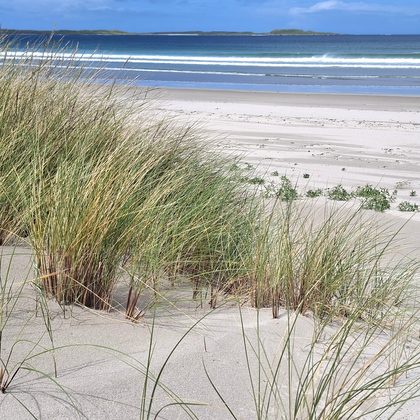
Strictly coastal: estuary mud and creeks, sandy beaches and spits, harbour basins, piers and fish quays. It goes barely any distance inland, though storm-driven birds do turn up on reservoirs and dock pools. It nests colonially, sometimes in thousands of pairs, on low coastal islands and saltmarsh along the Atlantic coast and through the Caribbean.
Where the bird is most at home, classified with EUNIS — the European standard for habitats.



Range and movements
Breeds along the Atlantic coast of North America, in the Caribbean and in northern South America, with northern birds shifting south for the winter. European occurrence is weather-driven: the autumn of 2005 produced an unprecedented arrival in Britain and Ireland after a run of Atlantic depressions in the wake of Hurricane Wilma, with birds scattered from Cornwall to the Northern Isles. Ireland and south-west England take the bulk of records in a normal year; the Netherlands has only a handful.
Where and when to look
In October and November, after a westerly gale, work the harbour basins, pier heads and beach spits and look for a hooded gull with a mantle too dark and a bill too long. If the bird is on the water, wait for it to fly and read the wing tip: black running out of grey with no white bar is Laughing Gull. Give the voice a chance as well, because the call alone will name the bird.
Conservation status
Least Concern, with a large and broadly stable world population. Regional pressures are real enough: low-lying nesting islands flood in storms and are losing ground to sea-level rise, colonies are disturbed by beach recreation, and larger gulls both compete and predate. On the Gulf coast of the United States oil spills have hit individual colonies hard.