All species › Woodpeckers and allies › Woodpeckers › White-backed woodpecker
White-backed woodpecker | Dendrocopos leucotos
Witrugspecht | Pico dorsiblanco
Europe's largest pied woodpecker and its fussiest: it lives only in old, damp broadleaved forest with plenty of standing and fallen deadwood. Tidy forestry drives it out, which is why it has become a rarity in western and northern Europe. It does not occur in Britain or Ireland.

Voice
The contact call is a soft, low kyuk, flatter and less sharp than the kik! of Great Spotted and repeated about once a second, running into a rattling series when the bird is agitated. The drum is the clearest clue: long, loud and accelerating, well over a second, where Great Spotted is finished in half that. In March and April it carries a long way through leafless woodland.
Recording: Hangvadász — CC BY-SA 3.0 · Wikimedia Commons
Identification
Bigger and longer-bodied than Great Spotted Woodpecker, with a long neck, heavy bill and a slightly top-heavy look. The lower back and rump are white — the best mark, though usually visible only on a climbing bird or in flight — and the wings are finely barred black and white, with no large white shoulder patch. The flanks and breast sides are streaked black and the vent is pink to dull red. The male has a wholly red crown, the female a black one; juveniles show a duller, mottled red crown. The southern form lilfordi, from the Pyrenees to the Caucasus, has a barred rather than clean white back and more heavily streaked underparts.
Confusion species
Great Spotted Woodpecker has two big white shoulder patches on a black back, plain white underparts and a vivid red vent, and its black moustache runs on to the nape; the male shows only a red nape patch. White-backed reverses all of that: barred wings without shoulder patches, a white lower back, streaked flanks and, on the male, an entirely red crown. Middle Spotted Woodpecker is much smaller, with an open white face and salmon-pink belly; Lesser Spotted is sparrow-sized and never shows red under the tail.
Habitat
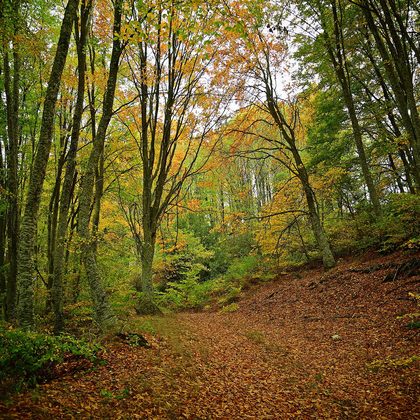
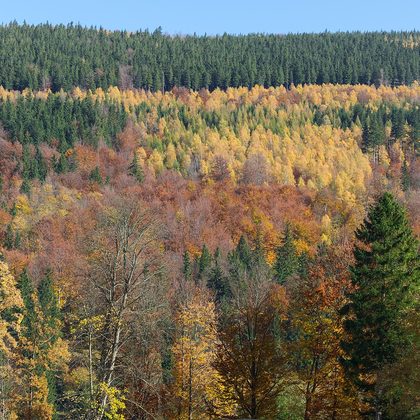
Old, damp broadleaved woodland with abundant deadwood: beech and oak forest, alder carr, birch and aspen regrowth, and montane beech further south. It chisels deep into soft, rotting timber for longhorn beetle and other larvae, so it needs thick dying and fallen trunks — more deadwood than any other European woodpecker. Windthrow, burnt stands and unmanaged reserves are its best ground; a tidied production forest is empty for it.
Where the bird is most at home, classified with EUNIS — the European standard for habitats.
Range and movements
From Scandinavia and the Baltic states through Poland and the Carpathians to the Balkans, Turkey and the Caucasus, with isolated mountain populations in the Pyrenees and the Italian Apennines, and on east through Siberia to Korea and Japan. Britain and Ireland lie outside the range altogether. For a British birdwatcher the nearest reliable ground is eastern Poland, the Carpathians or the Bavarian mountain forests.
- Resident
- Breeding (summer)
- Winter
- Passage
- Migration direction
- dark = core range, pale = thinly spread
Where and when to look
Go to a reserve where deadwood is left where it falls: Białowieża in eastern Poland, the Carpathians, or the forests of the Bavarian Alps. March and April are the months, early in the morning, and the long accelerating drum roll is the best pointer. Then walk slowly past fallen beech and birch and look for fresh, coarse excavations low on the trunks; the bird itself is quiet and surprisingly unwary.
Conservation status
Not threatened globally (IUCN: Least Concern), but much reduced in western and northern Europe and locally on the edge. In Sweden only about a dozen pairs raised young in 2024, despite a long-running recovery programme, and Spain holds roughly a hundred pairs in the Navarrese Pyrenees. The cause is the same everywhere: forestry that removes dead and dying wood. Where old broadleaved woodland is left alone, the species returns.