All species › Waders, gulls and terns › Skimmers, noddies, terns and gulls › Aleutian Tern
Aleutian Tern | Onychoprion aleuticus
Aleoetenstern | Charrán aleutiano
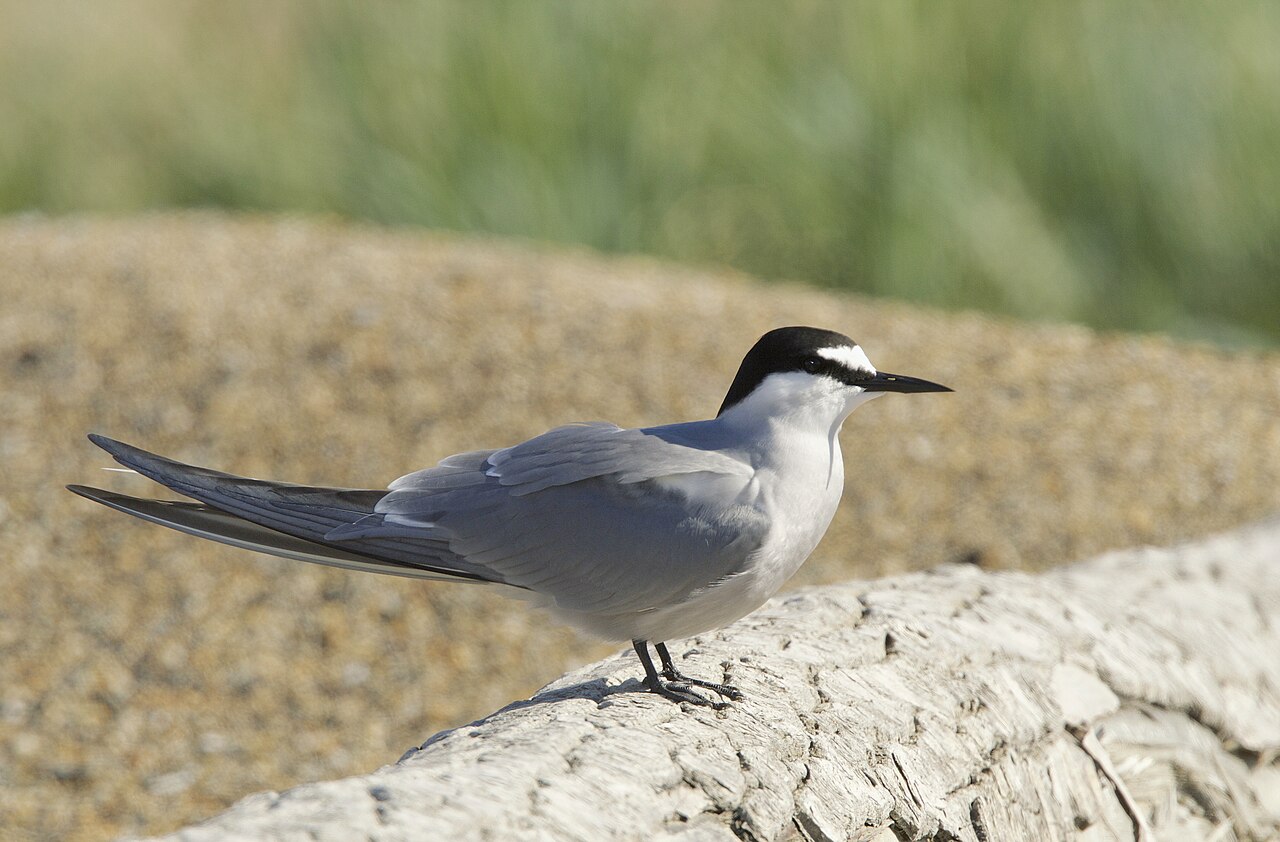
The Aleutian Tern is the only tern in this region that is grey below as well as above: mantle, wings, breast and belly all mid-grey, with a pure white rump and tail that flash as a pale wedge when the bird lifts off. It breeds on the cold North Pacific, in Alaska and the Russian Far East, and appears here only as a non-breeding visitor in Australian seas. It is one of the few seabirds whose wintering grounds were pinned down only this century.
Voice
The voice is higher, softer and more whistling than that of the terns it keeps company with: the usual contact note is a hurried chif-chif-choo-ak, followed in alarm by a fast descending wee-hee-hee-hee. It sounds more like a wader than a tern, and anyone who suddenly hears a whistled note among screaming terns on a pelagic should work that flock through. In Australian waters it is usually silent, since it is here outside the breeding season.
No freely licensed recording has been found for this species yet; what to listen for is described below.
Identification
A medium-sized, strikingly grey tern of thirty-two to thirty-nine centimetres: mantle, wings and underparts mid-grey, with a white rump and tail set against that grey back. The black cap leaves a sharply cut, almost rectangular white forehead patch running back above the eye. Bill and legs are black, in every plumage and all year round — no red, no orange, no yellow tip. In flight a dark bar along the trailing edge of the underwing stands out, a mark no other tern here shows in the same way. The tail is deeply forked but shorter than an Arctic Tern's. Outside the breeding season, and so in the plumages in which it turns up here, the cap is incomplete and flecked with white, which makes the bird look at first like an ordinary tern.
Confusion species
In Australian waters the first checks are Common Tern (Sterna hirundo) and White-fronted Tern (Sterna striata): both are white or very pale below and never show that even grey breast and belly, and their bills carry red or orange at the base or are longer and finer. Arctic Tern (Sterna paradisaea) is greyer below than Common Tern, but has white cheeks cutting sharply against the grey breast and translucent primaries in flight without the dark underwing bar. Bridled Tern (Onychoprion anaethetus) and Sooty Tern (Onychoprion fuscatus), its two close relatives in the same genus and the same tropical waters, are dark brown or black above and white below — exactly the reverse. On any suspect bird watch for the combination of black bill, grey underparts and white rump; those three together occur in no other tern here.
Habitat
In this region it lives entirely at sea: over the continental shelf and its deeper edges, often in mixed flocks with other terns above shoals of small fish. It rests on floating material and is occasionally seen on a sandbank or reef flat among moulting terns, but it does not come ashore here to breed. Its breeding habitat lies far outside the map window: saltmarsh, river mouths and tundra beaches along the cold North Pacific coasts.
Where the bird is most often found, arranged by main group and formation.


Range and movements
Within this guide's map window it is a rare visitor to Australian seas, almost entirely off the northern and north-eastern coasts, and nearly always seen well offshore among other terns. Most years produce a few records, always in small numbers, and the species is probably overlooked. It is unknown from New Zealand. Its breeding range — Alaska, the Aleutians, Kamchatka, the Sea of Okhotsk and Sakhalin — falls outside this guide; the wintering grounds remained a puzzle until 2016, when large flocks were found at sea in Indonesian waters, to the north-west of this region.
- Breeding (summer)
- dark = core range, pale = thinly spread
Where and when to look
The best chance is a pelagic trip over the northern continental shelf, where it may sit among Bridled and crested terns. Photograph every oddly grey tern: identification stands or falls on the grey belly and the white rump, and that combination is easier to judge on a photograph than through binoculars from a pitching deck. Listen as well: the whistled choo-ak is sometimes the first thing to stand out from a distant flock.
Conservation
Vulnerable (VU), and so the only threatened species among the dark terns and noddies of this region. The reason lies in the breeding range: many Alaskan colonies have fallen by tens of per cent to more than ninety per cent since the 1960s, through predation by foxes, gulls and introduced predators, through disturbance, and through erosion and flooding of low-lying nesting grounds. Because the migration route and wintering area have been known only recently, it is unclear what threatens the birds outside the breeding season; fisheries bycatch and shifting fish stocks in tropical seas are suspected. For Australia this mainly means that every well-documented record counts.
Scientific name
Onychoprion aleuticus | (Baird, 1869)
Spencer Fullerton Baird described the species in 1869 as Sterna aleutica; because it later moved to another genus, author and year take parentheses. The genus Onychoprion, which also holds Sooty and Bridled Terns, is formed from Greek onyx 'claw' and prion 'saw'. aleuticus means 'of the Aleutians'. The described specimen, however, came not from that island chain but from Kodiak Island in Alaska, where the species still breeds — so the name sits just beside its type locality.