All species › Waders, gulls and terns › Skimmers, noddies, terns and gulls › Bridled Tern
Bridled Tern | Onychoprion anaethetus
Brilstern | Charrán embriado
The Bridled Tern is the slimmest of the three dark tropical terns: greyish brown above, white below, with a black cap whose white forehead is drawn back as a narrow brow behind the eye — the bridle that gives it its name. It breeds through the Australian summer hidden under rock slabs and spinifex clumps on islands around half the continent, then spends months at sea, where it likes to ride on floating wood.

Voice
At the colony comes a low, hoarse, barking wep-wep, together with a growling rasp out of the crevices under the boulders where the nests lie. The pitch is clearly lower and rougher than the shrill, insistent screaming of the Sooty Tern. At sea it is nearly silent, though over a rich patch of food it gives short sharp cries. Because it breeds scattered and in small groups, a Bridled Tern colony is never the wall of sound that a Sooty Tern colony is.
No freely licensed recording has been found for this species yet; what to listen for is described below.
Identification
A slender tern of thirty to thirty-two centimetres, with long wings and a very long, deeply forked tail edged white. The upperparts are brownish grey — clearly paler than the sooty black of the Sooty Tern — and between the black cap and the grey mantle lies a pale hind-collar, the feature that settles it quickest in flight. The white forehead patch runs back as a narrow brow behind the eye, with a black lore stripe below it. The underparts are white, the underwing largely white with a dark trailing edge; bill and legs are black. Sexes alike; young birds have a shorter tail, pale fringes on the mantle and a dark, white-speckled head.
Confusion species
Sooty Tern (Onychoprion fuscatus) is the main test, and the two often share an island: it is heavier and black rather than brownish grey on the back, lacks the pale collar and has a white forehead patch that stops exactly above the eye instead of running back as a brow. Aleutian Tern (Onychoprion aleuticus), a rare visitor to northern Australian waters, is grey on the breast and belly rather than white and shows a white rump against a grey back. Brown Noddy (Anous stolidus) and Black Noddy (Anous minutus) are wholly dark with a pale cap and a wedge-shaped tail — exactly the reverse pattern. Behaviour helps too: Bridled Tern flies looser and more erratically, stays nearer land and does settle on driftwood, buoys and wreckage, which Sooty Tern rarely does.
Habitat
It hunts in warm sea over the continental shelf and along the reefs, taking small fish and squid from the surface and resting between bouts on floating material — a habit that gives it away. It breeds on rocky and sandy islands, and unlike its relatives it chooses cover there: the egg lies in a crevice under a rock slab, under a spinifex clump or deep under a bush, so a colony is all but invisible from outside. It does not breed on the mainland.
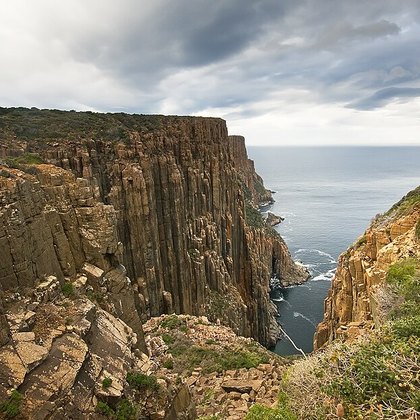
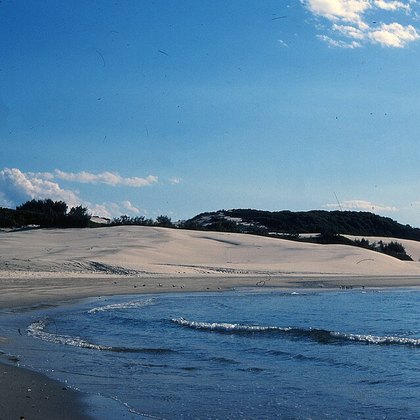
Where the bird is most often found, arranged by main group and formation.

Range and movements
In this region it is above all an Australian summer bird. It breeds on Western Australian islands — from Penguin Island and Rottnest near Perth by way of the Houtman Abrolhos and the Dampier Archipelago to the Lacepede Islands and Ashmore Reef — and on the eastern side on the cays of the Great Barrier Reef and in the Coral Sea; colonies are occupied from about September to March. Most birds then move north into the Indonesian and Arafura seas, and along the southern Australian coast almost none remain. In New Zealand it is an extreme rarity with only a handful of records.
- Resident
- dark = core range, pale = thinly spread
Where and when to look
Around Perth it is easy in summer: take the boat to Penguin Island or the ferry to Rottnest and look for terns sitting on a buoy or a piece of driftwood — that perching habit is almost always Bridled and not Sooty. On pelagic trips off the east coast look for the pale collar between cap and mantle, even when the bird is too far off for the brow. On an island never scan only open sand: this species sits under the stones and the spinifex, and gives itself away mostly by its low bark.
Conservation
Least Concern (LC), with a large world population in all tropical seas and tens of thousands of pairs in Australia, spread over so many islands that no single disaster takes the species at once. The risks are local: rats and cats on a breeding island, disturbance by visitors walking straight over the hidden nests, and entanglement or pollution at sea. Because the nests are under cover, a colony is also easily overlooked when visits or works are planned.
Scientific name
Onychoprion anaethetus | (Scopoli, 1786)
Scopoli described the species in 1786 as Sterna anaethetus; because it has since changed genus, author and year take parentheses. The genus Onychoprion is formed from Greek onyx 'claw' and prion 'saw'. anaethetus goes back to Greek anaisthetos, 'senseless, foolish', for the tameness with which breeding seabirds let themselves be approached — the same idea that lies behind the noddies' name. Scopoli gave the locality as 'in Guinea', but the specimen came through Sonnerat from the Philippines and was in fact collected on Panay.