All species › Waders, gulls and terns › Skimmers, noddies, terns and gulls › Sooty Tern
Sooty Tern | Onychoprion fuscatus
Bonte stern | Charrán albinegro
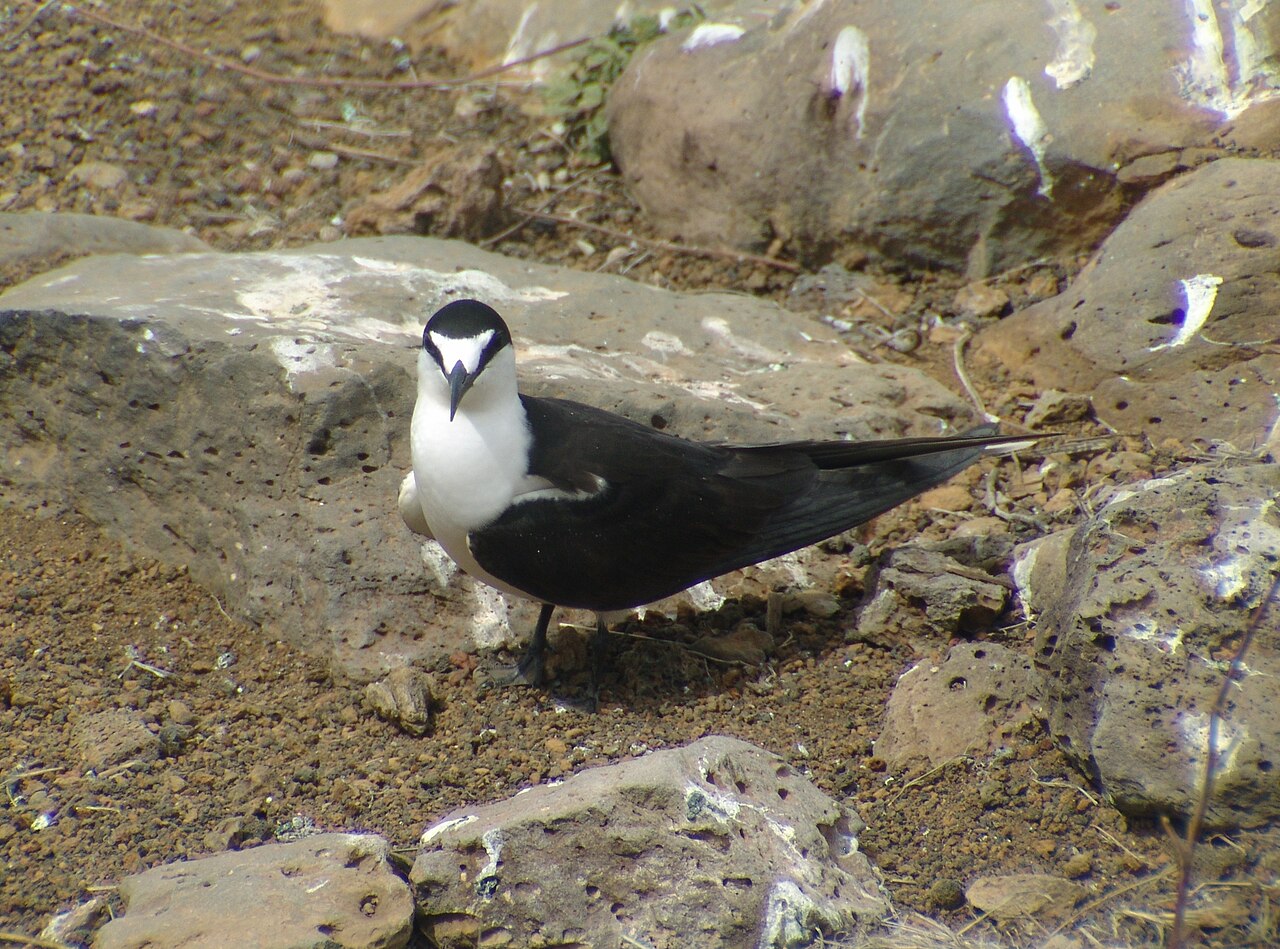
The Sooty Tern is the loud mass bird of the tropical sea: sooty black above, pure white below, with a sharply cut white forehead patch and a deeply forked tail. It breeds in colonies running into the hundreds of thousands on the largest Australian cays, and spends the years between breeding seasons almost entirely on the wing — its poorly waterproofed plumage barely lets it rest on the sea. After a cyclone, exhausted birds turn up far inland.
Voice
A colony can be heard day and night: a dense cloud of sound in which one call rises above the rest, a high, insistent wek-a-wek that English sailors wrote down as wide-a-wake and which gave the species its nickname wideawake tern. Around it runs a constant growling and rasping from birds on the ground. At sea it is much quieter, but a party working over hunting tuna raises a sharp barking clamour again. The sound of a large colony carries for kilometres over water and can be heard in calm weather before the island comes into view.
No freely licensed recording has been found for this species yet; what to listen for is described below.
Identification
A large, long-winged tern of thirty-six to forty-five centimetres, sooty black above and pure white below, with a sharply bounded white forehead patch ending exactly above the eye. The tail is deeply forked with white outer feathers; bill and legs are black. In flight the contrast is strong: black flight feathers against white underwing coverts, with a straight powerful beat high above the water. Sexes alike. Young birds look nothing like their parents: wholly sooty brown to black, with fine white drop-shaped spots on mantle and wing coverts and a paler belly.
Confusion species
Bridled Tern (Onychoprion anaethetus) is the great stumbling block, since the two breed on the same islands and differ less in the field than the measurements suggest. In Sooty Tern the back is black and the nape as black as the cap; Bridled Tern has a brownish-grey back and keeps a pale collar between cap and mantle. The white forehead patch ends above the eye in Sooty Tern, while in Bridled Tern it runs on as a brow behind it. Aleutian Tern (Onychoprion aleuticus) is smaller, grey below and shows a white rump. Wholly dark juvenile Sooty Terns are taken for Brown Noddy (Anous stolidus), but that bird is warm brown with a pale crown and has a wedge-shaped, not forked, tail.
Habitat
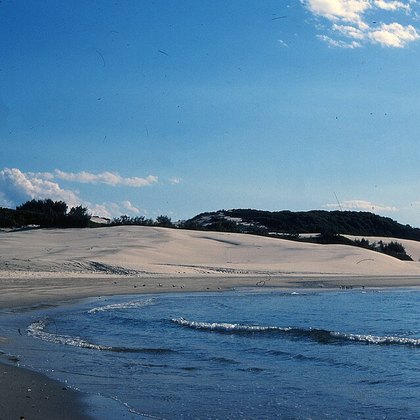
It forages far out to sea, often over hunting tuna and dolphins that drive small fish to the surface, taking prey on the wing without diving and without settling. It breeds on bare coral cays and sandy islands, in full sun and in the open: the egg lies in a scrape in sand or coral rubble, sometimes among low herbs, and the nests are packed so close that the sitting birds nearly touch. It makes no use of the mainland.
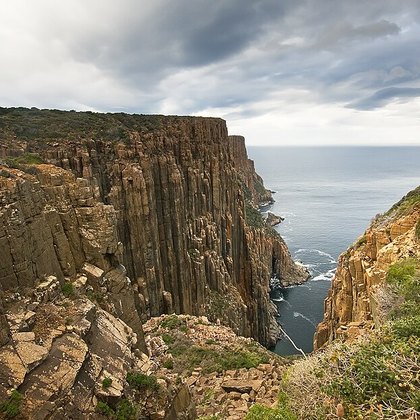
Where the bird is most often found, arranged by main group and formation.

Range and movements
In this region it breeds around almost the whole of tropical Australia: on the cays of the Great Barrier Reef, with Michaelmas Cay off Cairns and Raine Island the best-known colonies, in the Coral Sea, and on the western side on Bedout Island, the Lacepede Islands, Ashmore Reef and south to the Houtman Abrolhos. It breeds too on Lord Howe and Norfolk and, in New Zealand, only on the Kermadec Islands. Around the New Zealand main islands and along the cooler southern Australian coast it is a vagrant that nearly always arrives with a tropical storm; after a severe cyclone tens to hundreds of birds are then found inland or dead on the beach.
- Resident
- dark = core range, pale = thinly spread
Where and when to look
The easiest introduction is the day boat from Cairns to Michaelmas Cay: the colony sits tens of metres away and the wek-a-wek call carries over everything. On every dark tern check the back first — black or brownish grey — and only then the forehead, because at sea light that back difference is more reliable than head detail. After a cyclone it pays to work the beaches and even inland reservoirs for a few days: in New Zealand and southern Australia that is usually the only way to see the species.
Conservation
Least Concern (LC): with many millions of birds worldwide this is one of the most numerous seabirds on earth, and the Australian colonies are among the largest. Numbers per colony are volatile all the same, because everything hangs on a single island: rats, cats and feral pigs on a breeding island, a cyclone washing over a low cay, or a warm sea year in which the tuna schools the birds feed alongside fail to appear. On the main Australian cays visits are therefore fenced off and the colonies are protected areas.
Scientific name
Onychoprion fuscatus | (Linnaeus, 1766)
Linnaeus described the species in 1766 as Sterna fuscata; because it has since been placed in another genus, author and year take parentheses. The genus Onychoprion is formed from Greek onyx 'claw' and prion 'saw'. fuscatus is Latin for 'darkened', after the sooty upperparts. The described specimen came from Santo Domingo on Hispaniola; the birds of this region belong to the subspecies serratus, which breeds in Australian and western Pacific waters.