All species › Tubenoses › Petrels, shearwaters and diving petrels › Antarctic Prion
Antarctic Prion | Pachyptila desolata
Antarctische prion | Prión antártico
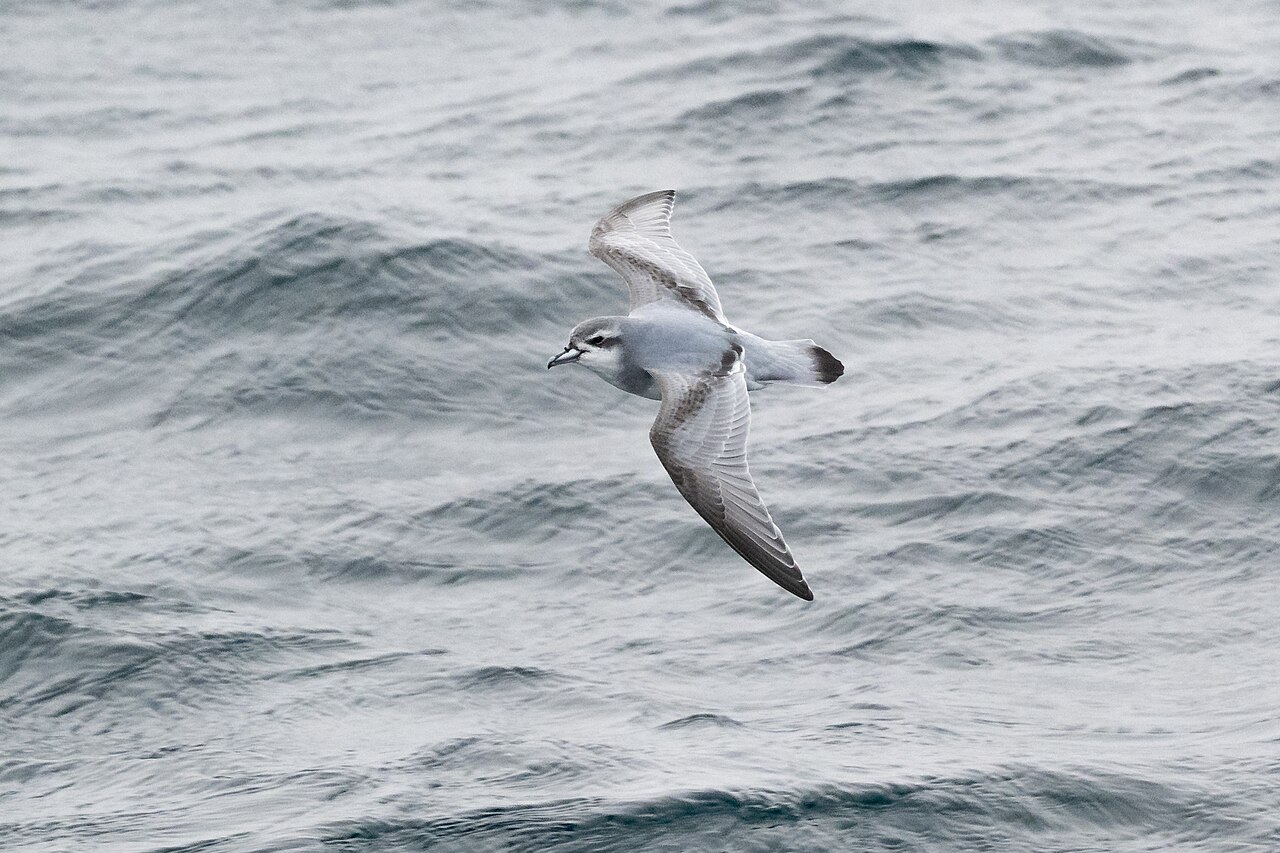
The Antarctic Prion is the commonest whalebird of the cold sea south of Australia and New Zealand: a dove-sized seabird, blue-grey above with a blackish M across the spread wings, white below and with a black tail tip. What separates it from its five near-identical relatives is not the plumage but the bill: bright blue, straight-sided and 11 to 15.5 mm wide — squarely in the middle of the genus.
Voice
At sea it is all but silent. The voice belongs to the colony, and there only after dark: a hard rattling chatter alternating with a softer, dove-like crooning — coo-roo-roo — that in a dense colony runs together into one continuous murmur. Birds circling over the tussock in the dark give short shrill calls; from inside the burrow the crooning comes muffled. It is the sound that earned the bird its Maori name totorore.
No freely licensed recording has been found for this species yet; what to listen for is described below.
Identification
About 26 cm long and 150 g, with a wing of some 18 cm. Blue-grey above with a blackish M running from one wingtip across the back to the other, white below, with a grey tail ending in a black tip, a dark eye-stripe and a grey cheek. The bill is bright blue and, seen from above, straight-sided; the lamellae — the comb-like filter plates along the upper mandible — stay hidden once the bill is closed. In flight it is fast and erratic, low over the water and often in parties of tens to hundreds that bank together, flashing blue-grey backs and then white bellies.
Confusion species
All six prions in this guide share the same plumage; identification turns on bill width and tail tip, and a share of the birds seen at sea honestly cannot be named. Slender-billed Prion (Pachyptila belcheri) has the narrowest bill in the genus (9.5–12.5 mm), a strikingly pale face with a broad white eyebrow and a finer black tail tip. Salvin's Prion (Pachyptila salvini) has a slightly wider (13.5–17.5 mm), darker bill with outwardly bowed sides and with lamellae that show from the side even when the bill is shut — that is the only hard separation from Antarctic Prion, and it works only in the hand or on a sharp close photograph. Broad-billed Prion (Pachyptila vittata) is clearly larger, with a massive lead-grey bill 18.7 to 24.3 mm wide, a high forehead and a darker upper breast. Fairy Prion (Pachyptila turtur) and Fulmar Prion (Pachyptila crassirostris) are smaller, with a short stubby bill and a far broader black tail tip.
Habitat
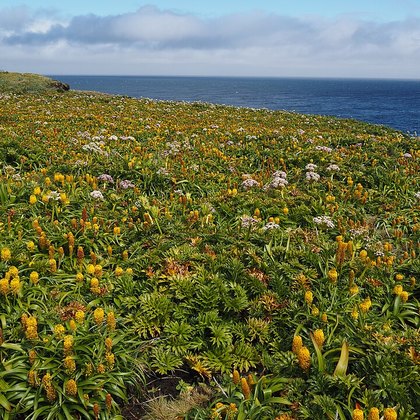
The cold sea south of the subtropical convergence, reaching in winter out over the continental shelf of southern Australia and New Zealand. It seeks the fronts where water temperature turns over and plankton gathers, and feeds by hydroplaning: wings held open, it runs across the surface with the bill half submerged and sieves krill, other crustaceans, small squid and polychaete worms through the lamellae. To breed it comes ashore on the tussock slopes and boulder beaches of subantarctic islands, digging a burrow or taking over a rock crevice.
Where the bird is most often found, arranged by main group and formation.


Range and movements
Within the map window it breeds on the Auckland Islands — Auckland itself, Adams, Enderby, Ewing and Ocean Island — almost certainly on the rock stacks off Campbell as well, and on Macquarie Island. At sea it fills the whole subantarctic zone between Tasmania, Macquarie, the Aucklands and the Antipodes, and pushes north in the winter half of the year over the shelf off South Australia, Victoria, Tasmania, New South Wales and both New Zealand main islands. After heavy winter storms thousands wash up on west coast beaches; it is by far the commonest prion on Australian shores.
- Breeding (summer)
- dark = core range, pale = thinly spread
Where and when to look
Take a pelagic out of Eaglehawk Neck in Tasmania, Port Fairy in Victoria or Wollongong in New South Wales between June and August, or sail off Kaikoura; prions come in flocks to the chum. Photograph every bird head-on and from above, because only such a frame allows the bill width to be judged, then photograph the tail. Walk a beach in August or September after a westerly gale: a dead prion in the hand is the only certain identification most observers ever get — measure the bill at its widest point.
Conservation
Least Concern (LC), with a world population of many millions. That hides the fact that in New Zealand the species counts as a relict: it has gone entirely from the mainland and holds on only on islands. On Auckland Island feral cats and pigs take eggs and chicks; removing rats from Campbell in 2001 and rabbits from some Auckland islets in 1993 has helped the bird there. Add drowning in squid fishery nets and storm mortality, which in a bad year costs thousands of birds.
Scientific name
Pachyptila desolata | (Gmelin, 1789)
Gmelin described the species in 1789 as Procellaria desolata; because the genus has since changed, author and year carry parentheses. desolata means 'forsaken' and points to the type locality Desolation Island, the old name of Kerguelen (Île de la Désolation). The genus Pachyptila was introduced by Illiger in 1811, from Greek pakhus 'dense, thick' and ptilon 'feather'. The word prion itself comes from Greek priōn, 'a saw', for the serrated filter lamellae in the bill. The Maori name is totorore.