All species › Tubenoses › Petrels, shearwaters and diving petrels › Fulmar Prion
Fulmar Prion | Pachyptila crassirostris
Dikbekprion | Prión picogrueso
The Fulmar Prion is a New Zealand island bird that hardly anyone ever sees from a boat: a small, compact whalebird of the Bounty Islands, The Snares and the Auckland Islands, with a stubby blue-grey bill and a broad black tail tip. It is the image of a Fairy Prion, and the difference lies almost entirely in the heft of that bill.
Voice
Alone among these six prions it calls by day, and precisely not at night: on the Bounty Islands, where there is no predator and the birds nest openly among the rocks, they are noisy in daylight and silent after dark. The male has a four-note call rendered in the New Zealand literature as what-not-to-do; the female answers with a more slurred, cooing call of three notes. At sea it is silent, like every prion.
No freely licensed recording has been found for this species yet; what to listen for is described below.
Identification
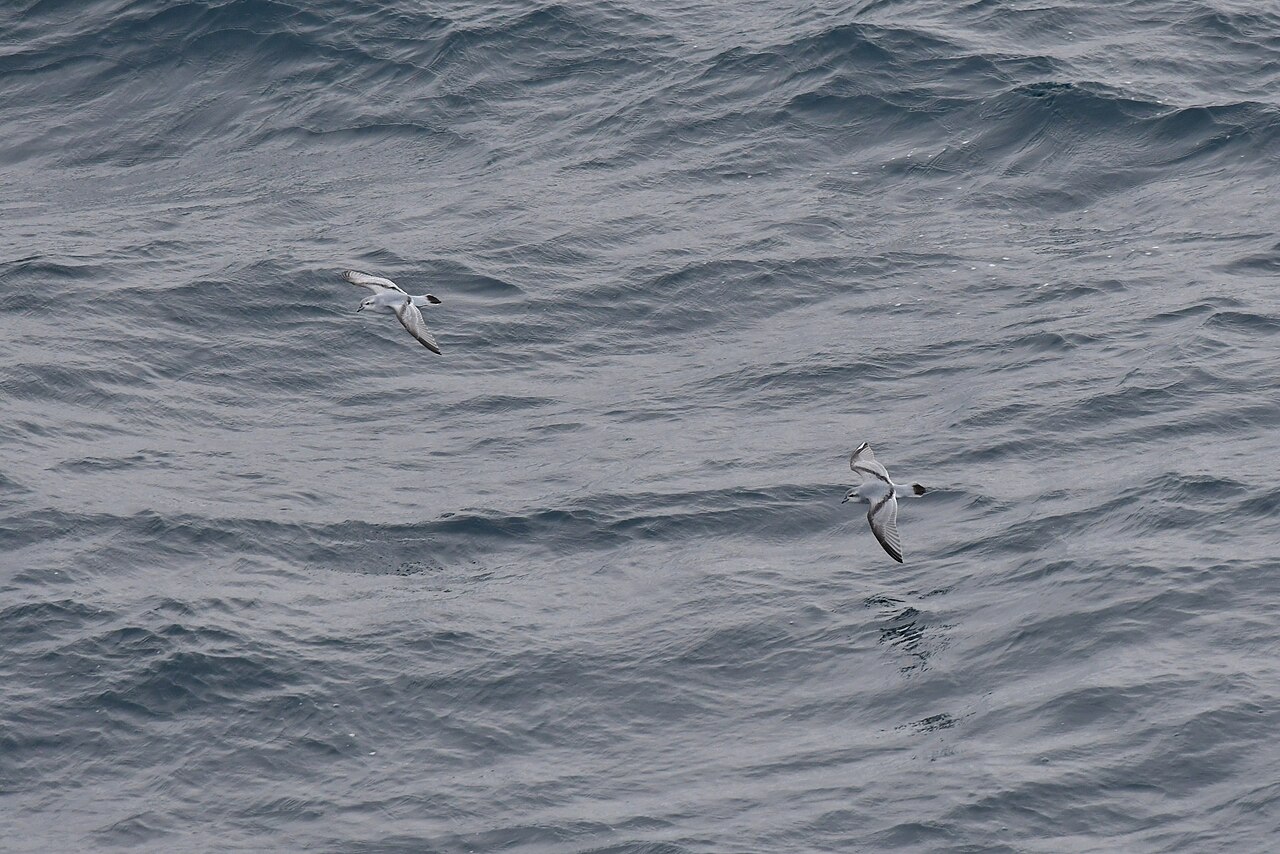
About 26 cm long and 140 g. Blue-grey above with the usual black M from wingtip to wingtip, largely white below, with a clear white eyebrow and blue legs with paler webs. Two things mark it: the black tail tip is broad and sharply cut off, broader than in the four large-billed prions, and the bill is short but notably robust and blocky — blue-grey, with a large nail at the tip of the upper mandible and a small gap between the nostril tube and that nail. At sea it looks white and blue and thickset, with a faster, stiffer wingbeat than the bigger prions.
Confusion species
Fairy Prion (Pachyptila turtur) is the true twin: a shade smaller (25 cm, 120 g) with a slimmer, less blocky bill, a smaller nail on the upper mandible and a larger gap between nostril tube and nail. At sea the two cannot be separated reliably; in the hand or on a sharp head shot they can. Pyramid Prion (Pachyptila pyramidalis), split off only in 2022 and found on The Pyramid off the Chathams, belongs to the same group and has a heavier bill still. The four large-billed prions fall out on bill width and a narrower black tail tip: Slender-billed Prion (Pachyptila belcheri, 9.5–12.5 mm) with its pale face, Antarctic Prion (Pachyptila desolata, 11–15.5 mm), Salvin's Prion (Pachyptila salvini, 13.5–17.5 mm) and Broad-billed Prion (Pachyptila vittata, 18.7–24.3 mm) with its high forehead and dark head.
Habitat
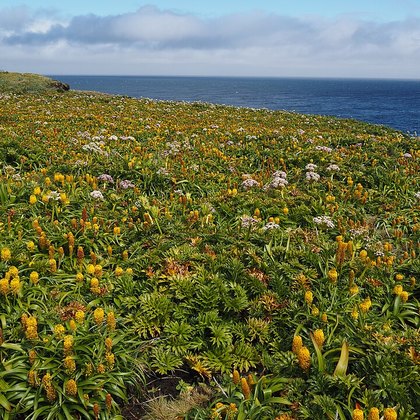
Subantarctic sea and the cool water around the southern island groups; strikingly little is known of where it goes outside the breeding season, because it seldom comes near the coast of the main islands. It takes small crustaceans and other animal plankton from the surface. Unlike most prions it barely digs: it nests in crevices and cavities in bare rock and under boulders, often on cliffs and rock platforms where no tussock grows — on the Bounty Islands, which are solid bare granite, it sits among the penguins and shags.
Where the bird is most often found, arranged by main group and formation.


Range and movements
A breeding bird of New Zealand and nowhere else. The nominate form nests on the Bounty Islands and The Snares; the smaller subspecies flemingi, the Lesser Fulmar Prion, holds the Auckland Islands — Ewing, Ocean, Rose, Disappointment and Monumental Island. At sea it is seen mainly around those island groups; it rarely reaches the South or North Island coast, and in Australia it is a major rarity with only a handful of accepted records.
- Resident
- dark = core range, pale = thinly spread
Where and when to look
The one place this bird is predictable is from the boat at the Bounty Islands or The Snares in the breeding season, on a subantarctic islands cruise; there they fly close alongside in daylight and even call. Elsewhere, do not assume that a small prion with a broad tail tip is this species — the odds that it is a Fairy Prion are hundreds of times better. Photograph the head in profile and head-on, and watch the size of the nail and how close the nostril tube sits to it.
Conservation
Least Concern (LC) on the IUCN list, but the total population is under 32,000 pairs, which for a seabird is few. The New Zealand classification calls it naturally uncommon, and the Auckland Islands subspecies flemingi is listed as Nationally Vulnerable. The chief threat is introduced predators: rats, cats, pigs and mice on islands not yet cleared. Add skuas taking adults, and the risk of an oil spill, which weighs heavily on a species with so few breeding sites.
Scientific name
Pachyptila crassirostris | (Mathews, 1912)
Mathews described the form in 1912 as Pseudoprion turtur crassirostris — that is, initially as a subspecies of the Fairy Prion, which says at once how alike the two are. Because the genus has changed, author and year carry parentheses. crassirostris means 'thick-billed', from Latin crassus 'thick' and rostrum 'bill'. The type locality is Bounty Island. The genus Pachyptila was introduced by Illiger in 1811, from Greek pakhus 'thick' and ptilon 'feather'.